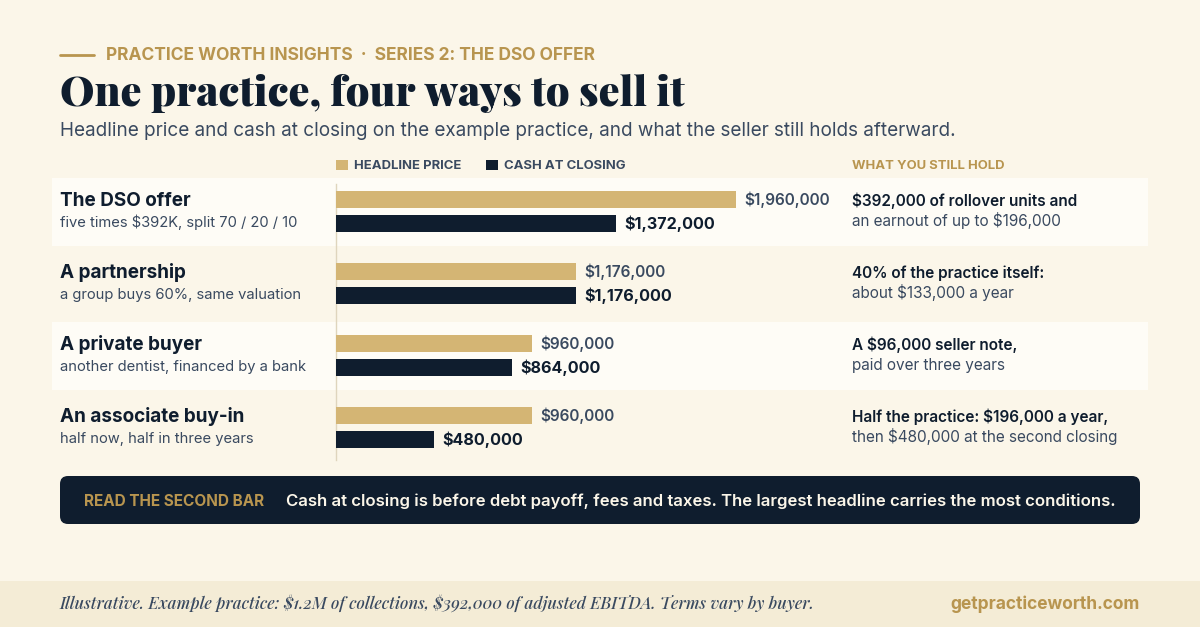
For nine weeks this series has followed one offer: the letter of intent at $1,960,000, five times the $392K of adjusted EBITDA on the $1.2M example practice. A DSO offer is one way to sell a practice. Most owners can reach three others: a sale to another dentist, a staged buy-in by an associate, and a partnership that buys part of the practice and leaves you the rest. The chart above puts all four on the same practice. Every figure is illustrative.
Price, proceeds, and what you keep
Compare the paths on three numbers, not one: the headline price, the cash at closing, and what you still hold afterward. Cash at closing here means before debt payoff, fees, and taxes. Those are the lines Week 4 walked through, and they apply on every path.
- The DSO offer. $1,960,000, of which $1,372,000 is cash at closing. You hold $392,000 of rollover units and an earnout of up to $196,000, and you work as an employee for the term in your agreement.
- A partnership. A group buys 60 percent of the practice at the same valuation and pays $1,176,000 at closing. You keep 40 percent of the practice itself, not units in a parent company. After a management fee like the $60,000 in Week 6, 40 percent of the remaining $332,000 is about $133,000 a year for as long as you hold it. What that 40 percent sells for later depends on the buyback terms.
- A private buyer. Another dentist, financed by a bank, pays $960,000, about 80 percent of a year’s collections. On the example, $864,000 arrives at closing and $96,000 is a seller note paid over three years. You work a transition of six to twelve months, and then you are finished.
- An associate buy-in. At the same $960,000 valuation, an associate buys half now for $480,000 and the other half in three years. In between you still own half, and half of $392,000 is $196,000 a year. If earnings hold, the second half brings another $480,000.
Why another dentist pays less
The gap between $1,960,000 and $960,000 is not a judgment of the practice. It comes from two buyers doing two different calculations, which the Series 1 piece on multiples described. A DSO buys earnings with institutional capital and is itself valued at a higher multiple than it pays. A dentist borrows from a bank, signs a personal guarantee, and lives on what is left.
On an $864,000 loan at 8 percent over ten years, the payment is about $126,000 a year. After the buyer is paid for the dentistry, the example’s $392,000 covers that payment about three times, so the loan is comfortable. The price still tends to follow what similar practices have sold for to other dentists, and that market is usually quoted as a percentage of collections.
Financing realities
Each path is only as good as the money behind it. A private buyer’s offer becomes real when the bank’s commitment letter arrives, not when the buyer says yes. Some lenders ask the seller to carry a small note and limit when it can be paid. A seller note is a loan you make to your buyer, so ask what secures it and where it ranks behind the bank.
A staged buy-in has two closings and two loans, and the second is the one to plan for. Write the price formula for the second half into the first agreement, along with what happens if the associate leaves, becomes disabled, or cannot get financing. An associate who was promised a buy-in someday is not yet a buyer.
Timeline and certainty of close
A DSO or a partnership usually runs four to six months from letter to closing, with quality-of-earnings review in the middle and the risk of a re-trade. A private sale can close in three to five months once there is a buyer, but finding one can take longer, especially outside a metro area. A buy-in is measured in years, and most start with an associate who has already worked in the practice for a year or two.
Certainty runs roughly the other way from price. The highest headline carries the most conditions. The lowest is nearly all cash from a bank.
Use the DSO offer as the benchmark
If you have a DSO offer, you have the most detailed outside read of your earnings that anyone has done. Use it. Put every alternative on the same four lines: cash at closing, what is deferred and who controls it, what you still own, and how long you work.
A partnership priced below the DSO’s valuation should explain why. A buy-in formula can borrow the same definition of earnings. And a private price that looks low against the headline looks different against the cash: $864,000 at closing against $1,372,000, with no rollover, no earnout, and a transition measured in months.
The DSO offer is the largest number. Whether it is the best path depends on how much of it is cash, how long you want to work, and what you want the practice to be after you.
These figures are illustrative, and the tax treatment differs by path. None of this is legal, tax, or lending advice. Your CPA and your transaction attorney should see any of the four before you sign. The series pauses for Thanksgiving week and returns December 1 with one practice and three numbers: the owner’s, the DSO’s, and the rebuilt one.
Where to start
Every path starts from the same figure, which is what the practice earns. Practice Worth rebuilds your earnings from the P&L and the collections-by-provider report and values them the way a DSO would or the way another dentist would, depending on the buyer you choose. If an offer is already in hand, the offer review sets it next to the alternatives on the same lines.
About the author. Dr. David Eslinger holds a DDS and an MBA and has spent more than a decade on the buy side of dental practice transactions, founding Eslinger Dental Consultants and holding C-suite, executive leadership, and board roles in the DSO industry. Karen Eslinger, RDH, co-founded Practice Worth in 2026. Practice Worth is a Missouri LLC. Learn more at getpracticeworth.com.
Karen’s companion piece on Thursday looks at the same four paths from the team’s side: which path keeps the practice you built.