Two weeks ago I walked the example offer from the headline to the wire, and $196,000 of the $1.96M never reached the closing table. That was the earnout: 10 percent of the price, paid over two years if the practice hits its EBITDA targets. Last week was the rollover, an investment in a company you will not control. The earnout is something else: a bet on a number you will no longer control.
That is the part sellers tend to miss. Before the sale, you decided who worked which days, what the office bought, and which lab got the cases. After the sale, the buyer decides most of that, and then measures you on the result. An earnout is not unfair by itself. It can bridge a real gap when the buyer will not pay today for growth you expect tomorrow. But before you sign, you should know who controls each input to the number you will be paid on.
Which number it is paid on
Earnouts are usually tied to collections, EBITDA, or margin. Collections moves with your production, the hygiene schedule, and the payer mix. You still influence a good part of it, although the buyer now staffs and schedules the office. EBITDA starts from collections and subtracts every cost line, which brings in the management fee, the supply formulary, the lab contract, staff pay on the new grid, and any overhead the buyer allocates. Margin is EBITDA divided by collections, so it moves from both ends.
Buyers usually prefer EBITDA, and the reason is fair as far as it goes: it is the number they paid a multiple on. The trouble is that after closing, most of the costs inside it are theirs to set. The further the metric sits from production, the less of the result is yours to move.
How overhead allocation quietly erases an earnout
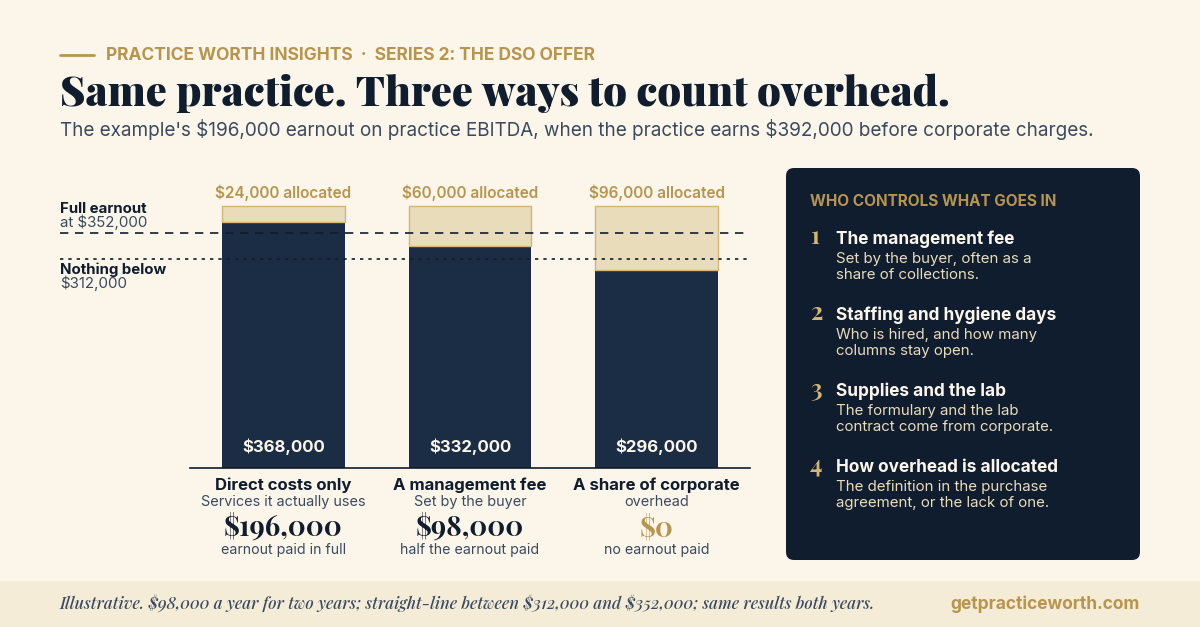
The chart above holds the practice perfectly still. Same patients, same production, same team, and $392,000 of earnings before any corporate charges, in both years of a two-year earnout. The earnout pays $98,000 a year in full at $352,000 of practice EBITDA, nothing below $312,000, and on a straight line in between. The only thing that changes is how the buyer counts its overhead.
If the practice is charged only for the services it actually uses, say $24,000 a year for billing, payroll and IT, it reports $368,000 and the full $196,000 is paid. If the buyer charges a management fee of $60,000 a year, the practice reports $332,000 and half, $98,000, is paid. If the buyer allocates a share of its corporate overhead, the regional managers, the marketing, the executive team, of $96,000 a year, the practice reports $296,000 and nothing is paid. Nobody broke a rule in the third case. The accounting simply moved $196,000 from your column to theirs.
The figures are illustrative, but the mechanism is common. If the purchase agreement does not define what can be charged against the earnout number, the buyer’s accounting policies will define it for you, after closing, when you have no leverage left.
Clawbacks, acceleration, and disputes
- Clawbacks and set-offs. Some agreements let the buyer take back earnout already paid if a later period falls short, or withhold payments against any claim it makes under the purchase agreement. Ask for each period to stand on its own, and for set-off only against claims that are agreed or decided.
- Acceleration. If the platform is sold, if you are let go without cause, or if the buyer breaks its operating promises, the unearned earnout should become payable in full. Without that clause, a new owner can measure you on a number it has no reason to protect.
- Dispute mechanics. You should receive the calculation and the supporting statements within a set number of days after each period, have the right to review the books behind them, and have disagreements settled by an independent accountant on a fixed timeline, not by the buyer’s controller.
The negotiating move: trade it
An earnout is worth less than its face value to you, because you cannot control whether it pays. It is often worth less to the buyer than you might think, too, because it brings accounting work and the risk of a dispute. That gap leaves room for a trade.
One version is to take less money held back instead of more money earned out. In the example, that might be about $150,000 held in escrow for twelve months and released unless the buyer has a claim, in place of $196,000 paid only if the practice hits a number over twenty-four. You give up about $46,000 of face value. In return you get money that is yours unless something goes wrong, a year sooner. Another version moves part of the earnout into cash at closing, at a discount. Either way you are paying for certainty, and it helps to know that price before you agree to the earnout.
Questions to ask before you agree
- What is it paid on? The metric, and the exact definition of it in the agreement.
- What can be charged against it? Which fees and allocations, and whether there is a cap.
- What will the buyer commit to? Staffing, hygiene days, and hours through the earnout period.
- What happens if things change? If the platform is sold, or if I leave or am let go.
- Who calculates it? When I see the work, and who settles a disagreement.
An earnout pays you for a result. Get the agreement to say who controls each thing that goes into it, before you sign, while you still have something the buyer wants.
These figures are illustrative, and earnout terms vary widely between buyers. None of this is legal, tax, or investment advice. Have your attorney read the earnout definitions with your CPA beside them, because the definitions are where the money is. Next week takes up quality-of-earnings review, where the buyer’s accountants rebuild the number all of this is priced on.
Where to start
An earnout target is usually set against the same EBITDA the price is built on. Practice Worth rebuilds yours from the P&L and the collections-by-provider report, so you know whether a target starts from a fair baseline or from the buyer’s lower one. If an offer is already in hand, the offer review covers the earnout: the metric, the definitions, what can be charged against it, and the protections to take to your attorney.
About the author. Dr. David Eslinger holds a DDS and an MBA and has spent more than a decade on the buy side of dental practice transactions, founding Eslinger Dental Consultants and holding C-suite, executive leadership, and board roles in the DSO industry. Karen Eslinger, RDH, co-founded Practice Worth in 2026. Practice Worth is a Missouri LLC. Learn more at getpracticeworth.com.
Karen’s companion piece on Thursday covers the team the earnout depends on: hitting an earnout with a team you no longer run.