On Tuesday Dave wrote about who controls the number your earnout is paid on. This piece is about the people who produce that number. Whether an earnout is measured on collections or on EBITDA, it starts with production, and production comes from a team. After the sale you still work beside that team every day. You just no longer decide who is on it, which days they work, or what they are paid. As I wrote last week, your authority after the sale mostly ends at clinical care.
The decisions that move production, and who makes them now
Before the sale, these were your decisions. After it, they usually sit with the management company and reach the office through a regional manager.
- The hygiene schedule. How many days each hygienist works, how many columns are open, and how long a recare appointment is.
- Replacing people who leave. How fast an opening is posted, what it pays on the new grid, and how long a column sits empty in the meantime.
- Associate hiring. Whether a new associate joins, and whose patients that associate ends up seeing.
- The supply budget and the lab. What the team works with, and where the cases go.
None of these decisions are made in bad faith. They are made by someone measured on the whole platform, who may not see their effect on your earnout until the year is over.
Hygiene capacity, the lever most earnouts quietly depend on
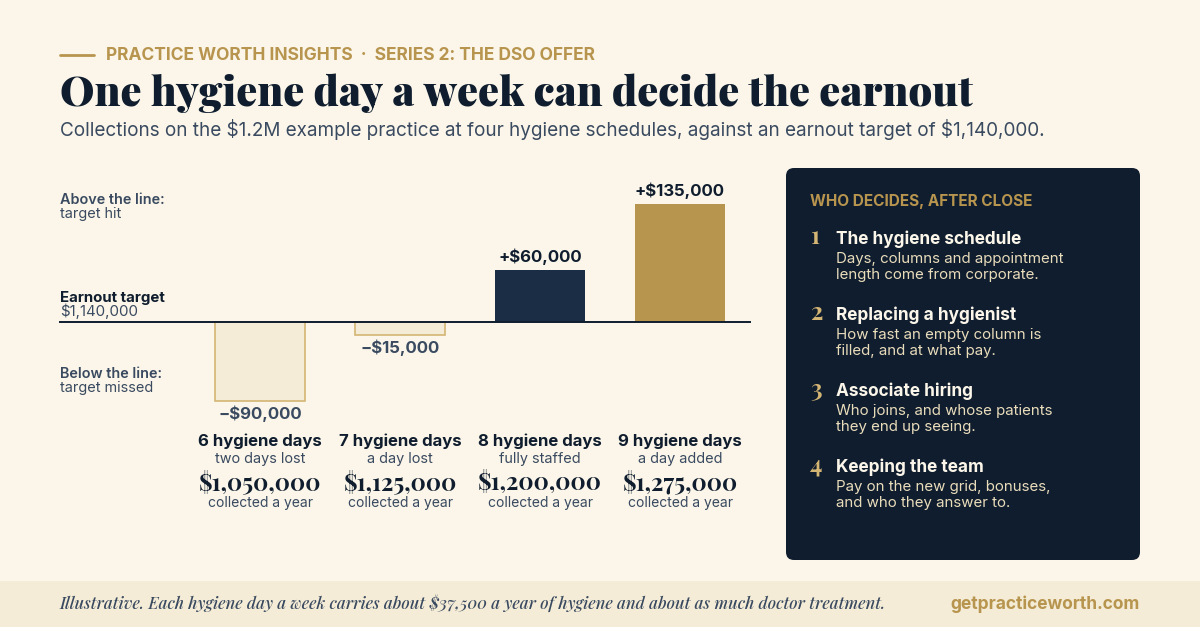
The chart above runs the example practice through four hygiene schedules during the earnout window. In the example, two hygienists work four days each, eight hygiene days a week, and the practice collects $1.2M. Each hygiene day a week carries about $37,500 a year of hygiene production, and about as much again in doctor treatment found in that chair. The earnout target is $1,140,000 of collections, 95 percent of last year.
Fully staffed, the practice clears the target by $60,000. Lose one hygiene day a week, through a cut to the schedule or a hygienist who drops to three days, and it misses by $15,000. Lose two and it misses by $90,000. Add a day and it clears by $135,000. Nothing about your own dentistry changed in any of the four.
A resignation does the same thing more quietly. If a four-day hygienist leaves and the column sits empty for four months while the position is posted, filled, and credentialed, the example loses about $100,000 of collections that year and misses its target. Anyone who has tried to hire a hygienist lately knows how long it takes to fill a chair. Most earnout targets are set as if it takes no time at all.
Getting a say on associate hiring, in writing
An associate can help an earnout or hurt it. A good associate who adds days can lift production. An associate who takes over patients you would have treated, or who leaves after six months, can lower it, and after closing the buyer decides both. Ask to be consulted on any associate who will see your patients during the earnout, and for the target to be adjusted if the buyer adds or removes a provider without your agreement. Spoken assurances from the deal team rarely survive the first change of regional manager.
Keeping the team through the earnout period
The people most likely to leave after a sale are the ones with the most options, usually experienced hygienists and a strong front desk. They are also the people an earnout depends on. A few terms are worth asking for before you sign.
- Staffing commitments. The hygiene days and positions the buyer will keep through the earnout, and how quickly it will fill a vacancy.
- An adjustment clause. If the buyer cuts days or leaves a column empty past an agreed time, the target comes down with it.
- Retention money from the buyer. Stay bonuses for key team members, paid by the buyer at the end of the earnout period.
- Pay on the new grid, in writing. What each person will earn after the transition, so nobody leaves in month three over a pay change they did not see coming.
In Week 1 I wrote that the buyer’s commitments on your team’s roles belong in writing before you sign. With an earnout, those commitments are part of your price.
Your earnout is paid on what the team produces. If the agreement says nothing about the team, it is a bet on decisions you will not be making.
The figures are illustrative, and the link between hygiene days and production varies widely by practice. Your own schedule, recare system, and payer mix decide what one hygiene day is worth to you, and that is worth working out before the earnout target is set.
Where to start
Practice Worth’s valuation uses your P&L and your collections-by-provider report, which shows how much of your production runs through the hygiene chair and what each provider carries. That is the baseline any earnout target is set against. If a letter of intent is already in hand, the offer review reads the earnout and the employment terms together, including the staffing commitments the target depends on.
About the author. Karen L. Eslinger, RDH, is a registered dental hygienist with decades of chairside experience and the owner and CEO of Practice Worth, which she co-founded in 2026 with Dr. David Eslinger, DDS, MBA. Practice Worth is a Missouri LLC. Learn more at getpracticeworth.com.
Dave’s companion piece from Tuesday covers the other half of the earnout: who controls the number you get paid on.