In Week 3 I wrote about the employment terms buried in the letter, and last week about what changes on the Monday after closing. This week is about the person in the middle of all of it, which is you. After a DSO sale with a rollover, you are two things at once. On paper you own a piece of the company that bought your practice. On the floor you are an employee who answers to a regional manager. Your team will notice both, often before you have sorted it out yourself.
The mixed message your team hears
From the hygiene side of the building, the sale often sounds like a contradiction. “Doctor sold the practice” and “Doctor still owns part of it” are both true, and the team will hear whichever one fits the day. When a schedule change comes down from corporate, they will assume you agreed to it, because you still own part of the company. When they ask you to stop it, they will learn that you cannot, because you are now an employee. Either way, it can feel to them like you are not being straight.
The fix is to say both halves out loud, early, in plain words. Something like this: “I sold the practice. I own a small piece of the company that bought it, with about as much say as any small shareholder. I still lead the clinical care in this office. I no longer set pay, hire, or decide the schedule, and here is who does.” Then give them names, not departments.
Where your authority ends now
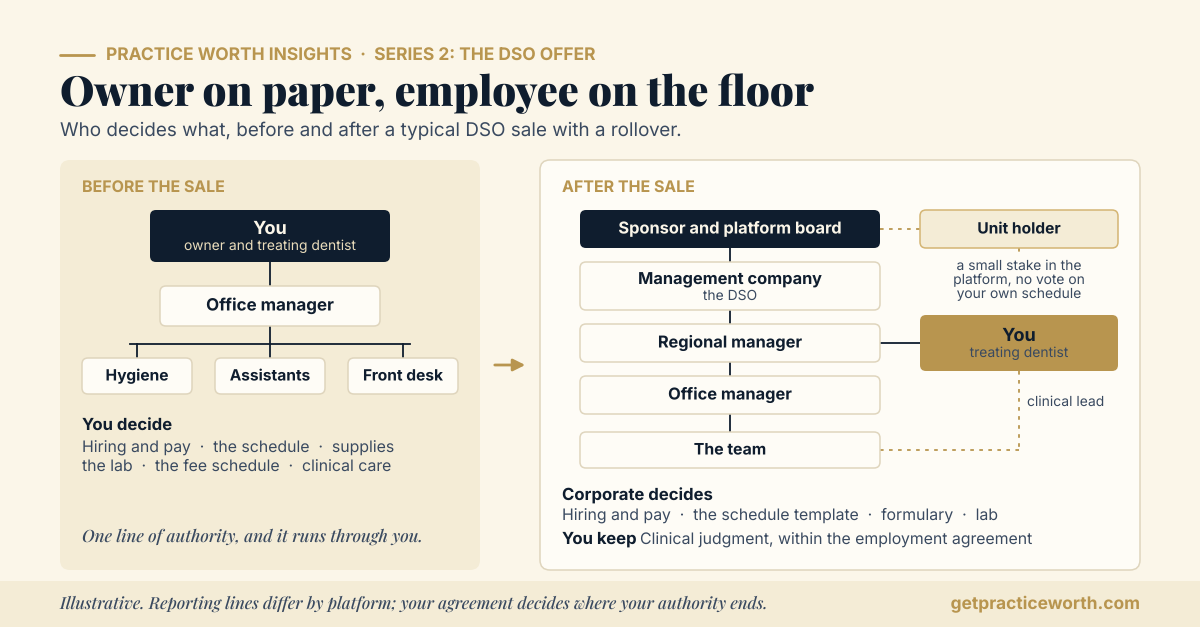
The chart above draws the reporting lines before and after a typical sale. Before, nearly every decision in the office ran through you: hiring, pay, the schedule, supplies, the lab, the fees. After, most of those belong to the management company and reach the office through a regional manager and your office manager. What usually stays with you is clinical judgment, within the limits your employment agreement sets.
The rollover does not change that picture. Your units give you a stake in how the whole platform performs. They do not give you a vote on your own office’s schedule, and Dave’s piece on Tuesday explains why what those units are worth depends on things neither of you controls. Doctors who keep acting as if they still decide things tend to make promises the regional manager then breaks, and after that the team stops believing either of them.
Being honest about where your authority ends is not the same as giving up. It means telling your team, “That one is not mine to decide anymore, but I will take it to the person who does,” and then doing it.
Advocating for the team inside a structure you do not control
The doctors who do this well usually treat the regional manager as a working relationship, not an opponent. A few habits help.
- Keep a standing meeting. Thirty minutes a month with the regional manager, with an agenda the team helped write. Problems raised in the hallway get forgotten. Problems raised on a list get answered.
- Pick the issues that touch patients and people. A hygiene appointment that has become too short for a periodontal assessment is a clinical issue, and you have standing on it. A brand of gloves is usually not worth spending that standing on.
- Bring numbers, not only feelings. Regional managers are measured on production, retention, and turnover. A hygienist who leaves costs the platform recruiting time, an empty column, and the patients who follow her. Say so.
- Close the loop. When the answer is no, tell the team it was no, and why. A no they hear from you does far less damage than a silence they fill in themselves.
Protecting the culture that made the practice worth buying
The buyer paid for more than your equipment and your patient count. It paid for a recall system that keeps the hygiene schedule full, a front desk patients trust, and a team that has stayed together. Those things are in the price even when nobody writes them down, and they are the first things an integration can wear away without meaning to.
Name them early to the regional manager, as reasons the practice performs: the morning huddle, the way recare appointments are booked before the patient leaves the chair, the hygienist who has seen the same families for twelve years. Framed that way, protecting them is not resistance to the new owner. It is protecting the value the new owner paid for, which is also the value your rollover depends on.
Your team does not need you to still be in charge. They need to know who is, what you can still do for them, and that you will tell them the truth about the difference.
Reporting lines differ by platform, and the chart is illustrative. Your employment agreement and the platform’s operating policies decide where your authority actually ends, and they are worth reading with that question in mind before you sign.
Where to start
The decisions that leave your hands after a sale show up first in the numbers a buyer models before it. Practice Worth’s valuation uses your P&L and your collections-by-provider report, the same production-by-provider view a platform uses to set targets for each chair, so you can see what your team is being asked to carry. If a letter of intent is already in hand, the offer review looks at the rollover and the employment terms side by side, including what you will and will not control after closing.
About the author. Karen L. Eslinger, RDH, is a registered dental hygienist with decades of chairside experience and the owner and CEO of Practice Worth, which she co-founded in 2026 with Dr. David Eslinger, DDS, MBA. Practice Worth is a Missouri LLC. Learn more at getpracticeworth.com.
Dave’s companion piece from Tuesday covers the other half of the dual role: what your rollover units are actually worth.