This summer I wrote that in most sales the employment terms arrive as a form near the end, after the financial terms have been argued for weeks. The letter of intent is where that starts. In the letter Dave walked through on Tuesday, your job after closing gets one sentence: the seller will enter into an employment agreement on terms to be negotiated in good faith.
From the hygiene side of the building, that sentence is the part of the sale the team feels first, because it sets the schedule everyone works. It deserves the same attention as the price, and it is easiest to shape while it is still one sentence.
Three ways to be paid for the same dentistry
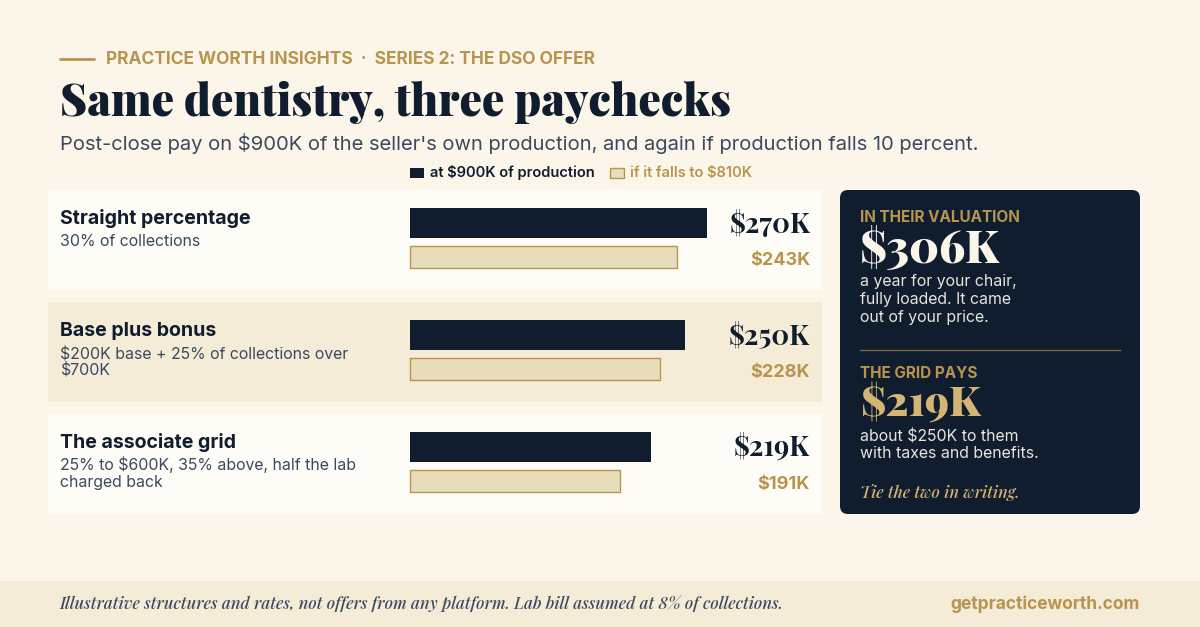
Post-close pay usually comes in one of three shapes. The chart runs all three on the series’ example practice, where the owner produces $900K a year.
- Straight percentage. 30 percent of what you collect, the market rate Dave used for the replacement dentist in Series 1. On $900K that is $270K.
- Base plus bonus. A guaranteed salary, here $200K, plus 25 percent of collections above $700K. That comes to $250K.
- The associate grid. The platform’s standard tiers, here 25 percent of the first $600K and 35 percent above it, with half of the lab bill charged back to the doctor. It is the only offer with 35 in it, and it pays the least: about $219K once the lab charge comes off.
These are illustrative structures with rates I chose to make the arithmetic visible, not offers from any particular platform. The point they make holds anyway. The headline percentage is the least useful number in the offer. The money is in the definitions underneath it: production or collections, what counts as a collection, whether lab and supplies are charged back, and when the bonus is paid.
The schedule you will inherit
The chart has a second bar for each offer for a reason. Production after closing rarely stays where it was. The platform has a schedule template: hours per day, days per week, procedure blocks, and how many hygiene exams the doctor is expected to fit into an hour. Some owners find their best procedures moved to a specialist the platform employs. Either way, the first year can come in below the year you sold.
Run the same three offers at $810K, 10 percent lower. The straight percentage falls to $243K. Base plus bonus falls to about $228K, the smallest drop, because the base does not move. The grid falls to about $191K. The structure decides who carries that risk. A percentage puts all of it on you. A base puts some of it back on the buyer, which is why buyers keep the base low.
Ask for the schedule template in writing before the agreement is final: your days, your hours, your procedure blocks, and who is allowed to change them.
The term, and what leaving early costs
These agreements usually run one to three years, and longer when part of the price depends on an earnout. The clause to read slowly is what happens if you leave before the term ends. Depending on the drafting, leaving early can forfeit unvested rollover equity, end the earnout, or both, and the non-compete starts either way.
Look for a definition of resignation “for good reason,” and make sure it includes a cut to your pay or a change to your schedule that you did not agree to. Without it, the buyer can change the two things you negotiated, and your only way out is the expensive one. Your attorney should read this clause twice.
Clinical control, and how to read it
Most agreements say the doctor keeps independent clinical judgment. Most then list what the platform decides: the lab, the supply formulary, the fee schedule, the software, the scheduling rules, and the hygiene protocol. Those are the decisions that shape a clinical day. Read the clinical control clause next to that list. If the two conflict, the list tends to win, because the list is what the regional manager enforces on a Tuesday.
Write down the three or four clinical decisions you cannot work without, such as the lab you trust, the periodontal protocol your hygienists follow, and the time you block for a new-patient exam. Get those into the agreement and not into a conversation.
The pay in your contract and the cost in their model
One last comparison, and it ties back to Dave’s bridge from last week. The buyer’s valuation priced your chair at $306K a year, fully loaded. That cost came out of your earnings, and at five times it came out of your price. If the grid pays you $219K, the chair costs the buyer closer to $250K once payroll taxes and benefits are added. You would pay for the difference once in the price and again in every paycheck. Ask for your compensation to be tied to the replacement cost in their model, in writing, before the letter is signed.
The price is paid once. The employment agreement is paid every two weeks for years. Read it with the same care, and start while it is still one sentence in a letter.
Where to start
Every one of these offers is built on your production by provider, so know that number before the terms arrive. Practice Worth uses your P&L and your collections-by-provider report to separate what you produce from what the practice produces without you. If a letter of intent is already in hand, the offer review reads the employment sentence alongside the price and compares the pay in the offer with the replacement cost in the buyer’s valuation.
About the author. Karen L. Eslinger, RDH, is a registered dental hygienist with decades of chairside experience and the co-owner and CEO of Practice Worth, which she co-founded in 2026 with Dr. David Eslinger, DDS, MBA. Practice Worth is a Missouri LLC. Learn more at getpracticeworth.com.
Dave’s companion piece from Tuesday covers the rest of the letter: the anatomy of a DSO letter of intent.