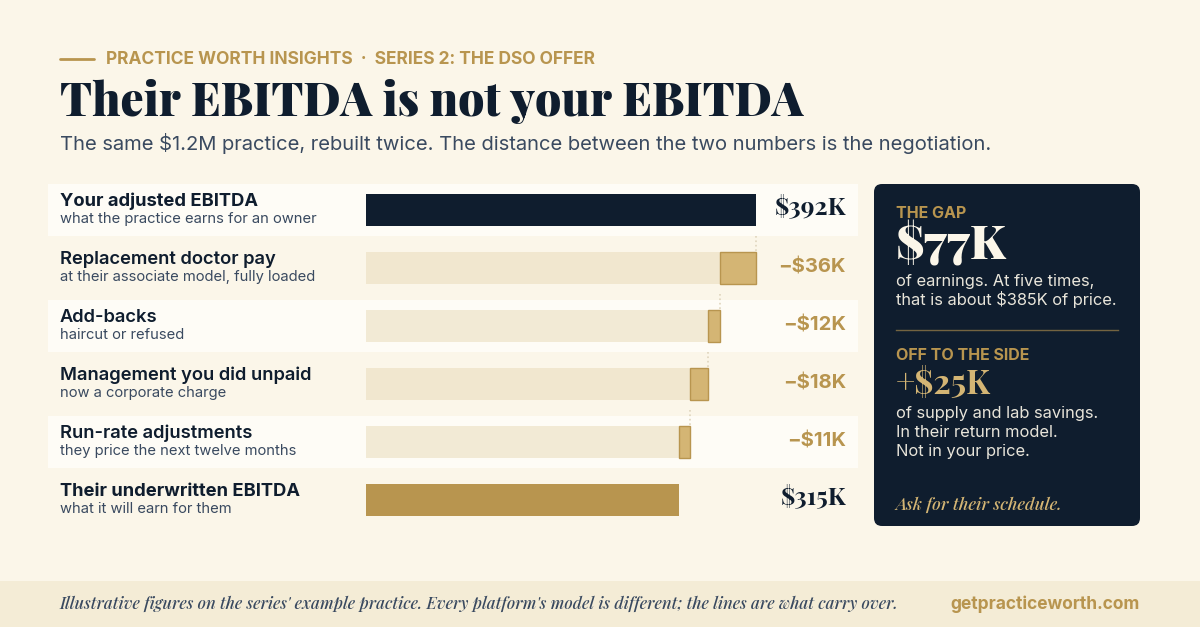
You did the work. You took the profit on your tax return and rebuilt it the way Series 1 walked through: interest and depreciation back in, your own pay normalized, the personal spending pulled out. On the $1.2M example practice that rebuild turned $289K of net income into $392K of adjusted EBITDA. Then the DSO that called in Week 1 sends back an indicative range, you divide it by the multiple they mentioned on the phone, and the earnings number underneath their offer is not $392K. It is closer to $315K.
Nobody made an arithmetic mistake. The buyer rebuilt your earnings a second time, with its own assumptions, and it did not show you the work. I built those models for a decade. The two numbers separate in four places, and the distance between them is the negotiation.
Replacement doctor pay, at their model and not yours
In Series 1 the owner of the example practice produces $900K of the dentistry, and we priced a replacement at about 30 percent of that production, or $270K. That is a fair market figure. It is not the figure in the buyer's model. A platform prices your chair at its own associate model, and it prices the loaded cost: the percentage it pays, plus employer payroll taxes, benefits, malpractice, and a CE allowance. On this practice that comes to roughly $306K. Same dentist, same production, and $36K of earnings is gone before anyone has looked at an add-back.
This is the largest line in the bridge and the most negotiable, because it is tied to something else in the deal. If you are staying, the buyer is about to hand you an employment agreement with a compensation number in it. The replacement cost in their valuation and the pay in your contract should be the same number. If they underwrite your chair at $306K and offer to pay you less than that, ask which one is real.
The add-backs they accept, haircut, and refuse
Your schedule has $27K of discretionary add-backs on it. The buyer sorts them into three piles. The ones with a lease, a payroll record, or an invoice behind them are accepted. The ones that are probably true but thinly documented get a haircut, usually half. The rest are refused, and the list of what gets refused is the same one from the add-backs piece: the one-time repair that recurs, the savings you have not actually made, the round number with nothing behind it. On the example practice $15K survives and $12K does not.
That $12K is the cheapest money in the deal to get back. It takes a folder, not an argument: assembled before the financials go out, and the same folder the quality-of-earnings team will ask for in Week 7.
The management you did for free
You run payroll. You hire, you handle the vendor calls, and you close the books on a Sunday night. None of that is on your P&L, because you never paid yourself for it. A platform replaces that work with a regional manager, a central billing team, and an accounting function, and it charges the practice for them. In this illustration the charge is $18K a year.
Buyers differ here, and the difference matters. Some price off practice-level EBITDA, before any corporate allocation. Some price after it. Ask which, in those words. A multiple quoted on one and applied to the other is a quieter price cut than any line in the letter of intent.
The mirror image is the synergy. The platform buys supplies and lab work on contracts you cannot get, and on this practice that might be worth $25K a year to them. It goes into their return model. It does not go into your price. They built those contracts and you did not, so that is fair. It is still worth knowing that the earnings they expect to own are higher than the earnings they are paying you for.
Run-rate, not last year
You rebuilt the trailing twelve months. The buyer prices the next twelve. The raise you gave your hygienist in October gets annualized. The front-desk position you have been covering yourself gets filled at a market wage. On the example practice those adjustments take another $11K. This one cuts both ways, and owners rarely use their half. If collections grew through the year, the run-rate is higher than the trailing number, and you are entitled to ask for that with the same logic they used.
The bridge, line by line
Start at $392K. Take off $36K for replacement pay at the buyer's associate model, $12K for add-backs that were haircut or refused, $18K for management the owner did unpaid, and $11K of run-rate adjustments. The buyer's underwritten EBITDA is $315K. The $25K of synergies sits off to the side, in their model and not in your price.
The gap is $77K of earnings. At the five-times multiple this series has used throughout, that is about $385,000 of price. The same practice that supports $1.96M on your number supports about $1.58M on theirs, and both sides can defend their arithmetic. These figures are illustrative. Every platform's model is different. What carries over is where the lines are.
Neither number is wrong. They answer different questions. Yours is what the practice earns for an owner. Theirs is what it will earn for them. The negotiation happens in the $77K between the two, and you can only find that gap if you arrived with your own number.
What to ask before you argue
Ask for their EBITDA and the adjustments behind it, not only the price. Most owners never do, and most buyers will share a summary if asked. Then put it next to yours and work the bridge one line at a time. Replacement pay is settled against your own employment terms. Add-backs are settled with documents. The corporate allocation is settled by asking whether the multiple is applied before or after it. Run-rate is settled with your most recent months. An owner who does this is reconciling two schedules instead of arguing about a price, and that is a conversation a buyer's analyst cannot easily wave away.
Where to start
You cannot build a bridge from one side. Practice Worth rebuilds your earnings from the P&L and the collections-by-provider report and documents every adjustment, so your half of the bridge exists before theirs arrives. If an indicative range or a letter of intent is already in hand, the offer review works backward from their price to the EBITDA underneath it and shows you which lines moved.
About the author. Dr. David Eslinger holds a DDS and an MBA and has spent more than a decade on the buy side of dental practice transactions, founding Eslinger Dental Consultants and holding C-suite, executive leadership, and board roles in the DSO industry. Karen Eslinger, RDH, co-founded Practice Worth in 2026. Practice Worth is a Missouri LLC. Learn more at getpracticeworth.com.
Karen’s companion piece on Thursday covers the operating rebuild: the provider and hygiene numbers a DSO will rebuild.