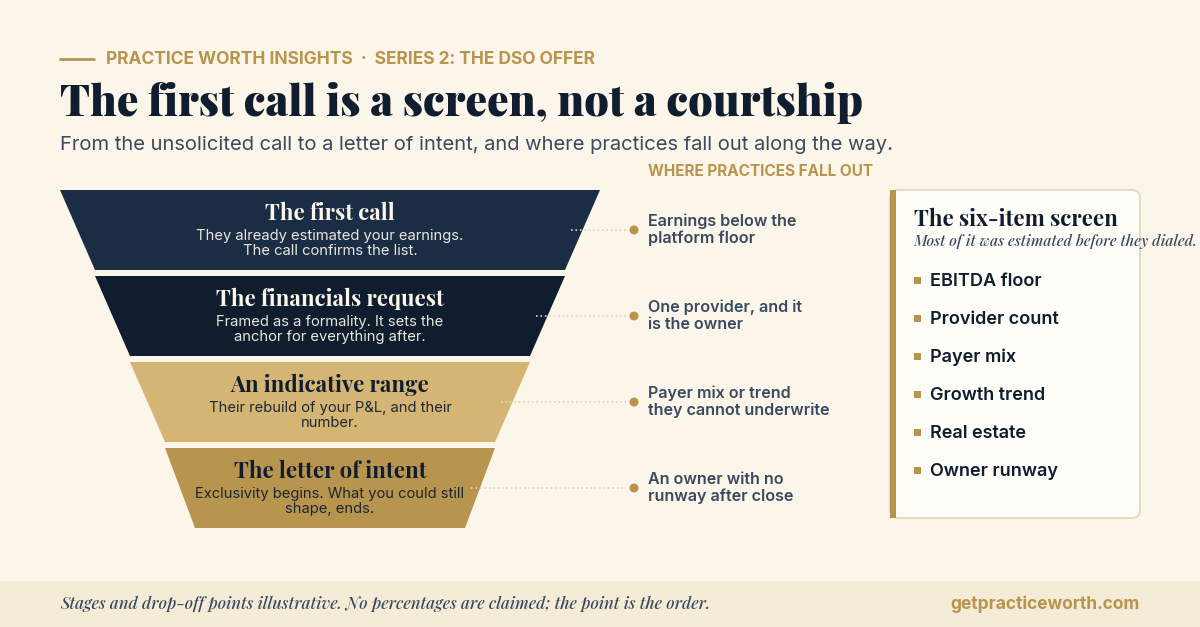
I have been on the other end of that call. A business development person, friendly and well briefed, opens with something like: we are growing in your area and would love to learn more about your practice. Most owners hear interest. What they are hearing is a screen. The caller has a list of six things, most of which were estimated before the phone rang, and the call exists to confirm or rule them out. That is not a criticism. It is how a platform that looks at hundreds of practices a year decides where to spend its diligence budget. But it means the owner who treats the first call as a courtship gives away the frame before the conversation has started.
This is the first piece in a new twelve-week series. Series 1 built the number. Series 2 follows what happens after a DSO wants it: the first call, the two EBITDAs, the letter of intent, the check you actually get, and the year after. Every Tuesday is the money. Every Thursday, Karen covers the team, the patients, and the day after closing.
The six things on the screen
The EBITDA floor. Every platform has a minimum, and it is stated in earnings, not collections. Before the call, someone has already estimated your adjusted EBITDA from your collections, your specialty, and a margin assumption. The $1.2M example practice from Series 1, with $392K of adjusted EBITDA, clears most add-on floors comfortably. A practice with the same collections and a twelve percent margin may not, and the caller is trying to find out which one you are.
Provider count and dependence. A single-doctor practice where the owner produces most of the dentistry is a different asset from a practice with an associate and a hygiene department that runs on its own schedule. The screen is asking how much of the earnings walk out the door when you do.
Payer mix. Fee-for-service, PPO share, and any Medicaid exposure. Platforms have underwriting rules about mix, and a practice outside them is out regardless of its earnings.
Growth trend. Three years of collections. Flat is acceptable. Declining needs a story. Growing gets you a better call back.
Real estate. Do you own the building, and if you lease, how long is left. A short lease with no options is a diligence problem the caller would rather know about now.
Owner runway. Will you stay three to five years after closing? An owner who wants to leave in twelve months is a different deal, and a cheaper one, because the buyer has to price the replacement doctor and the patient attrition that comes with the change.
What not to send yet
The P&L goes out after you know your own number, not before. The caller will ask for it on the first call, or the second, and the ask will be framed as a formality. It is not. The first set of financials sets the frame for every conversation that follows. If the platform rebuilds your earnings before you have, their number becomes the anchor, and you spend the rest of the negotiation arguing up from it instead of defending down from yours.
Dr. David Darab, a sell-side dental advisor who reviewed Practice Worth before launch, put it this way: adjusted EBITDA and EBITDA margin are not optional for a practice owner anymore. They are a KPI. The first call is where that stops being a management idea and becomes a negotiating position. Know the number before anyone on the other side of the table does.
What you can send is a summary: collections, provider count, operatories, days open, and whether you own the real estate. That keeps the conversation alive without handing over the raw material to price you.
The questions to ask them
The screen runs both ways, and most owners forget to run their half. Four questions, in this order.
- Platform or add-on? Are they building around your practice or bolting it onto a region that already exists? The answer changes the price, the rollover, and how much of your team survives integration.
- Who funds the deal? A private equity sponsor, bank debt, or the platform's own balance sheet. And where in the fund's life are they. A platform two years from a recapitalization behaves differently from one that just closed its own.
- What is the hold period? This is the question that tells you whether the second bite of the apple, the rollover equity story, is real or a slide.
- How many practices closed this year, and how many letters of intent did you sign? The ratio tells you how they use the LOI. A platform that signs ten and closes three is using exclusivity to take practices off the market while it decides.
A serious buyer answers all four without hesitation. A buyer who deflects has told you something too.
Why the unsolicited call is leverage
They called you. That outreach cost the platform something, and it means your practice fits a map they are trying to fill. The mistake owners make is treating the call as a favor and responding with gratitude, which is how a practice ends up under exclusivity at a price set by the buyer's model. The leverage is real, but it only works if you have a number of your own to hold. Do not say a number on the first call. Do not react to theirs. Take the questions above, get their answers, and end the call with a date to follow up. Then go get your number.
The first call is not a negotiation. It is the moment the negotiation's frame gets set, and the owner who knows their adjusted EBITDA before answering the phone is the only one who gets to set it.
Where to start
Run the valuation before you return the call. Practice Worth rebuilds your earnings from the P&L and the collections-by-provider report, walks every adjustment, and gives you the documented number in about ten minutes, which is the number the platform's development team is estimating right now. If an offer is already in hand, the offer review puts a decade of buy-side experience on your side of the table before you sign anything with an exclusivity clause in it.
About the author. Dr. David Eslinger holds a DDS and an MBA and has spent more than a decade on the buy side of dental practice transactions, founding Eslinger Dental Consultants and holding C-suite, executive leadership, and board roles in the DSO industry. Karen Eslinger, RDH, co-founded Practice Worth in 2026. Practice Worth is a Missouri LLC. Learn more at getpracticeworth.com.
Karen’s companion piece on Thursday covers the other half of week one: what to tell your team when a DSO calls, and when.