Two owners compare notes at a study club. Similar specialty, similar towns, both profitable. One sold last year at a shade under five times earnings. The other just signed at nearly seven. The first owner spends the drive home wondering what he did wrong. Usually the answer is nothing. The two practices sold into different markets, and the difference between those markets is worth understanding long before a buyer ever calls.
What a multiple actually multiplies
A multiple is shorthand for price divided by earnings, and the earnings that matter are adjusted EBITDA, the rebuilt profit figure I walked through in the EBITDA article. Get that base number wrong and the multiple is decoration. Get it right and the multiple becomes the honest question: how many years of these earnings will a buyer pay for up front? The answer is set by the market, meaning who is bidding, how much they want the asset, and how durable the earnings look under a new owner.
Two buyer pools, two methodologies
An individual dentist buying your practice lives on its cash flow. The practice has to service the bank loan, pay the new owner a living wage for the dentistry, and leave margin for surprises, all out of the same earnings. That math caps what an individual can rationally pay, which is why owner-operator deals cluster in the lower multiple ranges.
A group buyer runs different arithmetic. A DSO prices your adjusted EBITDA after paying market rate for the clinical work, the owner-comp normalization from Week 3. It funds the purchase with institutional capital rather than a personal note, and it gets valued by its own investors at a higher multiple than it pays you. Buying your earnings at one price and being valued at a higher one is the engine of the whole consolidation trade, and it is why a DSO can rationally outbid an individual for the same practice.
The tiers where the buyer pool changes
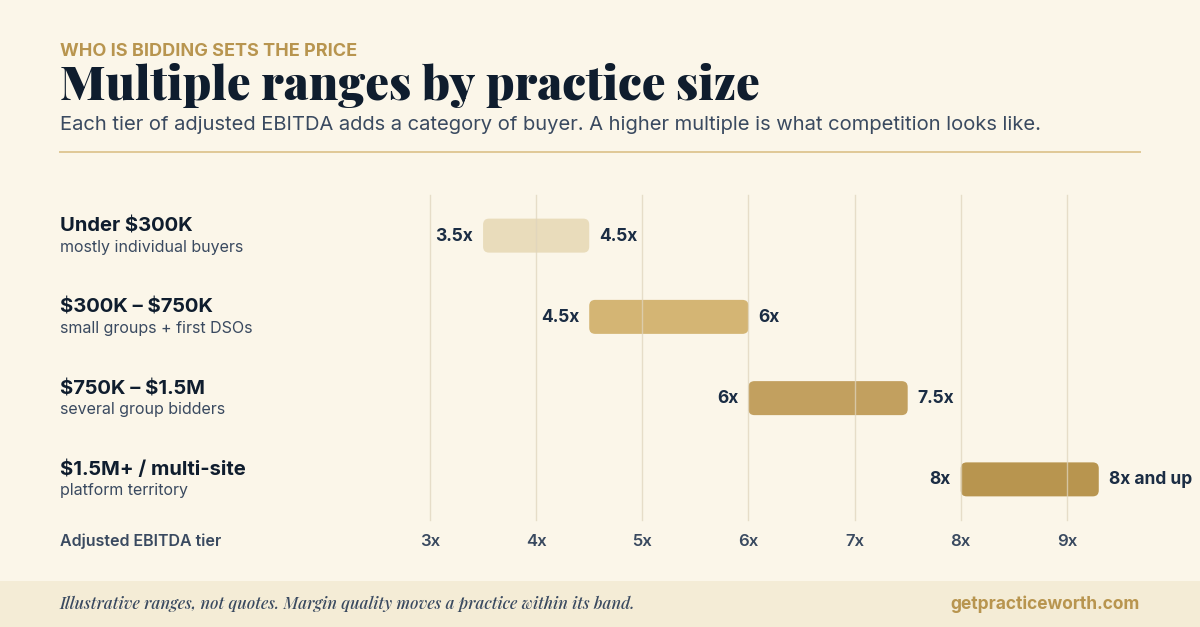
Group buyers screen on scale, so the practical question is which pool your practice sells into. Illustrative ranges, not quotes:
- Under about $300K of adjusted EBITDA: mostly individual buyers, roughly 3.5x to 4.5x.
- $300K to $750K: small groups and the first DSO interest arrive, roughly 4.5x to 6x.
- $750K to $1.5M: several group buyers can bid, roughly 6x to 7.5x.
- Above $1.5M, or multi-location: platform territory, 8x and up.
Notice what moves the number between tiers. It is not that bigger practices are better run. Each tier adds a category of buyer, and a higher multiple is simply what competition looks like when it shows up in a purchase agreement.
Margin quality moves you within the band
Size decides which buyers show up. Margin quality decides how they behave once they arrive. Take two practices that each produce $392K of adjusted EBITDA. One earns it on $1.2M of collections, a 33 percent margin. The other needs $2.4M of collections to produce the same profit. The first practice has room to absorb wage inflation and a slow quarter. In the second, a small rise in costs takes a large bite of the earnings. Buyers price that fragility, so the leaner practice books the top of its range while the strained one negotiates from the bottom.
At $392K of adjusted EBITDA, the step from 5x to 6x is worth roughly $392,000. One extra turn of the multiple is another full year of earnings, paid at closing.
That is why the earlier work in this series matters so much. The add-backs, the owner-comp normalization, the clean P&L: they all feed the base number the multiple multiplies. Practice Worth values your practice on the corridor of multiples buyers in your tier actually pay, and shows the math. The framework is on the methodology page, and there is a free sample report at getpracticeworth.com.
About the author. Dr. David Eslinger holds a DDS and an MBA and has spent more than a decade on the buy side of dental practice transactions, founding Eslinger Dental Consultants and holding C-suite, executive leadership, and board roles in the DSO industry. Karen Eslinger, RDH, co-founded Practice Worth in 2026. Practice Worth is a Missouri LLC. Learn more at getpracticeworth.com.
Karen’s companion piece looks at the same threshold from inside the operatory: when is a practice “big enough” for a DSO?