On Tuesday, Dave laid out why two practices get two very different multiples: each tier of size adds a category of buyer, and competition raises the price. The question owners actually ask me is more personal than a tier chart. Is my practice one a DSO would even look at? Having spent years on the clinical side of practices that group buyers walked through, I can tell you what they notice, and it is not just the revenue line.
Scale gets you screened in
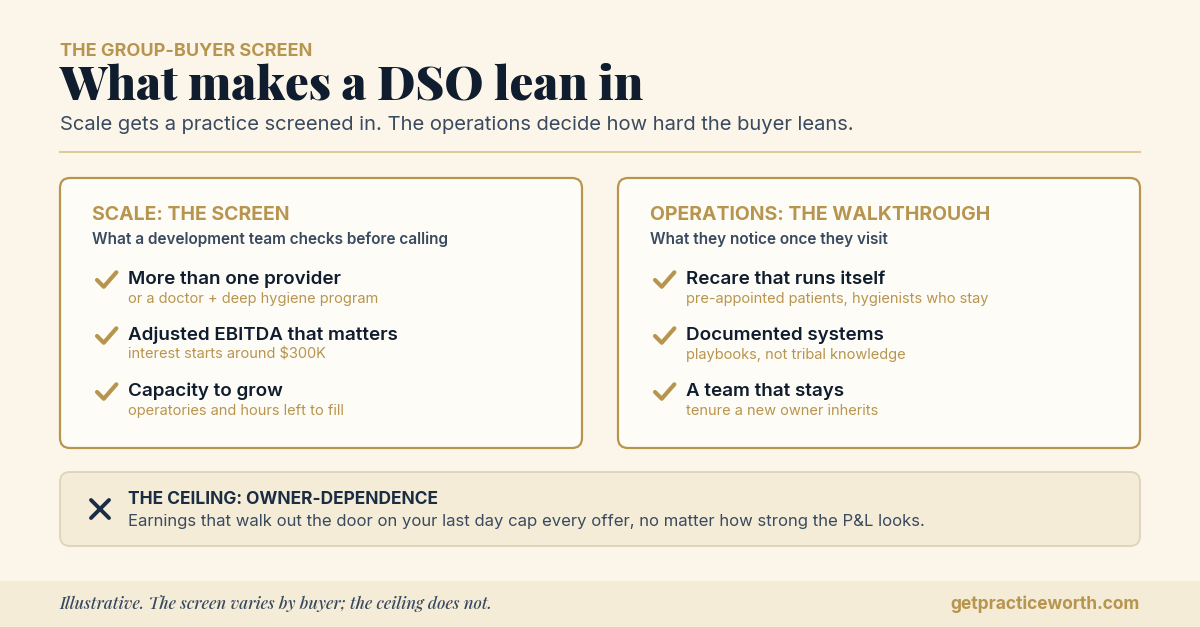
The blunt filters come first. Most group buyers want to see more than one provider, either a second doctor or a doctor supported by a deep hygiene program, because a one-doctor practice is one resignation away from being an empty building. They want adjusted EBITDA large enough to matter; interest tends to start somewhere around $300K and strengthens from there. And they want capacity, meaning operatories and hours that could produce more than they currently do. None of this is secret. It is the screen a development team runs before anyone calls you.
Hygiene and recare are the tell
Once you pass the screen, the walkthrough starts, and the first place a sophisticated buyer looks is the hygiene schedule. A recare system that runs itself reads as durable revenue: patients pre-appointed before they leave, a short-notice list that actually fills holes, hygienists who stay. A buyer can fix a marketing budget in a quarter. Rebuilding a broken recare culture takes years, and they know it, so they pay a premium for the practice that already has one.
The ceiling is owner-dependence
Here is the hard one. If the practice is really you, the patients are loyal to you, the treatment plans live in your head, and the front desk checks with you on everything, then a group buyer sees earnings that walk out the door on your last day. That perception caps their interest no matter how strong the P&L looks. The signals that a practice runs without its founder are ordinary and learnable: an associate who has stayed, a treatment philosophy that is written down, a front desk playbook, a manager who can run a full day without calling you. I wrote about this transferability in the goodwill piece, and it decides more DSO conversations than any single number.
If you are not there yet
Falling short of the screen is not a verdict on your practice. Practices below the group-buyer threshold sell every week to individual dentists, at the owner-operator multiples in Dave’s piece, and many owners net a perfectly good retirement that way. The point of knowing the criteria is choice. If a group sale is the exit you want, the gap between your practice and their checklist is a to-do list, and most of it is operational work you can start this year.
If an offer is already on your desk
A DSO that approaches you has done this hundreds of times. You will do it once.
The development rep is friendly, the number sounds large, and you have no way of knowing whether it is a strong offer or an opening one. That is exactly the moment for a neutral read. We built the DSO Offer Second Opinion for it: run your own numbers first, then have Dave review the offer against them before you sign anything. The methodology page shows how we get to the number, and there is a free sample report at getpracticeworth.com.
About the author. Karen Eslinger, RDH, spent more than two decades chairside as a registered dental hygienist before co-founding Practice Worth in 2026 with her husband, Dr. David Eslinger. She focuses on the clinical and operational side of practice value. Practice Worth is a Missouri LLC. Learn more at getpracticeworth.com.
Dave’s companion piece explains the pricing mechanics behind the threshold: why two practices get two very different multiples.