Last week my husband and co-founder Dave wrote here about why the number on your tax return isn’t what your practice is worth, and how normalizing earnings can move that figure by six figures. If you read it, you have the financial half of the story. I want to talk about the other half, the part I spent more than twenty years living before we ever built a valuation tool.
I’m a hygienist. For most of my career the value of a practice wasn’t an abstraction to me. It was the recare column. It was the patients who came back every six months because they trusted us. It was the assistant who knew which patient needed her hand held before the anesthetic. When a practice changes hands, a buyer is paying for all of that. They just can’t always see it on a spreadsheet, and most valuation tools can’t either.
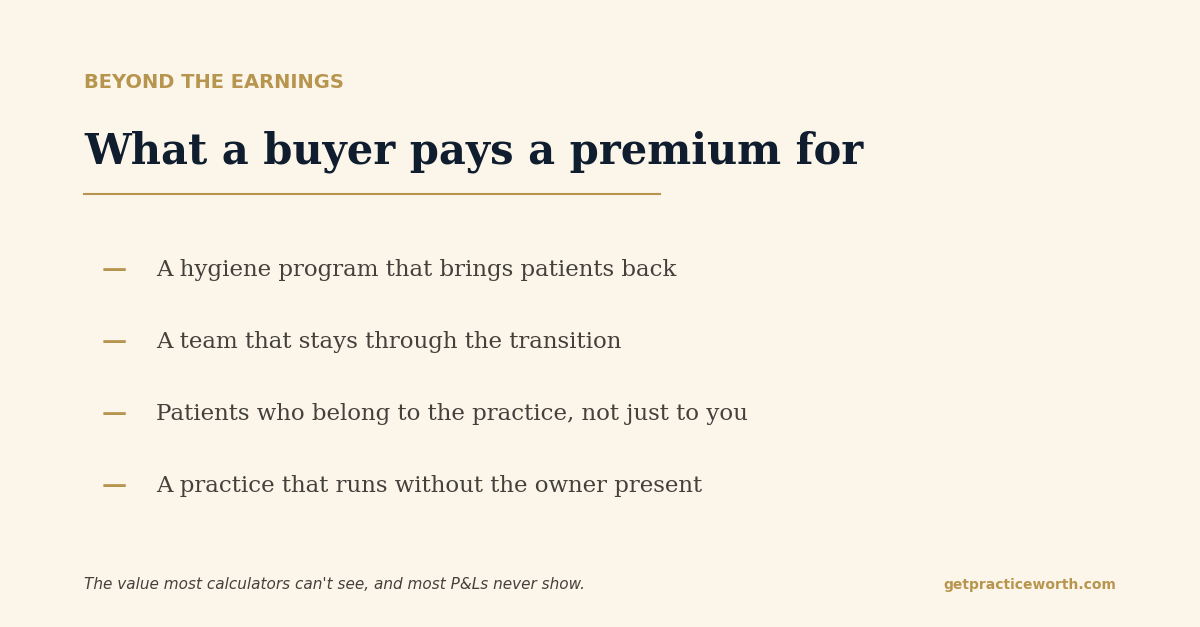
Here is what a thoughtful buyer is really pricing, beyond the earnings:
- Your hygiene program. A strong recare system is the closest thing a dental practice has to a subscription business. It is predictable, it brings patients back through the door, and it feeds the restorative schedule. Two practices can collect the same amount in a year, but the one with a healthy hygiene engine and high reappointment rates is worth more, because its revenue is far more likely to still be there next year.
- A team that stays. When an owner sells, the single biggest fear on the buyer’s side is that the people walk out the door. A tenured, cross-trained team that runs the day without the owner hovering is not a soft benefit. It is real value, and it lowers the buyer’s risk in a way they will pay for. If your front desk and your hygiene team would stay through a transition, that is part of your number.
- Patients who belong to the practice, not just to you. There is a difference between patients who come to see the office and patients who come to see you. The more your goodwill lives in the systems, the brand, and the relationships across the whole team, the more of it transfers to a new owner. A practice built entirely around one personality is harder to sell and sells for less.
- A practice that runs without you. This is the thread connecting all of it. The less a day depends on the owner being physically present, the more transferable the whole thing becomes. Documented systems, a capable office manager, an associate already in place: each one tells a buyer the engine keeps running after you hand over the keys.
None of this is something you fix the month before you list the practice. You build it over years, through the unglamorous work of training people, tightening your recall, and writing down how things actually get done. The good news is that the same work that makes a practice valuable to a buyer is the work that makes it calmer and more profitable to own in the meantime.
When we built Practice Worth, we wanted these factors to be visible, not buried in an appraiser’s judgment. Inside the tool they show up as levers you can move, so you can see what your hygiene strength, your team, and your dependence on the owner are actually worth in dollars. It turns a vague sense that these things matter into a number you can plan around.
If you ran your practice through the wizard after Dave’s article, look again at those levers this week. If you haven’t run it yet, this is a good reason to start. You may find that the most valuable thing you’ve built isn’t on any financial statement at all.
About the author. Karen L. Eslinger, RDH, is co-owner and CEO of Practice Worth and spent more than twenty years as a registered dental hygienist before co-founding the company in 2026 with her husband, Dr. David Eslinger, DDS, MBA. Practice Worth is a Missouri LLC. Learn more at getpracticeworth.com.
The companion piece on the financial half: why the number on your tax return isn’t what your practice is worth.