There is a week in most sales when the requests change. The buyer stops asking for the P&L and starts asking for reports out of the practice-management software: production by provider, hygiene production by month, the recare list, the active-patient count. The office manager pulls them, and nobody on the owner's side thinks much of it, because the financials felt like the important part.
They are the other half of the valuation. Dave's piece on Tuesday walked the accounting rebuild, where the buyer takes your adjusted EBITDA and rebuilds it with its own assumptions. This is the operating rebuild. The buyer is answering a different question with these reports: of the earnings on the page, how much is still there a year after the owner's name comes off the door? I spent my career in the column that answers most of it.
Why hygiene gets its own model
On the $1.2M example practice this series has used, the doctor produces $900K and hygiene produces $300K, a quarter of collections. A buyer splits the two, because they behave differently in a sale. Doctor production is attached to a person who is leaving. Hygiene production is attached to a recall system, a schedule, and a hygienist the patients already know. As Dave put it in the hygiene piece in Series 1, the doctor's $900K leaves with the seller and hygiene's $300K stays with the practice.
So the buyer models hygiene on its own lines: production per hygiene hour, hours filled against hours available, the hygienist's wages against what she produces, and the restorative work her exams send to the doctor's side. A department that produces about three times its wages and keeps its column full reads as earnings that transfer.
How much walks out the door with you
The production-by-provider report answers the question the buyer cares about most and asks least directly. On the example practice the owner produces all $900K of the doctor-side dentistry, so every dollar of it depends on patients accepting someone new. Every buyer assumes a share of that production does not make the transfer, and the assumption gets larger as the owner's share does.
What shrinks it is everything around the owner: an associate the patients already see, a hygienist with long tenure and her own relationships, and patients who are pre-appointed and would come back whoever did the exam. None of that is on a P&L, and all of it is in the reports the buyer asked for.
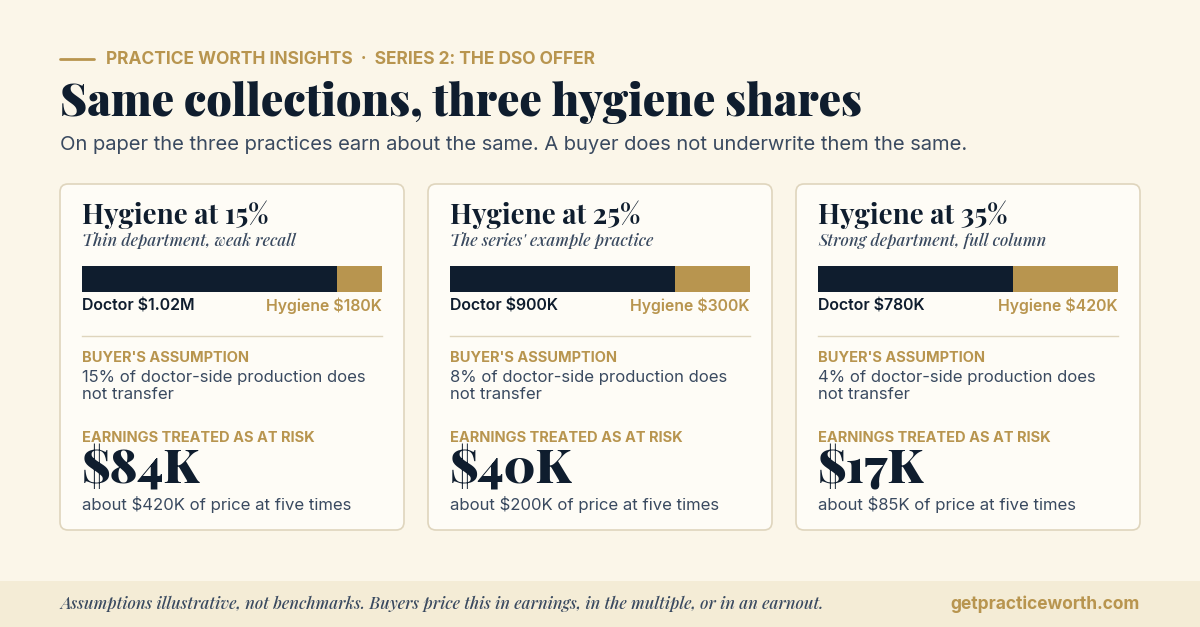
The chart: one practice, three hygiene shares
Take the same $1.2M in collections and run it three ways: hygiene at 15 percent of production, at 25 percent, and at 35 percent. The cost of providers comes out nearly the same in all three, because a replacement dentist and a hygienist each cost about a third of what they produce. On paper the three practices earn about the same.
The buyer does not underwrite them the same. For illustration, assume the buyer's model expects 15 percent of doctor-side production not to transfer when hygiene is thin and recall is weak, 8 percent at the base case, and 4 percent when a strong hygiene department is holding the patient base. Each dollar of lost production costs about 55 cents of earnings, after the provider pay and the lab and supply costs that go away with it. That puts the earnings the buyer treats as at risk at roughly $84K, $40K, and $17K. At a five-times multiple the distance between the thin department and the strong one is more than $300,000 of price, on practices with identical collections.
Those percentages are assumptions I chose to make the arithmetic visible. They are not benchmarks, and buyers do not all handle this the same way. Some take it out of earnings, some take it out of the multiple, and some move it into an earnout so that you carry the risk instead of them, which Dave gets to in Week 6. However it is handled, it gets priced.
Know your active-patient count before they define it
Ask three offices how many active patients they have and you will get three definitions. One counts anyone seen in the last 24 months, another uses 18 or 12, and some count only patients with a completed hygiene visit. Most owners quote whatever number the dashboard shows. A practice that calls itself 2,200 active patients on a 24-month count can be closer to 1,600 on an 18-month count of patients with a completed hygiene visit. Both numbers are honest, and only one of them is the buyer's.
The smaller number is not the problem. The problem is quoting 2,200 on the first call and watching the buyer's analyst arrive at 1,600, because every other figure you quoted now gets a second look. Run the count yourself at 12, 18, and 24 months before anyone asks. Know which one you are quoting, and say so when you quote it.
Recare is an earnings input
Inside a practice, recare is a clinical habit. To a buyer it is the closest thing a dental office has to recurring revenue. The report shows how many patients leave a hygiene visit with the next one booked, how many are overdue, and how many hours sit open in a normal week. In the department buyers pay a premium for, reappointment runs above 85 percent. Ten open hygiene hours a week is roughly $75K a year of production that never happened.
This is the most fixable number in the file, and it takes months, not years. Pre-appoint at the chair before the patient reaches the front desk, give the overdue list to one person who works it every week, and fill the open hours before you add new ones. A buyer reading six months of a rising reappointment rate is reading earnings that are getting more durable, and that moves where you land in the range.
The financials tell a buyer what the practice earned. The provider and hygiene reports tell them how much of it will still be there after you are not. Pull those reports before they do, and read them the way they will.
Where to start
Start with the collections-by-provider report, because it is the one input that sits in both rebuilds. Practice Worth uses it alongside your P&L to separate what you produce from what the practice produces without you, and shows how that split moves your number. If an offer is already in hand, the offer review reads the buyer's assumptions about your providers and your hygiene department against what your own reports show.
About the author. Karen L. Eslinger, RDH, is a registered dental hygienist with decades of chairside experience and the co-owner and CEO of Practice Worth, which she co-founded in 2026 with Dr. David Eslinger, DDS, MBA. Practice Worth is a Missouri LLC. Learn more at getpracticeworth.com.
Dave’s companion piece from Tuesday covers the accounting rebuild: why the DSO’s EBITDA is not your EBITDA.