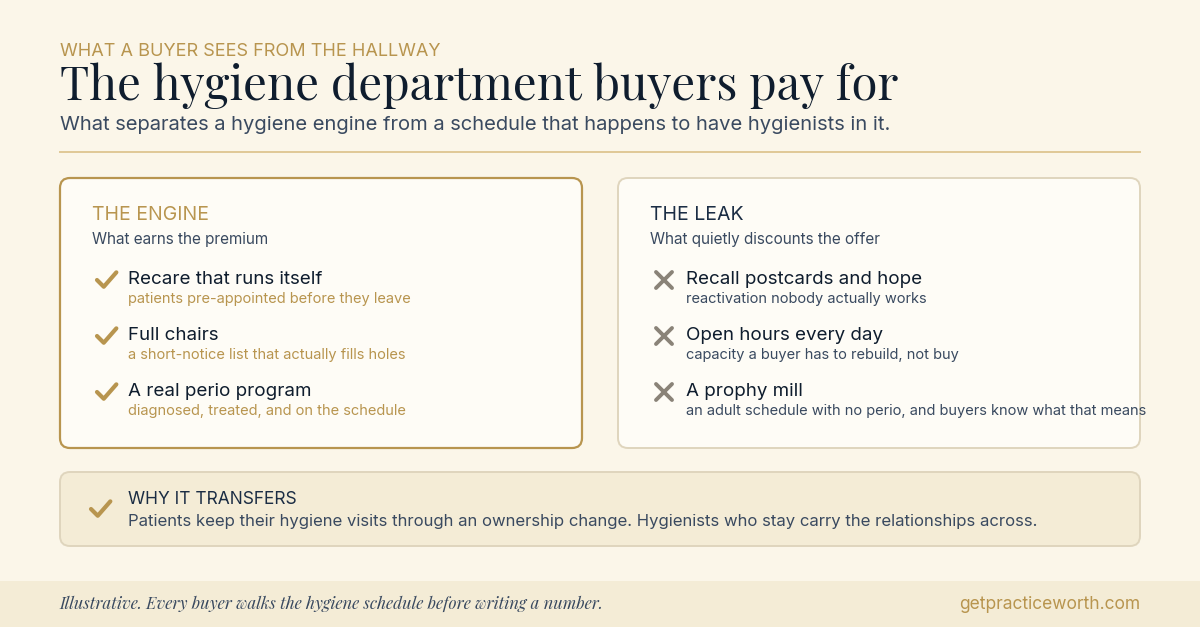
In the DSO article two weeks ago, I wrote that the first place a sophisticated buyer looks is the hygiene schedule. A few readers asked the obvious follow-up: what exactly are they looking for? I spent more than two decades in that chair, and the answer is not complicated. A buyer is trying to work out whether your hygiene department is an engine or a leak, and the schedule gives it away in about ten minutes.
Recare that runs itself
The engine version is easy to recognize. Patients are pre-appointed before they reach the front desk, and the reappointment rate lives somewhere above 85 percent. There is a short-notice list, and it actually fills the holes that open up during the week. Reactivation is a system with a name attached and a number reviewed at the morning huddle, so patients who lapse get a call from a person who knows them.
The leak version sends recall postcards and hopes. Nobody owns reactivation, so the patients who drift away stay away, and every open slot gets explained as a slow season. A buyer does not have to take anyone’s word for which practice they are standing in. The schedule density says it, week after week, in writing.
Empty chairs are lost value
Capacity is the operational side of the arithmetic Dave ran on Tuesday. Ten open hygiene hours a week is roughly $75K a year of production that never happened, in a department where the room and the equipment are already paid for. When a buyer sees that gap, they are not imagining found money. They are pricing the work of rebuilding a recare culture, and rebuilding one takes years. A full schedule is something they can buy. An empty one is a project.
A real perio program, not a prophy mill
Now look at what is on the schedule, not just how full it is. Periodontal disease exists in every adult patient base. A hygiene day that is wall-to-wall adult prophies tells a clinical reviewer the disease is there and nobody is diagnosing it. That reads badly twice. Clinically, it is supervised neglect. Commercially, it means the hygiene department is producing below its potential, because perio therapy and maintenance are appropriately compensated work that also keeps patients healthier. A schedule with a sensible share of perio maintenance says the standard of care and the P&L are both being taken seriously.
The people who carry patients across
Here is the part I lived. Patients are loyal to the person who cleans their teeth. Plenty of them will say so out loud: they came for the doctor, they stay for their hygienist. In a transition, that loyalty is the bridge. A hygienist with eight years of tenure walks hundreds of relationships across to the new owner. A department that turns over every eighteen months makes a buyer wonder how many patients leave with each departure, and they discount the offer accordingly.
None of this requires a consultant or new software. Pre-appointment, a worked short-notice list, honest perio diagnosis, and a team people want to stay on are habits, and every one of them is buildable in a year. They also show up in your number long before you sell, which is the best reason to start. The goodwill article from week one explains why buyers pay for what survives the handoff, and the methodology page shows how Practice Worth reads these signals. There is a free sample report at getpracticeworth.com.
About the author. Karen Eslinger, RDH, spent more than two decades chairside as a registered dental hygienist before co-founding Practice Worth in 2026 with her husband, Dr. David Eslinger. She focuses on the clinical and operational side of practice value. Practice Worth is a Missouri LLC. Learn more at getpracticeworth.com.
Dave’s companion piece runs the numbers on the same department: what your hygiene department does to EBITDA.