Walk an owner through their own P&L and the hygiene lines usually draw a sigh. Wages keep climbing, the schedule has holes in it, and the whole department can feel like a cost of doing business. A buyer reads the same two lines and reaches the opposite conclusion. On the buy side, the hygiene department was one of the first places we looked, because it answers the question every acquisition model is really asking: which of these earnings survive the sale?
The quiet profit center
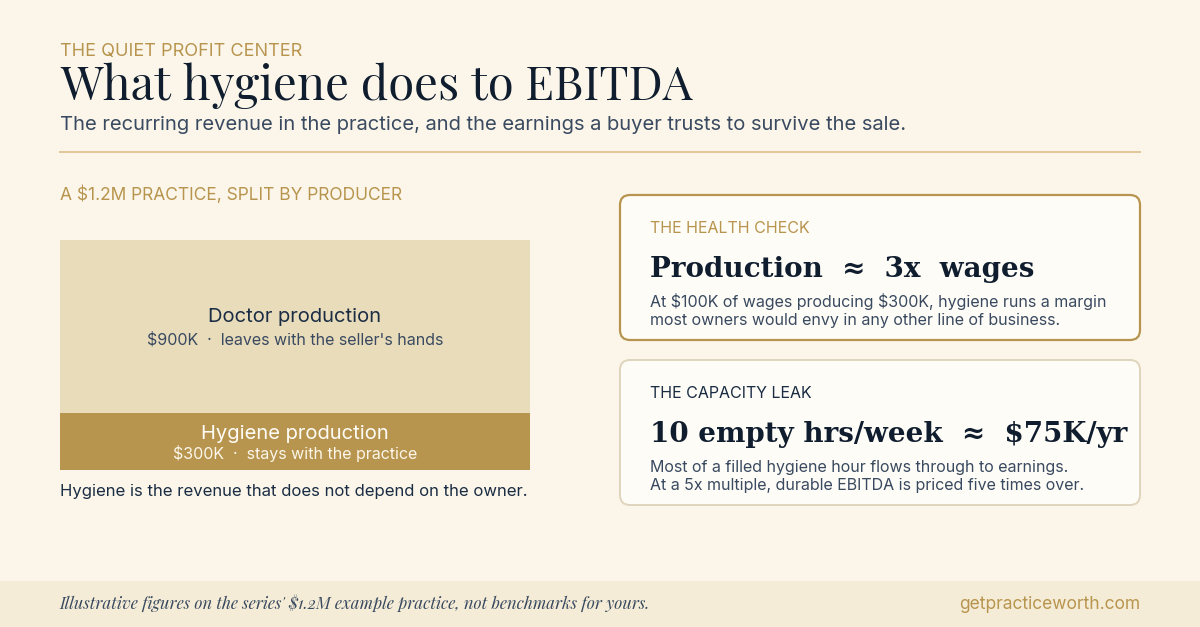
Start with the split. On the $1.2M example practice this series has used since week one, hygiene produces about $300K, a quarter of collections. Now set that production against what it costs to generate. A full-time hygienist earning $100K who produces $300K is returning three dollars for every dollar of wages, and that old benchmark still holds: a healthy department produces roughly three times its hygienist’s wages. Even after supplies, hygiene runs a margin most owners would envy in any other line of business. When the ratio slips toward two, the problem is usually the fee schedule, the appointment length, or the calendar, and it is costing more than the wages ever did.
Why buyers trust hygiene earnings
The margin is only half the story. The deeper reason buyers reward hygiene is durability. Doctor production leaves with the seller’s hands. Hygiene production does not. Patients keep their cleanings through an ownership change, which makes hygiene the closest thing dentistry has to recurring revenue. Each of those visits also carries the periodic exam, and the exams are where the next year of restorative dentistry gets diagnosed. A strong hygiene department is not just its own $300K; it is the referral engine that keeps the doctor’s side of the schedule full under whoever owns the practice next.
Remember what a valuation actually prices. As covered in the EBITDA article, a buyer pays a multiple of adjusted EBITDA, and the multiple is applied to earnings they believe will persist. Hygiene-driven earnings clear that test more easily than any other dollars in the practice.
Capacity, the lever hiding in the schedule
Here is the part that moves the number while you still own the practice. An unfilled hygiene hour is $150 to $180 of production that never happened, and the wages, the operatory, and the equipment were paid for anyway. Ten open hours a week compounds to roughly $75K a year. Because the fixed costs are already covered, most of a newly filled hour flows straight through to earnings rather than being eaten by overhead.
At the 5x multiple this series has used throughout, $50,000 of durable hygiene-driven adjusted EBITDA is worth roughly $250,000 at closing.
That arithmetic is why hygiene capacity shows up in diligence. A buyer who sees open chair time is deciding whether to price the practice on what it produces or on what it should produce, and they will pay for the second only when the systems that fill the schedule already exist.
What a systematized engine looks like
Those systems are observable: patients pre-appointed before they leave, a short-notice list that actually fills holes, hygienists whose tenure is measured in years, and a real periodontal program rather than an endless run of prophies. None of it depends on the owner, which is exactly the point. In the multiples article I argued that owner-dependence caps what any buyer will pay. A hygiene engine is the strongest evidence a practice runs on systems instead of on the seller, and buyers put that evidence near the top of the walkthrough list.
Practice Worth’s valuation reads hygiene the way a buyer does, as part of the earnings base and the risk picture, and shows the math. The framework is on the methodology page, and there is a free sample report at getpracticeworth.com.
About the author. Dr. David Eslinger holds a DDS and an MBA and has spent more than a decade on the buy side of dental practice transactions, founding Eslinger Dental Consultants and holding C-suite, executive leadership, and board roles in the DSO industry. Karen Eslinger, RDH, co-founded Practice Worth in 2026. Practice Worth is a Missouri LLC. Learn more at getpracticeworth.com.
Karen’s companion piece walks the same department from inside the operatory: the hygiene department buyers pay a premium for.