Most dentists I talk to carry a number in their head for what their practice is worth, and most of the time it traces back to the same rule of thumb: a practice sells for 70 to 80 percent of its annual collections. It is the first thing a hallway conversation produces, the first thing a broker’s free calculator returns, and it is wrong often enough to cost an owner real money.
I want to explain where that rule comes from, why it survives, and what a buyer actually pays for, because the gap between the two is where deals are won and lost.
Where the rule of thumb comes from
The collections multiple is a shorthand. Years ago, when most practices were single-owner general practices with similar overhead, a percentage of collections was a rough but serviceable estimate. If two practices looked alike, their collections were a decent stand-in for their profit, and profit is what a buyer is really buying. The rule stuck because it is easy. You need one figure off the production report and you can quote a value at a cocktail party.
Why it breaks
The problem is that two practices with identical collections can be worth very different amounts. Collections tell you how much money came through the door. They tell you nothing about how much stayed.
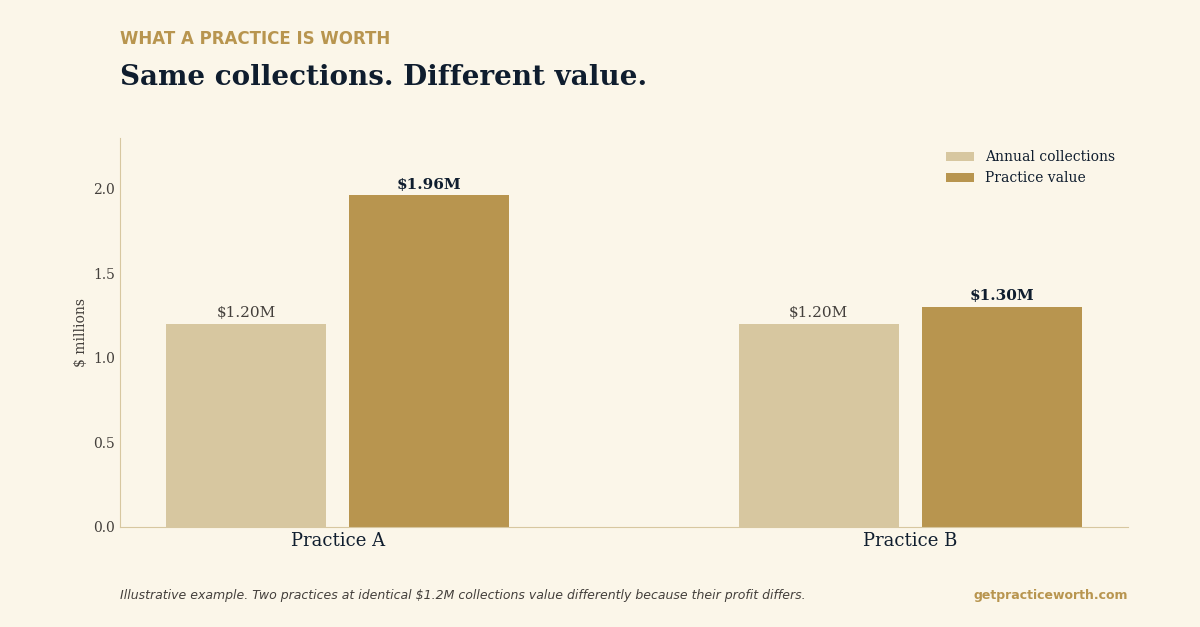
Take two practices, each collecting 1.2 million dollars a year. The first runs disciplined overhead, the owner produces efficiently, and the hygiene department carries its weight. After you reconstruct its earnings, it throws off enough profit to support a value near 1.96 million. The second collects the same 1.2 million but carries heavier staff costs, a richer facility, and softer scheduling. Its defensible value lands closer to 1.3 million. Same top line, and a difference of more than half a million dollars in what a buyer will pay.
A collections rule of thumb cannot see that difference. It values both practices the same, and at least one of those numbers is going to be wrong.
What a buyer actually pays for
A real buyer, whether a DSO, a group, or an individual dentist with a lender behind them, does not price off collections. They price off adjusted EBITDA, the practice’s normalized profit, multiplied by a market multiple. I have spent more than a decade on the buy side of dental transactions, and I have never once seen a serious buyer write an offer as a flat percentage of collections. They rebuild the earnings, normalize what the owner pays themselves, add back the discretionary spending that would not transfer to a new owner, and apply a multiple appropriate to the size and risk of the practice.
That is the number that survives diligence. The collections estimate is usually the number that gets revised downward in the first serious conversation, often in front of the seller.
Why this matters before you ever sell
Even if a sale is years away, the number you carry shapes real decisions. It affects how you think about taking on debt, bringing in a partner, funding retirement, and planning your exit. Anchoring all of that to a percentage of collections means anchoring it to a figure that may be off by six figures in either direction.
The fix is not complicated. Start from profit, not revenue. Understand your adjusted EBITDA and the multiple your practice actually commands. That is the language buyers speak, and it is the only number worth planning around.
That is exactly what Karen and I built Practice Worth to produce. It takes your real numbers, reconstructs your earnings the way a buyer would, and gives you a defensible value range in about ten minutes. If you want to see what that looks like, there is a free sample report at getpracticeworth.com.
About the author. Dr. David Eslinger holds a DDS and an MBA and has spent more than a decade on the buy side of dental practice transactions, founding Eslinger Dental Consultants and holding C-suite, executive leadership, and board roles in the DSO industry. Karen Eslinger, RDH, co-founded Practice Worth in 2026. Practice Worth is a Missouri LLC. Learn more at getpracticeworth.com.
Karen’s companion piece looks at the operational reasons two equal-revenue practices are worth different amounts: same collections, a very different practice.