Dave wrote on Tuesday about what actually lands in your account when a headline price gets split into cash, rollover, and earnout. There is a companion question that owners ask me far later than they should, usually after the financial terms are settled. What is it like to work there afterward?
Because in most sales, you do. The buyer is not just buying equipment and a patient list. They are buying continuity, and continuity means you.
The transition is a job, not a formality
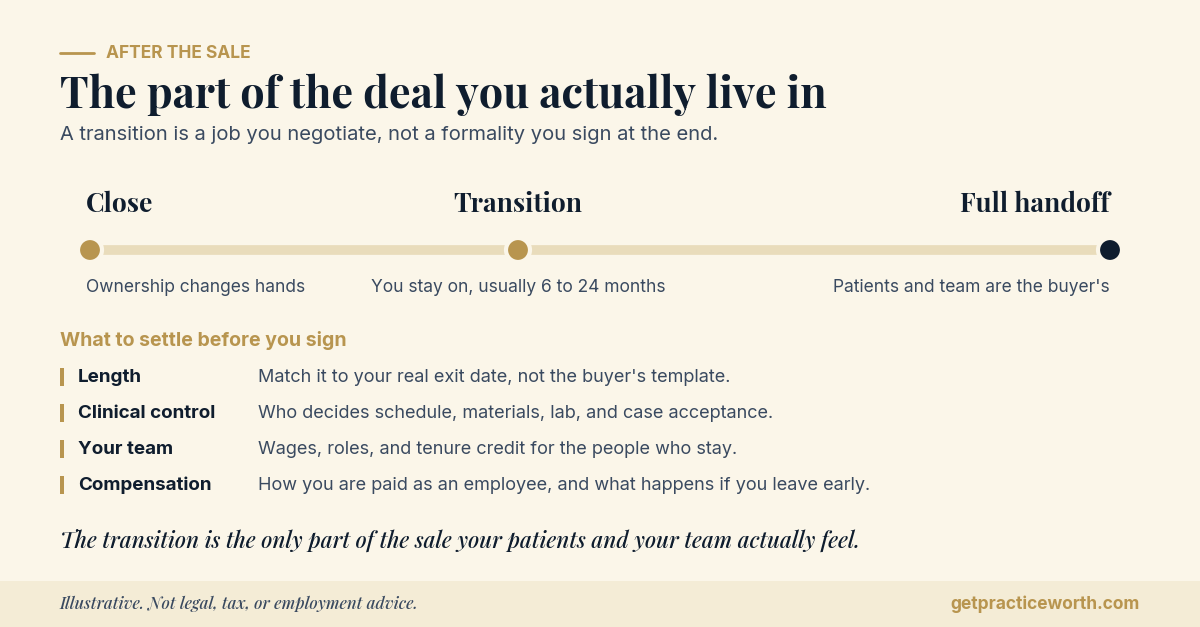
A private buyer will often want six to twelve months. A group or DSO buyer frequently wants longer, one to two years, sometimes more if a meaningful piece of your proceeds is tied to an earnout. During that stretch you are an employee of a practice you used to own, working under an employment agreement that was negotiated as an afterthought to the purchase agreement.
The financial terms are argued over for weeks. The employment terms are often handed across the table near the end, as a form. They deserve the same attention.
What changes on Monday, and what does not
The clinical day usually looks similar at first. Same operatories, same patients on the schedule, largely the same team. What changes is who decides. Supply ordering, lab selection, software, hygiene protocols, hiring, and the fee schedule move up to somebody else, sometimes gradually and sometimes on day one.
None of that is inherently bad. Some owners are relieved to hand over the parts of the job they never wanted. The difficulty comes from surprise, from discovering in month three that a decision you assumed was yours is not. Write down the handful of clinical decisions you genuinely cannot live without, and get those in the agreement rather than in a conversation.
Your team is reading you
The people who work for you will know something is happening before you tell them, and how you handle the transition is what they will remember. Their wages, their roles, their accrued time, and whether their years with you count toward tenure with the new owner are all negotiable, and they are much easier to negotiate before you sign than after.
This matters commercially, not only personally. As the lease and team piece covered, a buyer is underwriting the assumption that the practice keeps running. A hygienist who leaves in month two takes a column of production and a stack of relationships with her, and the patients notice long before the spreadsheet does. Protecting your team is protecting the deal.
Match the length to what you actually want
This is the one I would push hardest on. Owners routinely accept a transition length because it appeared in a draft, then spend two years in a job they meant to leave in one. Work backward from your real date. If you want to be finished in twelve months, do not sign twenty-four and plan to renegotiate, because your leverage is highest before closing and it never comes back.
Be equally clear about the reverse. If you want to keep practicing without owning, say so, and get the terms that make that good: the schedule you want, the compensation structure you understand, and a clear picture of what happens when your term ends. Plenty of dentists are happier chairside without the administrative load, and a transition can be the on-ramp to exactly that.
Ask what happens if you leave early, whether your compensation is tied to production or salary, how any earnout survives your departure, and what the non-compete covers in distance and duration. Then have your attorney read all of it. None of this is legal or employment advice, and the details vary by state and by buyer.
Knowing your number before any of this starts is what makes the rest of the conversation calm. That is what Practice Worth is for. The framework is on the methodology page, and there is a free sample report at getpracticeworth.com.
About the author. Karen L. Eslinger, RDH, is a registered dental hygienist with decades of chairside experience and the co-owner and CEO of Practice Worth, which she co-founded in 2026 with Dr. David Eslinger, DDS, MBA. Practice Worth is a Missouri LLC. Learn more at getpracticeworth.com.
Dave’s companion piece covers the money side of the same week: headline price versus what you actually pocket.