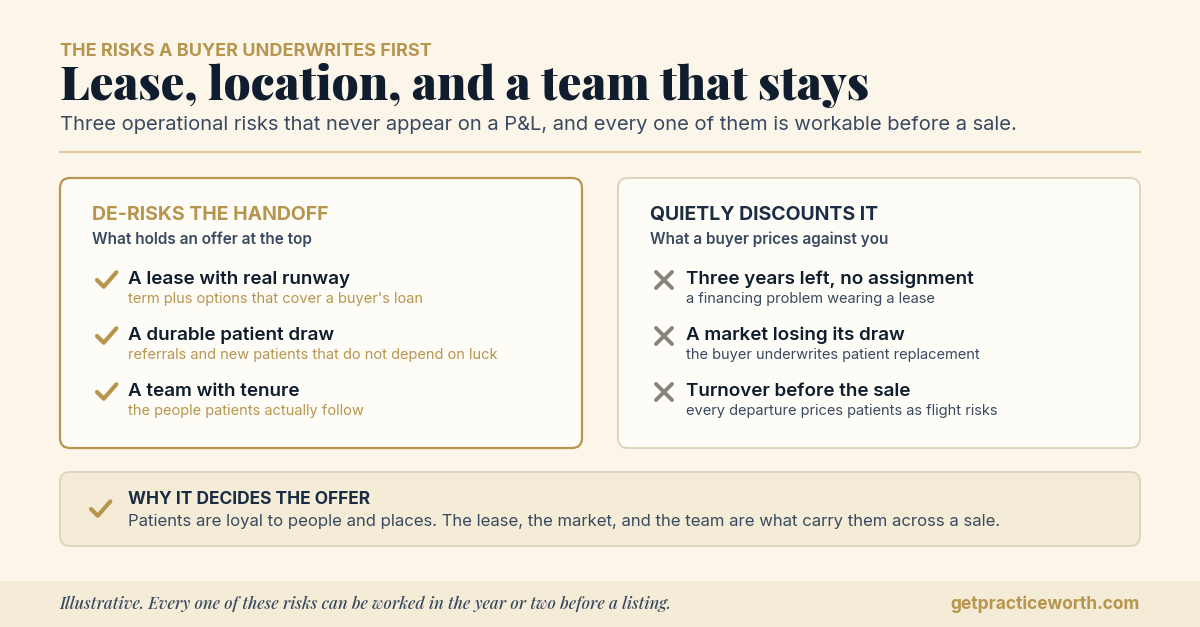
On Tuesday, Dave showed how risk factors decide where in the range an offer lands. I want to stay on the three of those risks that are operational, because they are the ones an owner can actually work on, and the ones I watched decide deals from inside the practice. None of them lives on the P&L. All of them live in filing cabinets, schedules, and break rooms.
The lease question buyers ask first
Start with the piece of paper most owners have not read since they signed it. A buyer’s lender wants the lease, term plus renewal options, to cover the life of the loan, and their attorney wants to know whether the lease can be assigned to a new owner at all. Those two questions get asked before anyone compliments your operatories. A practice on a month-to-month arrangement, or with three years left and a landlord who has to approve any transfer, hands the buyer a problem and hands the landlord leverage over your sale. The fix is unglamorous and cheap: pull the lease out this year, not the year you list. Negotiate renewal options and a reasonable assignment clause while you have no deadline and the landlord has no leverage. It may be the highest-return hour an owner spends on their practice value.
Location and the patient draw
Location risk is not about a nice address. A buyer maps where your patients actually come from, how many competing chairs sit inside that draw, and which direction the demographics are moving. A practice in a growing suburb reads differently from the same practice in a town losing its employers, because the buyer is underwriting the next decade of new-patient flow, not the last one. You cannot move the building. You can document what makes your draw durable: the referral relationships, the school and employer connections, the reviews, and a new-patient count that holds steady year over year.
The team that carries patients across
Here is the risk I lived. Patients are loyal to people, and mostly not to the person selling the practice. The hygiene piece made this case for hygienists, and it is just as true at the front desk: the voice patients have heard for a decade is part of what the buyer is buying. Long tenure de-risks the handoff. Turnover right before a sale does the opposite, because the buyer prices the patients who may follow the departed staff out the door. This is why experienced buyers ask about tenure, pay, and morale in the first meeting, and why a practice that only runs because the founder holds it together gets a cautious offer. Documented systems, cross-trained staff, and a team that plans to stay tell a buyer the practice will still be itself a year after closing.
Every one of these risks can be worked in the year or two before a sale, and each one you retire moves the realistic offer toward the top of your range. Practice Worth reads these operational signals the way a buyer does and shows you the effect. The framework is on the methodology page, and there is a free sample report at getpracticeworth.com.
About the author. Karen Eslinger, RDH, spent more than two decades chairside as a registered dental hygienist before co-founding Practice Worth in 2026 with her husband, Dr. David Eslinger. She focuses on the clinical and operational side of practice value. Practice Worth is a Missouri LLC. Learn more at getpracticeworth.com.
Dave’s companion piece runs the numbers on the same risks: the risk factors that move a buyer’s offer within your range.