Owners tend to ask for their number as if there is one. There is not. On the buy side, every model I ever built produced a range, and the interesting work was never the arithmetic in the middle. It was deciding where in the range this particular practice deserved to land. The earnings set the range. Risk sets the position.
Why the range exists
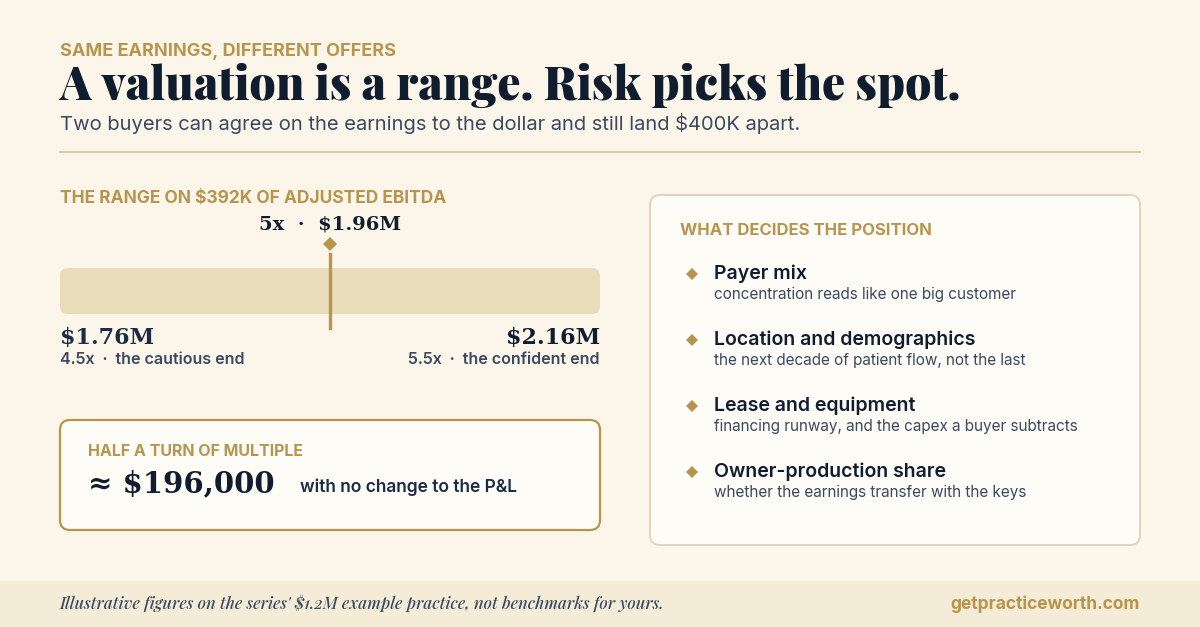
Take the $1.2M example practice this series has used all summer, with its $392K of adjusted EBITDA. In the multiples article I showed how buyer type and scale set the neighborhood of the multiple. But even inside one neighborhood, the multiple flexes. At 4.5x, that EBITDA is $1.76M. At 5.5x, it is $2.16M. Same practice, same P&L, and the distance between those two offers is roughly $400,000.
Half a turn of multiple on the example practice is about $196,000, and not one line of the P&L has to change for an offer to move that far.
A buyer sliding toward the bottom of the range is not being cynical. They are pricing the odds that the earnings you showed them survive the transfer. As covered in the EBITDA article, a multiple is only applied to earnings a buyer believes will persist. Risk factors are the evidence they weigh to decide how much belief you have earned.
Payer mix, the customer-concentration test
The first schedule a sophisticated buyer pulls is payer mix. Fee-for-service and well-reimbursed PPO revenue reads as durable. A practice where one PPO drives a large share of collections reads like a business with one big customer, because a single renegotiated fee schedule can reprice a meaningful slice of revenue overnight. Heavy Medicaid concentration gets the same read for a different reason: reimbursement and eligibility are set by policy, and policy moves. None of this makes a practice unsellable. It changes which buyers lean in, and where in the range they start.
Location, lease, and the equipment walk-through
Market type and demographics get the same underwriting. A growing suburb with young families supports the top of the range. A shrinking market makes a buyer price the patient attrition they cannot see yet. Then comes the lease, the risk factor owners most often discover late. A buyer’s lender generally wants the lease, term plus options, to cover the life of the acquisition loan, often ten years. A strong practice on a three-year lease with no assignment provision has a financing problem the seller never knew existed. Equipment reads the same way: the walk-through is not about whether the operatories impress, it is about deferred replacement. Every end-of-life chair, compressor, and sensor is capital the buyer will have to spend, and they subtract it from somewhere.
The owner-production question
The heaviest factor is the one in the mirror. On the example practice, the doctor produces $900K of the $1.2M. Whether those dollars transfer depends on what surrounds them: an associate who stays, a hygiene engine that keeps the schedule full, patients bonded to the practice rather than to one set of hands. A practice where the owner is the product gets priced at the cautious end of the range, because the buyer is underwriting the seller’s departure. A practice that demonstrably runs on systems earns the top of it.
Notice what all four factors have in common: none of them appears in adjusted EBITDA. That is the point. Two practices with identical earnings can deserve offers hundreds of thousands of dollars apart, and both offers can be rational. Practice Worth’s valuation reads these risk factors alongside the earnings and shows where your practice sits in its range, and why. The framework is on the methodology page, and there is a free sample report at getpracticeworth.com.
About the author. Dr. David Eslinger holds a DDS and an MBA and has spent more than a decade on the buy side of dental practice transactions, founding Eslinger Dental Consultants and holding C-suite, executive leadership, and board roles in the DSO industry. Karen Eslinger, RDH, co-founded Practice Worth in 2026. Practice Worth is a Missouri LLC. Learn more at getpracticeworth.com.
Karen’s companion piece walks the operational side of the same risks: lease, location, and a team that stays.