Two owners called me within a month of each other, both holding a signed letter of intent, both quoting me the same number. One of them was going to end up with roughly six hundred thousand dollars more than the other on closing day. Neither of them knew it yet, because both of them were reading the headline.
The headline is a total, not a payment
On the $1.2M example practice this series has used all summer, adjusted EBITDA is $392K. An offer at 5.0x puts the headline price at $1,960,000. That number is real. It is also a sum of several different promises, and only one of them is money that exists on the day you sign.
A typical structure splits it three ways. Seventy percent as cash at close, which on this deal is $1,372,000. Twenty percent as rollover equity, $392,000, which happens to equal one full year of the practice’s adjusted EBITDA. Ten percent as an earnout, $196,000, which is almost exactly half a turn of multiple, the figure this series has been using to describe what half a turn is worth.
Only the cash at close is money in hand. The other two are conditions you agree to live under.
What each piece actually is
Cash at close is the certain part. It funds your debt payoff, your tax bill, and whatever comes next. When people compare offers in their head, this is usually the only number that matters, and they are not wrong to weight it heavily.
Rollover equity means you keep a slice of the buyer’s company rather than cashing out entirely. If the buyer grows and exits well, that slice can be worth more than the cash you gave up for it. If they stall, it is an illiquid position in a private company whose decisions you no longer control. Rollover is not a discount. It is a bet, and it should be evaluated as one.
An earnout pays you later if the practice hits agreed targets. The uncomfortable part is that you are usually agreeing to hit those targets after handing over the levers. Someone else now sets the schedule, the fee schedule, the hiring, and the marketing spend. Ask who controls the inputs before you accept a number that depends on the outputs.
Structure is a risk transfer
Here is the way to hold all of it at once. Every dollar a buyer moves out of cash at close and into rollover or earnout is a dollar of risk moved off their balance sheet and onto yours. That is not a criticism of buyers. It is the job. But it means a shift in structure is a real change in what you are being offered, even when the headline never moves.
Two offers, same sticker
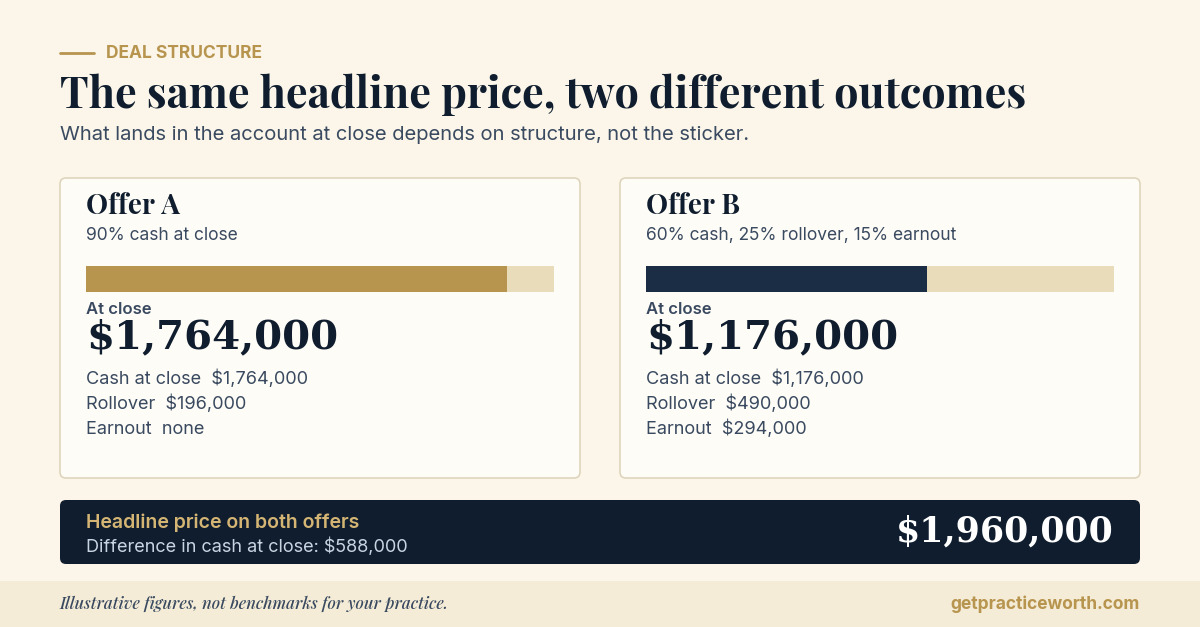
Take the same $1,960,000 headline. Offer A is ninety percent cash, which is $1,764,000 at close, with the small remainder rolled. Offer B is sixty percent cash, twenty-five percent rollover, and fifteen percent earnout, which is $1,176,000 at close, $490,000 rolled, and $294,000 contingent.
The gap in cash at close is $588,000 on an identical headline price. Offer A is not automatically the better deal. If you know the buyer, believe in the platform, and want a second bite when they sell, Offer B can be worth considerably more over time. The point is that you should be choosing between them deliberately, and you cannot do that while you are still comparing the front page.
What to ask before you compare
Ask what percentage is cash at close, in dollars, not percentages. Ask what the rollover is being valued at, and whether you are buying in at the same price the buyer’s investors did. Ask who controls the levers behind any earnout target, and what happens to that earnout if you leave early or the buyer sells. Ask how the working capital and accounts receivable are treated, because that quietly moves the number too. Then get your CPA and your attorney to read the whole thing, because none of this is tax or legal advice and the tax treatment of each piece is its own conversation.
What Practice Worth gives you is the part that comes before all of this: a defensible adjusted EBITDA and a valuation range built the way a buyer builds it, so that when a headline number arrives you already know whether it is a fair starting point. The framework is on the methodology page, and there is a free sample report at getpracticeworth.com.
About the author. Dr. David Eslinger holds a DDS and an MBA and has spent more than a decade on the buy side of dental practice transactions, founding Eslinger Dental Consultants and holding C-suite, executive leadership, and board roles in the DSO industry. Karen Eslinger, RDH, co-founded Practice Worth in 2026. Practice Worth is a Missouri LLC. Learn more at getpracticeworth.com.
Karen’s companion piece takes up what happens after the signing: staying on after you sell.