The letter usually arrives as a PDF on a Friday afternoon: three or four pages, a signature block, and a date by which the offer expires. After last week’s two EBITDAs, it is the first time the buyer’s number is in writing. Most owners read the price twice and forward the letter to their attorney. That is the right instinct in the wrong order, because the price is the least informative sentence on the page.
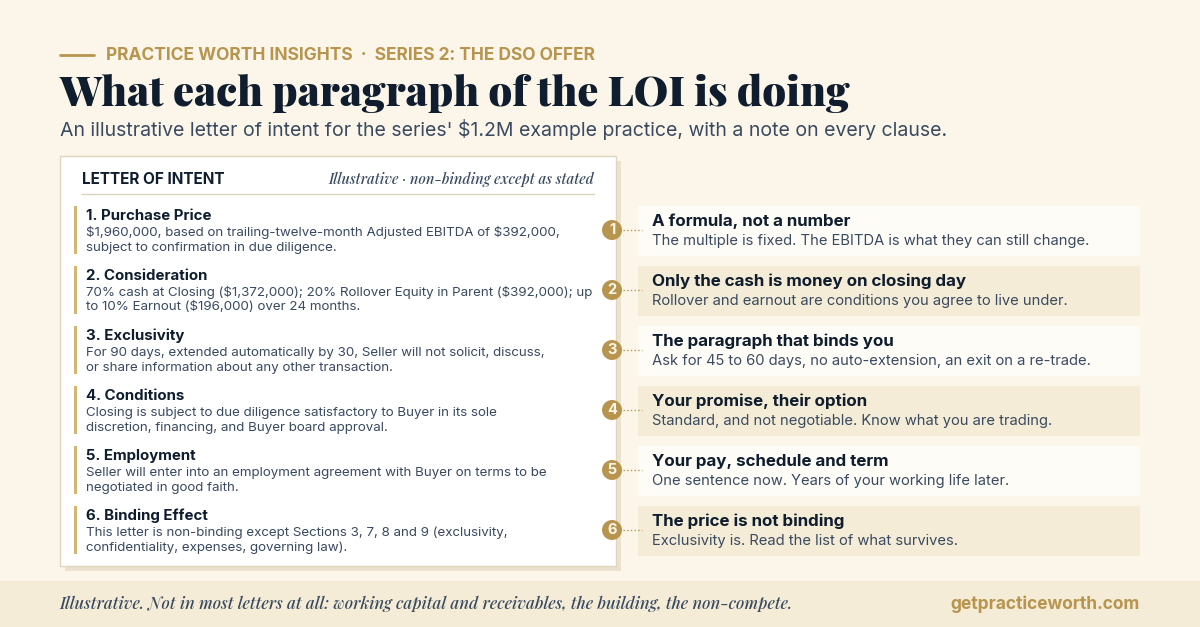
I spent a decade on the side of the table that sends these. Here is what each paragraph is doing, on an illustrative letter for the series’ $1.2M example practice. The chart above is that letter with the callouts.
The price is a formula, not a number
The first paragraph will say something like this: a purchase price of $1,960,000, based on trailing-twelve-month adjusted EBITDA of $392,000, subject to confirmation in due diligence. Read the second half of that sentence again. The price is five times an earnings figure, and the earnings figure is the one thing the buyer has reserved the right to change. If diligence arrives at the $315K from last week’s bridge, the same letter supports about $1.58M, and nothing in it has been broken.
Ask for the EBITDA schedule the price is built on, attached to the letter as an exhibit. A price tied to a specific schedule is much harder to move later than a price tied to “adjusted EBITDA as determined in diligence,” because every change now has to point at a line.
The structure sentence matters more than the price
The next sentence splits the $1.96M. On the example letter it is 70 percent cash at closing, or $1,372,000; 20 percent rollover equity in the buyer’s parent company, or $392,000; and up to 10 percent as an earnout, or $196,000, paid over two years if the practice hits its EBITDA targets. As the headline-versus-proceeds piece put it in Series 1, only the first of those is money on the day you sign.
In the letter each piece gets one line. In the purchase agreement each gets ten pages. The rollover line should say what the equity is priced at and whether you receive the same class of shares as the investors. The earnout line should say who sets the targets and what happens to them if the buyer changes the fee schedule. If the letter gives you only percentages, the definitions get written later by the buyer’s lawyer. Next week I walk the $1.96M headline down to the wire.
Exclusivity is the paragraph that binds you
Somewhere in the middle is a no-shop. For 90 days, often with an automatic 30-day extension, you agree not to talk to another buyer, return another call, or share your financials with anyone else. This paragraph is binding. The price is not.
That asymmetry is the most important thing in the letter. On the day you sign, the buyer can still change the price, the structure, and the timeline. The one thing you can no longer do is find out what anyone else would pay. Every week of exclusivity moves leverage to their side of the table, which is why the first-call piece suggested asking a platform how many letters it signs against how many deals it closes.
It is also the most negotiable paragraph, because shortening it costs a serious buyer nothing. Ask for 45 to 60 days, no automatic extension, and a clause that ends exclusivity if the buyer proposes a lower price. That last one is the protection that matters. It turns a re-trade from a free option into a decision with a cost.
What binds, and whom
Near the end is a paragraph that says the letter is non-binding except for certain sections. Read the list. It usually includes exclusivity, confidentiality, each side paying its own costs, and governing law. It almost never includes the price. Put plainly, the parts that protect the buyer survive and the parts that describe your deal do not.
The conditions paragraph belongs with it. Closing is typically conditioned on diligence “satisfactory to Buyer in its sole discretion,” on financing, and on approval by the buyer’s board. Each of those lets the buyer walk for almost any reason. That is standard, and you will not negotiate it away. It is still worth knowing that you are giving a binding promise in exchange for a well-drafted option.
What most letters leave out
The terms that cost owners the most are often not in the letter at all.
- Working capital and receivables. Who keeps the accounts receivable at closing, and whether the buyer expects a level of working capital left in the practice. On the example practice a month of collections is about $100K.
- The building. If you own the real estate, the lease you sign as landlord sets the rent, the term, and the renewals, and the rent feeds straight back into the buyer’s EBITDA.
- Your compensation. “Employment terms to be negotiated in good faith” is the most common sentence in these letters and the least useful. Karen covers what belongs in those terms on Thursday.
- The non-compete. The radius and the years, which start the day you leave, whenever and however that happens.
None of these are exotic. They are left out because a short letter is easier to sign. Every term the letter does not settle gets settled in the buyer’s first draft of the purchase agreement, during an exclusivity period when you cannot walk to anyone else.
A letter of intent lists what the buyer has promised to try to do and what you have promised not to do. Read it in that order, and negotiate it before you sign, because it is the last document in the process where you still have an alternative.
These examples are illustrative, and every platform’s letter reads a little differently. None of this replaces your transaction attorney, who should read the letter before you sign it and not after.
Where to start
You can only judge the price sentence if you know what EBITDA it should be built on. Practice Worth rebuilds your earnings from the P&L and the collections-by-provider report and documents every adjustment, so the schedule behind their number has something to be compared against. If a letter is already in hand, the offer review reads it clause by clause, starting with the price formula and the exclusivity terms, before you sign.
About the author. Dr. David Eslinger holds a DDS and an MBA and has spent more than a decade on the buy side of dental practice transactions, founding Eslinger Dental Consultants and holding C-suite, executive leadership, and board roles in the DSO industry. Karen Eslinger, RDH, co-founded Practice Worth in 2026. Practice Worth is a Missouri LLC. Learn more at getpracticeworth.com.
Karen’s companion piece on Thursday covers the sentence about your job: the employment terms buried in the LOI.