Dave explains that normalizing owner pay has two halves: adding back what you pay yourself, and subtracting what it costs to replace your clinical work. I want to talk about that second half, because it is where owners tend to guess, and the guess can be expensive.
Why a buyer has to replace you
When you sell, someone still has to do the dentistry you do today. It might be you, staying on for a year or two as an associate, or it might be a new hire. Either way, that person gets paid at market rate, and that cost comes straight out of the earnings a buyer is willing to pay for. The replacement dentist is not a hypothetical. They are a real line in the buyer’s model.
How associate pay actually works
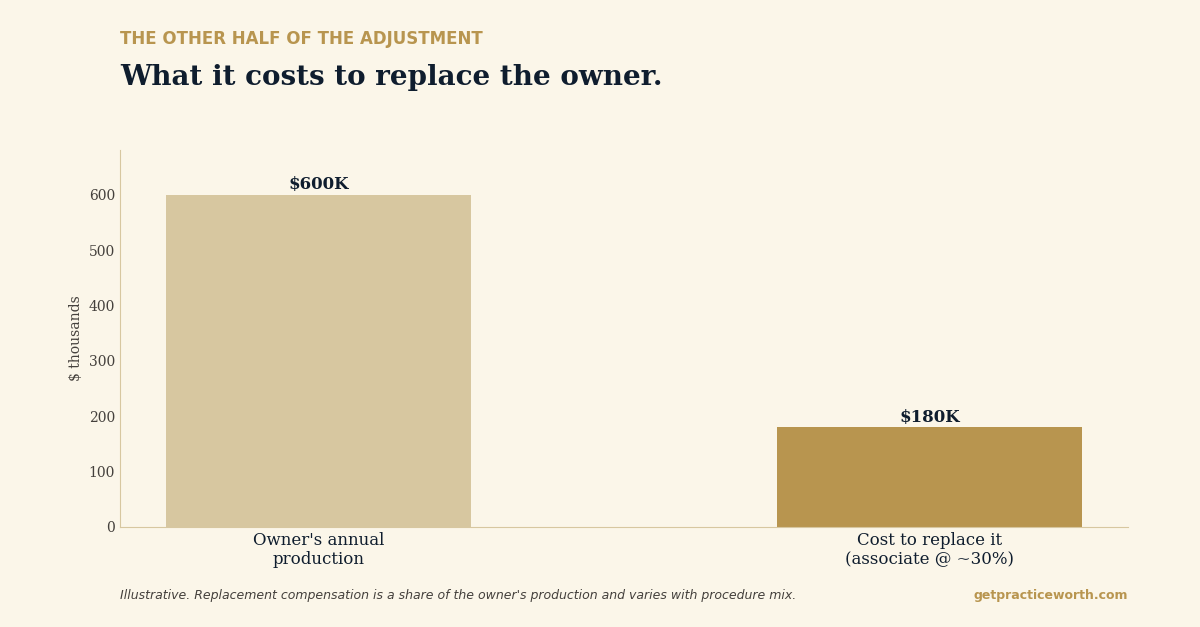
Associate compensation is usually a share of the collections or production the associate generates, commonly somewhere between a quarter and a third, depending on the market and the arrangement. So if your personal production is 600,000 dollars a year, a replacement associate at around 30 percent costs roughly 180,000. That 180,000 is what gets subtracted when your earnings are normalized.
Procedure mix changes the math
Not all production replaces at the same rate. A practice whose value leans on high-end procedures the owner personally performs, certain implant, complex restorative, or specialty work, can carry a different replacement cost than one built on routine restorative care and a strong hygiene base. The more specialized and owner-specific the production, the more carefully this number has to be set.
If you plan to stay on
Many owners stay for a transition period and become their own replacement, paid as an associate. If that is your plan, this number is also your future paycheck, so it is worth understanding before you ever sit down to negotiate. It shapes both the valuation and your income for the first year or two after the sale.
The operational angle
Here is the part I care about. A practice where production is spread across associates and a strong hygiene program depends less on any single person. That lowers the replacement risk a buyer is pricing, and it makes this whole adjustment cleaner. The more the practice runs on the team rather than on the owner’s hands, the less fragile it looks to a buyer, and the more they will pay.
The replacement number is not a round figure to wave away. It is one of the largest single inputs in your valuation, and it deserves a real market rate.
Practice Worth models it for you based on your production, so you are not guessing at the number that may matter most. There is a free sample report at getpracticeworth.com.
About the author. Karen Eslinger, RDH, spent more than two decades chairside as a registered dental hygienist before co-founding Practice Worth in 2026 with her husband, Dr. David Eslinger. She focuses on the clinical and operational side of practice value. Practice Worth is a Missouri LLC. Learn more at getpracticeworth.com.
The companion piece on the first half of the adjustment: the single biggest number in your valuation, owner compensation.