Last week I walked the example offer from the headline to the wire, and the first thing that came off the $1.96M was $392,000 of rollover. That is 20 percent of the price, paid to you in units of the buyer’s parent company instead of cash. The honest answer is that nobody can tell you on the day you sign. What you can know is what has to go right for them to be worth more than the cash they replaced, and what happens if it does not.
Rolling 20 to 30 percent is normal in DSO deals, and it is where a lot of them are won and lost. A seller who rolls well can make more on the platform’s sale than on their own. A seller who rolls badly can hold paper for six years that comes back as a fraction of what it cost. Most of the difference is decided in a few paragraphs of the purchase agreement that sellers tend to skim.
What you actually own
The rollover buys units, or shares, in the holding company that owns the platform. They are usually priced at the deal, and the exchange is often structured so that tax is deferred until you sell them. What you cannot do is sell them when you want to. There is no market for units in a private platform. They turn into cash when the platform is sold or recapitalized, on the private equity sponsor’s timeline, not yours.
Where your units sit in the stack
When a platform sells, the money is paid out in order. Lenders are paid first. Then any preferred equity, which is usually the sponsor’s and often carries a preferred return that accrues every year it is outstanding. Common units are paid last, from whatever is left.
That order matters more than most sellers think. Take a platform that borrowed half of what it paid and sells five years later for exactly what it cost. Index the price at 100. The lenders take 50. If the sponsor’s 40 of equity is preferred with an 8 percent annual return, it is owed about 59 by year five, which is more than the 50 that is left. A seller who rolled into junior common, the other 10, gets nothing. A seller who rolled into the same security as the sponsor shares the 50 in proportion and gets roughly their money back. Same platform, same sale, and the difference is one line in the purchase agreement.
So the first question about a rollover is not what the platform will sell for. It is what security you are getting, at what price, and what sits ahead of it. As I wrote about the letter of intent, the rollover line should say whether you receive the same class as the investors.
Dilution at every raise
Platforms grow by buying practices, and buying practices takes money. Each time the sponsor raises new equity, your percentage of the company shrinks. That is not automatically bad. If the new money comes in at a fair price and the platform grows faster because of it, a smaller slice of a larger company can be worth more. It hurts when the new money comes in at a lower price than yours, or with a preference that sits ahead of your units. Ask how past raises on the platform were priced, and whether you have the right to invest alongside new money.
The second bite, three ways
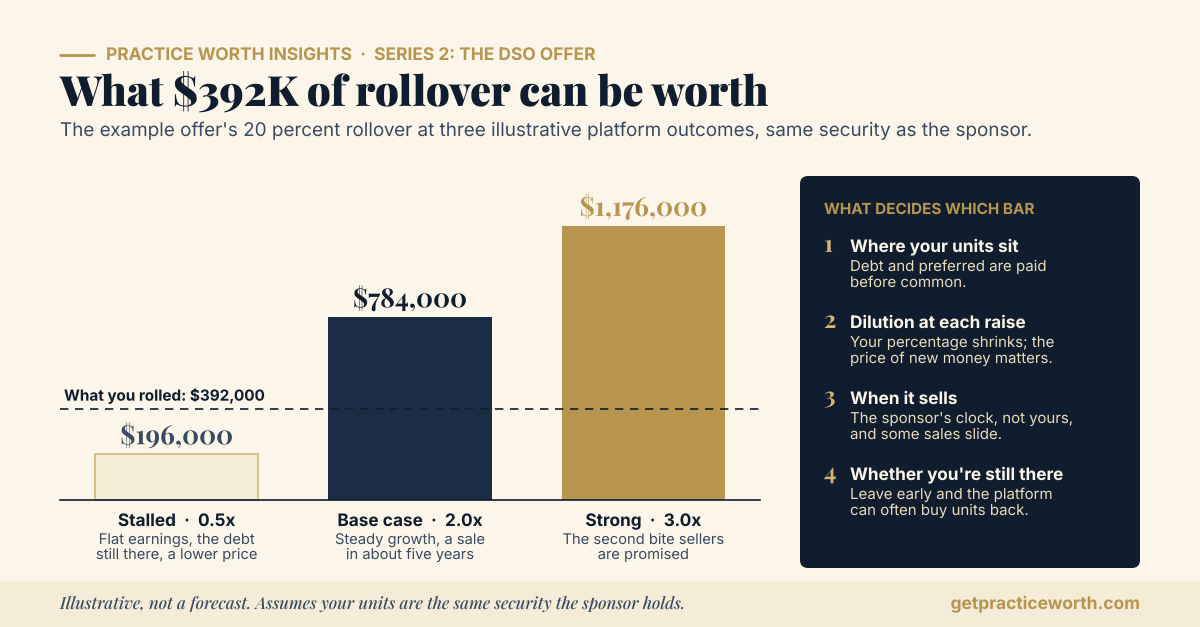
The chart above runs the example’s $392,000 through three illustrative outcomes, assuming your units are the same security the sponsor holds. If the platform stalls, with flat earnings, the debt still there, and a next buyer who pays less than the last one, the units come back at about half, $196,000. In a base case, five years of steady growth and a sale at a reasonable price, they are worth about twice what you rolled, $784,000. In a strong case, three times, $1,176,000. That is the second bite sellers are promised, and some of them get it.
Two things the chart cannot show. The first is time. A sponsor usually plans to sell within three to seven years, but the clock started when the sponsor bought the platform, not when you joined it. Joining in year five of a five-year plan is a different investment from joining in year one, and some sales simply slide. The second is your job. Many agreements let the platform buy back your units if you leave before a set date, sometimes at cost or at the lower of cost and current value. Karen covered how leaving early can forfeit unvested rollover. Read that clause next to this one, because it decides whether the second bite is still yours when it arrives.
Questions to ask before you roll
- What security am I getting? Is it the same class the sponsor holds, and at the price per unit the sponsor paid?
- What sits ahead of my units? How much debt the platform carries, and whether any preferred return is accruing.
- How have past raises been priced? And whether I can invest alongside the next one.
- Where is the sponsor in its hold? When it bought the platform, and who decides when and how it sells.
- What happens to my units if I leave? Or if I am asked to leave, and at what price they can be bought back.
The rollover is not a second payment. It is an investment you make with part of your price, in a company you will not control. Underwrite it the way you would any other investment of that size.
These figures are illustrative, and rollover terms vary widely between platforms. None of this is investment, tax, or legal advice. Have your attorney and CPA read the rollover documents themselves, not just the one line in the letter. Next week takes up the earnout, the other part of the price that depends on a number someone else controls.
Where to start
The rollover is priced off the same number as the rest of the deal: the adjusted EBITDA behind the headline. Practice Worth rebuilds yours from the P&L and the collections-by-provider report, so you know whether the price your units are issued at starts from a fair number. If an offer is already in hand, the offer review covers the rollover: the security, the price per unit, what sits ahead of it, and the buyback terms to take to your attorney.
About the author. Dr. David Eslinger holds a DDS and an MBA and has spent more than a decade on the buy side of dental practice transactions, founding Eslinger Dental Consultants and holding C-suite, executive leadership, and board roles in the DSO industry. Karen Eslinger, RDH, co-founded Practice Worth in 2026. Practice Worth is a Missouri LLC. Learn more at getpracticeworth.com.
Karen’s companion piece on Thursday covers the other half of the rollover: being an owner on paper and an employee on the floor.