Last week’s letter of intent put $1,960,000 at the top of the page. That is five times the $392K of adjusted EBITDA on the series’ $1.2M example practice, and it is the number most owners repeat to their spouse, their CPA, and themselves. Nobody is going to wire it to you.
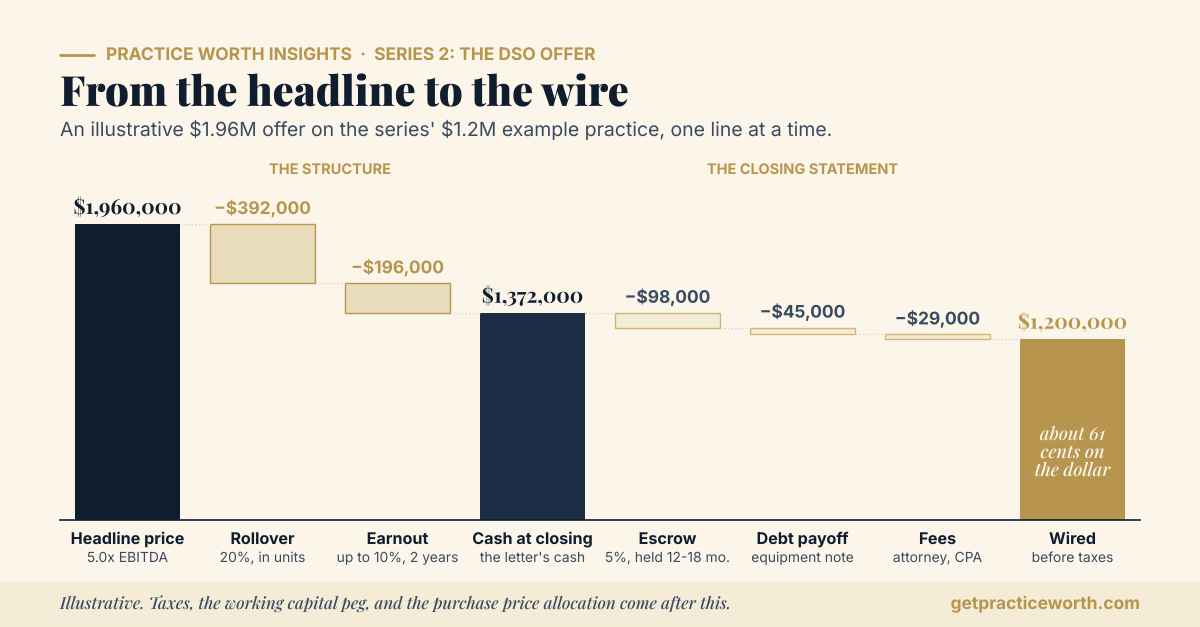
I have watched a lot of sellers see their closing statement for the first time. The reaction is rarely about the price. It is about how many lines sit between the price and the wire. The chart above walks the example letter from the headline to the cash at closing, one line at a time. Every figure in it is illustrative.
The first cut is the structure
The letter split the price 70/20/10. Rollover equity takes $392,000 and the earnout takes up to $196,000, which leaves $1,372,000 as cash at closing. That is the figure the letter calls cash, and it is the most you should expect to see on closing day before anything else comes off. As the Series 1 piece on sale proceeds put it, the rollover and the earnout are conditions you agree to live under. Next week takes up what the rollover units are actually worth.
Then the closing statement
Three more lines usually come out of the cash before it is wired, and most letters mention none of them.
- Escrow or holdback. Buyers hold back part of the price against claims that surface after closing, such as a billing problem or a liability nobody disclosed. On the example it is 5 percent of the price, $98,000, released in twelve to eighteen months if nobody makes a claim. It is still yours. It is not in your account.
- Debt payoff. Equipment loans, a practice line of credit, and any remaining acquisition note are paid from your proceeds at the closing table, because the buyer takes the practice free and clear. The example carries a $45,000 equipment note.
- Transaction costs. Your attorney, your CPA, and any adviser who is paid at closing. The example uses $29,000.
That leaves $1,200,000 wired on closing day. On a $1.96M headline, that is about 61 cents on the dollar, and taxes have not come out yet.
Working capital, the line nobody prices
The example assumes you keep your accounts receivable and collect them after closing, which is common in dental sales. Some letters instead set a working capital target, called a peg, that the practice has to hold on the closing date. If receivables and cash come in below the peg, the shortfall comes out of your price dollar for dollar. On a practice that collects about $100K a month, the peg can move your proceeds by tens of thousands of dollars, and it is usually defined in the buyer’s first draft of the purchase agreement, not in the letter. Ask for the peg and how it is calculated before you sign.
Taxes follow the structure line
Most DSO transactions are structured as asset purchases, in part because of state rules on who can own a dental practice. In an asset sale the price is allocated across the assets being bought, and the allocation decides how each dollar is taxed. Goodwill is generally taxed at capital gains rates. Equipment you have already depreciated can be taxed as ordinary income when it is sold. A payment for your non-compete is generally ordinary income too. The same $1.96M can leave you with a noticeably different after-tax number depending on how the allocation is written, and the buyer has its own reasons to prefer a different one.
The rollover and the earnout have their own timing. Rollover is often structured so that tax is deferred until you sell the units, and an earnout is generally taxed when it is paid. Have your CPA model the allocation before the purchase agreement is drafted, not after. None of this is tax advice, and the details vary by state and by entity.
Two offers, same headline, $588K apart
In Series 1 I compared two offers at the same $1,960,000. Offer A paid 90 percent cash at closing, $1,764,000. Offer B paid 60 percent, $1,176,000, with 25 percent rolled and 15 percent in an earnout. Run both through the same closing statement: the same $98,000 escrow, the same $45,000 note, the same $29,000 of fees. Offer A wires $1,592,000. Offer B wires $1,004,000. The gap is still $588,000, because every line below the structure is the same for both.
Offer B is not automatically the worse deal. If the platform performs and sells well, the rollover can end up worth more than the cash it replaced. The point is that the comparison belongs on the wire, and you can only make it there if you ask for every line in dollars.
The headline is what your practice is worth to the buyer. The wire is what the sale is worth to you. Ask for the second number in writing before you sign anything built on the first.
These figures are illustrative, and every closing statement reads a little differently. None of this replaces your CPA and your transaction attorney, who should see the structure, the peg, and the allocation before the purchase agreement is drafted.
Where to start
Every line on this chart starts from one number, the adjusted EBITDA behind the price. Practice Worth rebuilds yours from the P&L and the collections-by-provider report and documents every adjustment, so you know whether the headline is a fair starting point before you start subtracting. If an offer is already in hand, the offer review walks it from the headline to the wire, including the escrow, the peg, and the allocation questions to take to your CPA.
About the author. Dr. David Eslinger holds a DDS and an MBA and has spent more than a decade on the buy side of dental practice transactions, founding Eslinger Dental Consultants and holding C-suite, executive leadership, and board roles in the DSO industry. Karen Eslinger, RDH, co-founded Practice Worth in 2026. Practice Worth is a Missouri LLC. Learn more at getpracticeworth.com.
Karen’s companion piece on Thursday covers what happens after the wire lands: what changes on the Monday after closing.