The closing happens on paper, usually on a Friday, often without anyone in the office knowing the exact hour. The sale happens to your team on Monday. In Week 1 I wrote about what to tell your team when a DSO calls, and when. This piece is about what you tell them once it is done, because by Monday the questions are no longer hypothetical.
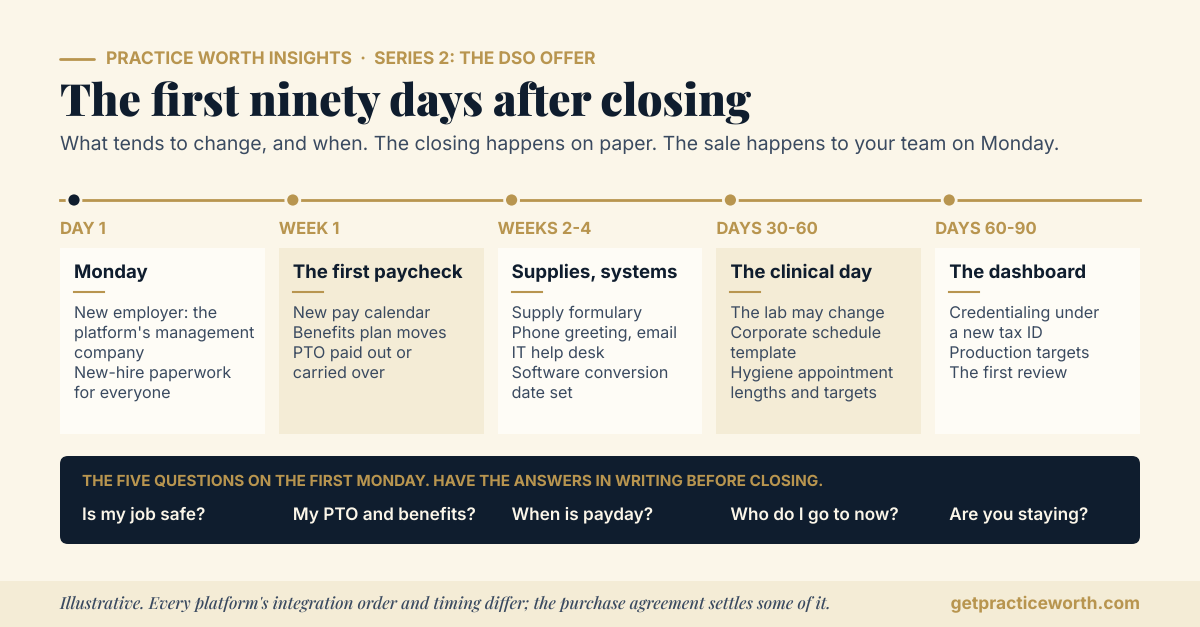
From the hygiene side of the building, the first ninety days are not one big change. They are a long list of small ones, arriving from people your team has never met. The timeline above is the order they usually arrive in. It is illustrative, and every platform runs its integration a little differently, but the list itself rarely changes much.
Week one: payroll, benefits, and a new employer
In most deals your team does not simply keep their jobs. They are hired by a new employer, usually the platform’s management company, on the closing date. That means new-hire paperwork for everyone: tax forms, direct deposit, an I-9, and a handbook to sign. It feels routine to the buyer. To a hygienist who has worked for you for fourteen years, it can feel like applying for her own job.
The first paycheck is where trust is won or lost. Pay schedules often change, from every two weeks to twice a month or the other way around, and a short first check can arrive simply because the calendar moved. Health insurance moves to the platform’s plan, sometimes with a different network and a different deductible. Accrued paid time off is either paid out at closing or carried over, and the purchase agreement decides which. Know all of it before Monday, in writing, because “I’ll find out” is the answer your team will remember.
Weeks two to four: supplies, phones, and systems
Supplies move to the platform’s formulary, a list of approved products from a contracted vendor. The gloves, the prophy paste, and the composite your assistants like may not be on it. These are small things, but the clinical team feels them every hour. Ask what is on the formulary before closing, and which items can be exceptions.
The phone greeting changes, the email addresses change, and IT support starts coming from a help desk instead of the vendor you have used for a decade. A conversion of your practice management software usually comes later, but the date is often set in the first month.
Days thirty to sixty: the lab and the schedule template
The lab you have trusted for years may not be one the platform contracts with. Some platforms allow exceptions for a while. Others move everyone to a preferred lab within a couple of months. Remakes, shade matching, and turnaround all reset when the lab changes, and your patients notice before anyone else does. This is one of the clinical decisions I suggested last week getting into your agreement rather than leaving to a conversation.
Then the schedule template arrives from corporate: appointment lengths, production blocks, and daily targets by provider. Hygiene is often where it lands hardest. A sixty-minute recall with a periodontal assessment can become fifty minutes, with the doctor exam expected to fit inside it. Your hygienists will ask whether they are now expected to produce more in less time. Sometimes the honest answer is yes, and they should hear it from you first.
Days sixty to ninety: credentialing, targets, and the first review
If the sale creates a new billing entity, insurance credentialing under the new tax ID can take weeks to months, and claims can slow down while it happens. That is an operational problem for the buyer and a cash problem for anyone whose pay or earnout depends on collections in the meantime. Ask how the platform handles credentialing and whether the existing insurance contracts can be assigned.
By the end of the quarter the practice is on the platform’s dashboard. Production per hour, case acceptance, and the hygiene reappointment rate become the numbers a regional manager discusses with you, and with your team, at the first review.
The questions in week one, and the answers to have ready
Every team asks roughly the same five questions on the first Monday. Have the answers written down before the closing date.
- Is my job safe, and is my pay changing? Their offer letter, with rate and title, in writing.
- What happens to my time off and my benefits? Paid out or carried over, and the new plan with its start date and what it costs them.
- When is my first paycheck, and will it be short? The pay calendar for the first two months.
- Who do I go to with a problem now? A name at the platform, not just a department.
- Are you staying? Your own term, said plainly. They will read every other answer through this one.
Your team will judge the sale by its first paycheck and by the first thing that changes without warning. You cannot prevent every change. You can make sure none of the early ones are a surprise.
Integration plans differ by platform, and these timings are typical rather than promised. Your transaction attorney can tell you which of these items the purchase agreement settles and which it leaves to the buyer.
Where to start
An integration plan is easier to negotiate before you sign than to fix after. Practice Worth’s valuation uses your P&L and your collections-by-provider report, the same production-by-provider view a platform starts from when it sets the targets in its schedule template, so you can see what each chair is being asked to carry. If a letter of intent is already in hand, the offer review includes the operational questions to ask before closing: payroll timing, time off, the lab, the formulary, and credentialing.
About the author. Karen L. Eslinger, RDH, is a registered dental hygienist with decades of chairside experience and the owner and CEO of Practice Worth, which she co-founded in 2026 with Dr. David Eslinger, DDS, MBA. Practice Worth is a Missouri LLC. Learn more at getpracticeworth.com.
Dave’s companion piece from Tuesday covers the other side of closing day: the multiple they quote and the check you get.