Dave’s piece on Tuesday put four ways to sell the example practice on one chart: a DSO, a partnership, another dentist, and an associate buying in. He compared them on price and cash. This is the same four from the hygiene column and the front desk, because for the team and the patients they are four different futures.
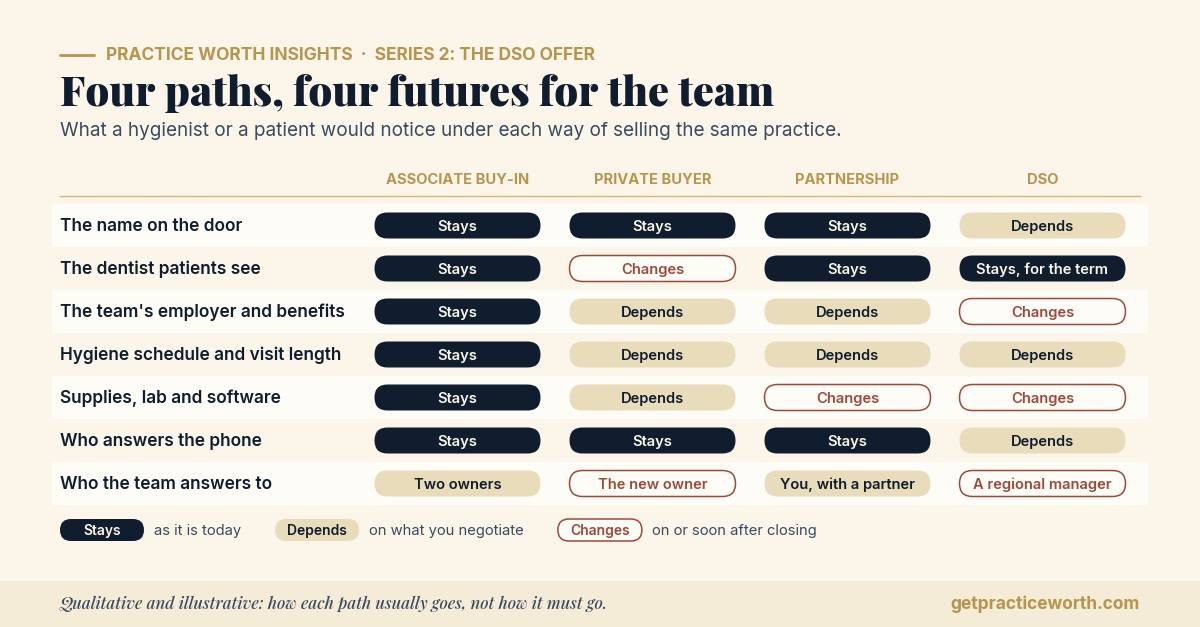
The chart above is qualitative. It shows how each path usually goes, not how it must go, and most of the cells move with what you negotiate.
What stays the same under each buyer
Start with what a patient or a hygienist would notice. Under an associate buy-in almost nothing changes on the day the papers are signed: the same name, the same two dentists, the same payroll, the same lab. A private sale usually keeps the name, the team, and the systems, and changes the one thing patients care about most, which is the dentist. A partnership keeps the dentist and usually the name, and what changes sits behind the front desk: purchasing, software, reporting, and a partner who now has a say. Under a DSO, as Week 4 covered, the team has a new employer on day one, and the rest depends on the platform.
No path keeps everything. Each one changes a different thing first.
The associate buy-in keeps the culture and adds work
This is the path that keeps the most of what you built, and it asks the most of you. The team has had one boss for twenty years. Now it has two, and for a few years the two will not always agree. Decide before the first closing who the team goes to for what: the schedule, time off, raises, a complaint about the other doctor. Write it down, the way Week 5 described for a regional manager.
The associate also needs patients, which means you hand over some of yours on purpose. New patients go to the associate’s column, hygiene exams are shared, and you say out loud in the operatory that this is the dentist you would send your own family to. Hygienists carry most of this. Patients ask them whether the new doctor is any good, and their answer matters more than any letter.
It works best when the associate has been in the practice a year or two before any money changes hands. If the team does not want to work for this person, find out before you sell them half.
The private buyer and your overlap role
A dentist who buys your practice owns it on closing day, and you usually stay six to twelve months, as I wrote in Series 1. Your job in that stretch is to make yourself unnecessary. Introduce the buyer to patients in person, in the chair. Send the letter from Week 9, signed by both of you. And stop being the boss in front of the team. The first time a hygienist brings you a question that belongs to the new owner, send her to the new owner. That is harder than it sounds.
Before you sign, ask the buyer what they plan to change in the first year: the hours, the hygiene schedule, the insurance plans, the lab. A new owner is entitled to change all of it. You are entitled to know before you tell your team it will be fine.
The partnership and the second signature
In a partnership you stay an owner, so the team still sees you as the person in charge, and mostly you are. What changes is that some decisions now need a second signature. Ask which ones: hiring, pay, the schedule template, supplies, the lab. They are the questions from Week 8, and the answers belong in the agreement, not in a conversation.
The honest conversation about what you are optimizing for
Most owners say they want the best price, a quick exit, a secure team, and a practice that still feels like theirs. No path gives you all four. The DSO offer usually wins on price. The private sale wins on a clean exit. The buy-in wins on continuity and costs you years. The partnership sits between them.
So rank the four on paper before you compare offers. Do it with your spouse, and do it honestly. If the truthful first line is that you want to be done in a year, the buy-in is the wrong path no matter how much you like your associate. If it is that you want your team working here in ten years the way they do now, the largest number may not be your number, and Dave’s chart shows what that choice costs.
Every path sells the same practice. They do not hand the same practice to the people who work in it.
The chart is qualitative and illustrative. Employment, partnership, and buy-in terms differ by state and by buyer, and your attorney should read them before you describe any of this to your team.
Where to start
Practice Worth’s valuation starts from your P&L and your collections-by-provider report, which shows what the practice earns and how much of it runs through the hygiene chair. That is the starting point for any of the four paths. If an offer is already in hand, the offer review includes the team and transition questions to settle before you sign.
About the author. Karen L. Eslinger, RDH, is a registered dental hygienist with decades of chairside experience and the owner and CEO of Practice Worth, which she co-founded in 2026 with Dr. David Eslinger, DDS, MBA. Practice Worth is a Missouri LLC. Learn more at getpracticeworth.com.
Dave’s companion piece from Tuesday puts the four paths in dollars: the alternatives to a DSO offer.