On Tuesday Dave wrote that the non-compete is part of the price. This piece is about the other half of the same bargain: what you still get to decide once you are working in a practice someone else owns.
In Week 3 I suggested writing down the three or four clinical decisions you cannot work without and getting them into the agreement. This week is about what goes on that list, and why.
Almost every agreement says the dentist keeps independent clinical judgment, and in most states the law says something similar: a non-dentist cannot direct a dentist’s treatment. In my experience the pressure rarely arrives as an order. It arrives through the schedule, the supply formulary, the lab contract, and the production report. Nobody tells you what to diagnose. They change the hour you have to do it in.
Treatment planning and the targets behind it
After the sale, your pay and often part of your price depend on production. The comp grid from Week 3 pays on collections, and the earnout from Week 6 measures them. A target is not a treatment plan, but it leans on one.
Watch for targets stated by procedure rather than in total dollars: crowns per month, a share of patients receiving a particular service, case acceptance rates. Watch for who presents your treatment plans. A treatment coordinator who reworks the plan you wrote into the plan the target needs is a clinical decision made by someone who is not a clinician. And ask who reviews your charts. Clinical review by a licensed dentist is quality control. Review by a regional manager is a sales meeting.
Materials and the lab
Most of the time the formulary product is fine, and a platform buying for fifty offices gets better prices than you did. The exceptions are the ones your patients feel. If you have restored implants from one system for fifteen years, those patients need parts from that system no matter what the formulary says. If a material has given you years of good results and the replacement has not, that is a clinical reason, not a preference.
The lab moves early. In Week 4 I put it at roughly day sixty, and in some comp plans part of the lab bill is charged back to the doctor. Ask for an exception process for documented clinical reasons, decided by a dentist and not by purchasing. Ask to keep your current lab for complex cases, such as implants, full-arch work and anterior esthetics, for a set period.
The schedule and the hygienist’s day
This is where I spent my career, so I will be plain about it. The schedule template is the most powerful clinical document in a DSO office, and it is rarely in the agreement.
A hygienist on sixty-minute appointments sees eight patients in an eight-hour day. Move the template to fifty minutes and it is nine or ten. The arithmetic looks small. What gets squeezed first is the periodontal charting, the full set of radiographs when one is due, and the conversation about the treatment the doctor just recommended. Those are the parts of a hygiene visit that keep patients healthy and keep them coming back.
Hygiene protocols come next: perio maintenance intervals, and adjunct services such as fluoride varnish or locally delivered antibiotics, sometimes with a target per patient. Each of these can be good dentistry. A quota is not a diagnosis. The doctor’s exam time in hygiene matters too. If the template expects you in four hygiene rooms an hour, the exam becomes a glance.
Three models, three answers
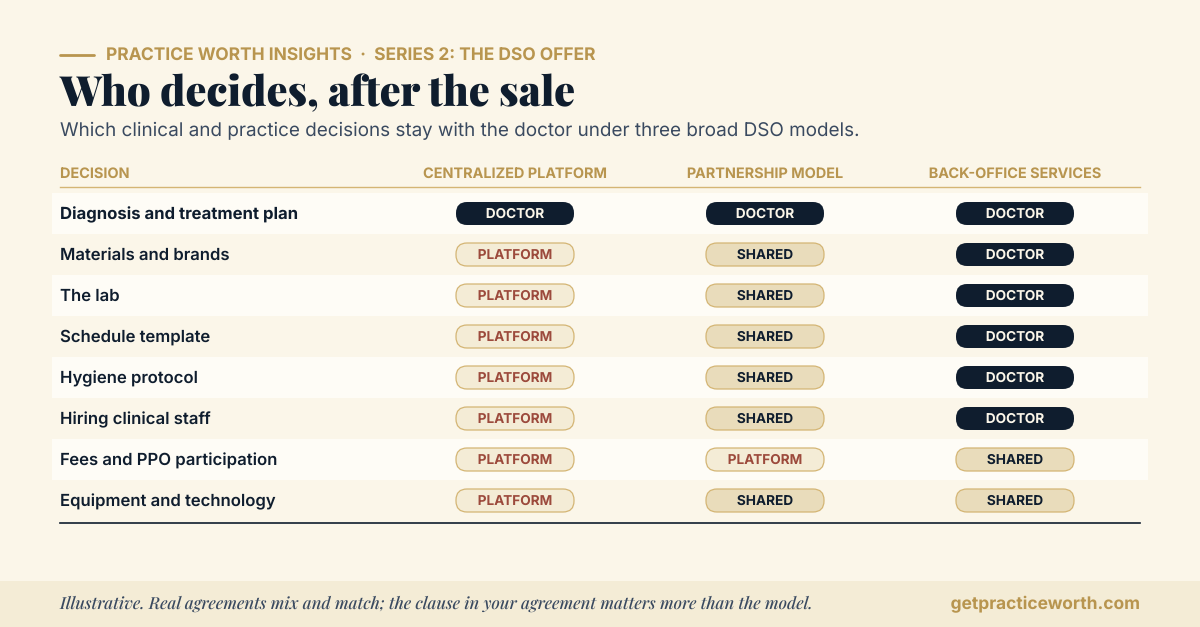
The chart above shows how the same decisions tend to fall under three broad models. A centralized platform sets most of them for every office. An affiliated or partnership model, where the doctor often keeps equity in the office, shares more of them. A back-office services model handles billing, payroll and purchasing, and leaves most clinical decisions in the office. Diagnosis and the treatment plan stay with the doctor in all three. Real agreements mix and match, and the model on the brochure matters less than the clause in your agreement.
The clauses to ask for
- Clinical judgment with teeth. No requirement to provide treatment you judge is not indicated, and no penalty in pay, targets or discipline for declining it.
- An exception process. You may use an alternative material or lab for a documented clinical reason.
- The schedule template as an exhibit. Your days, appointment lengths, procedure blocks and exam time, with notice and a conversation before anyone changes them.
- Targets in total dollars. Not procedure counts.
- Clinical review by a dentist. Peer review, not management review.
- Hygiene protocols set with you. The dentist of record and the hygienists decide perio intervals and adjunct services by diagnosis.
Ask before you sign, as part of the employment agreement, while the buyer still wants the deal. Frame it as patient retention, because that is what it is, and the buyer cares about retention as much as you do. Then ask to speak with two doctors who sold to the same platform a few years ago. They will tell you which of these clauses mattered.
Nobody will tell you what to diagnose. They will change the hour you have to do it in. Get the hour in writing.
The three models are illustrative, and the rules on who may direct clinical care differ by state. Your attorney should read the clinical clauses alongside the policies they refer to, because a policy can change after closing and a clause cannot.
Where to start
Practice Worth’s valuation starts from your P&L and your collections-by-provider report, and the report shows how your production splits between the doctor and the hygiene chair. That split is what a platform’s schedule template will be built to protect or to change. If an offer is already in hand, the offer review reads the employment agreement alongside the letter of intent.
About the author. Karen L. Eslinger, RDH, is a registered dental hygienist with decades of chairside experience and the owner and CEO of Practice Worth, which she co-founded in 2026 with Dr. David Eslinger, DDS, MBA. Practice Worth is a Missouri LLC. Learn more at getpracticeworth.com.
Dave’s companion piece from Tuesday covers the covenant that comes with the same agreement: the non-compete is part of the price.