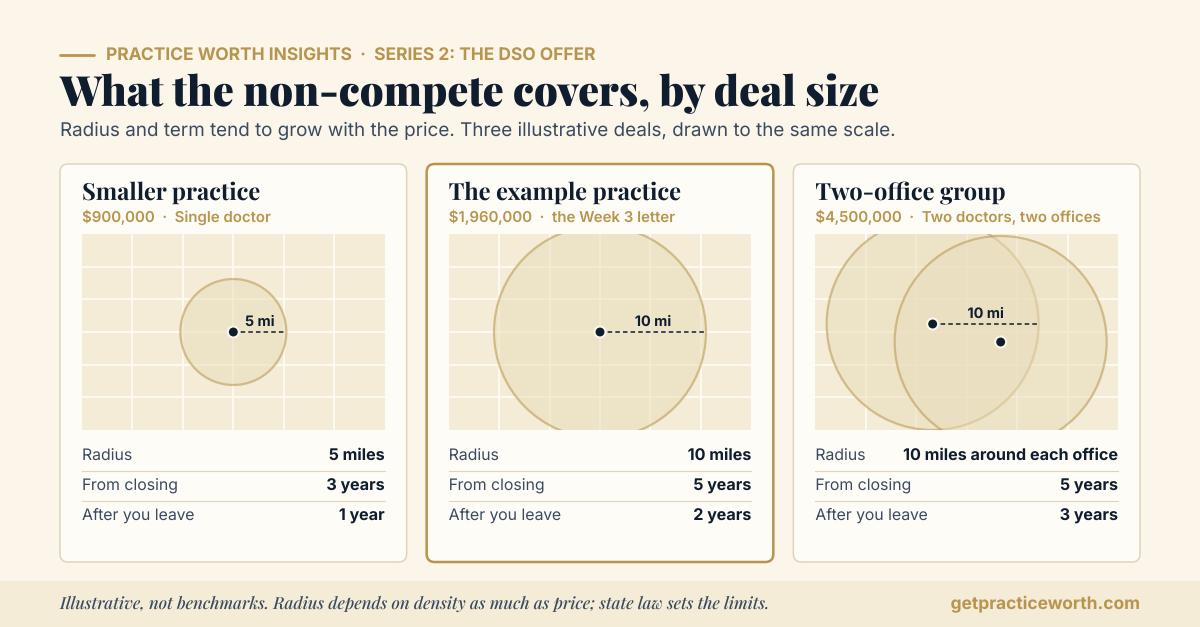
In Week 3 the letter of intent gave the non-compete one line: the radius and the years, which start the day you leave, whenever and however that happens. It is easy to read past. The price is the number everyone argues about, and the non-compete reads like boilerplate.
It is not boilerplate. A buyer paying $1,960,000 for the example practice is paying for patients who keep coming back after you stop owning the place. The non-compete is how the buyer makes sure you are not the reason they stop. That makes it part of what you are selling, and part of the price.
Two covenants, two clocks
Most DSO deals carry two of them. The purchase agreement has a seller’s covenant that runs from closing, often for several years. The employment agreement has another that runs from the day you stop working there, usually for a year or two. Both run at once, and the later one decides when you are free.
In the example, the purchase covenant runs five years from closing, the employment term is three years, and the employment covenant runs two years after you leave. Work the three years and leave, and both clocks end at year five. Leave after one year because the job is not what you expected, and the employment clock ends at year three, but the purchase clock still holds you to year five. Renew and stay six years, and you are not free until year eight. The longer you stay, the later you are free, which surprises most sellers.
What is typical, and how it scales
Radius depends on density more than anything else. In a dense city a few miles can cover a practice’s patients. In a rural county it can take twenty or thirty. Term and radius also tend to grow with the price, because a bigger check buys more protection. The chart above shows three illustrative deals: a smaller single-doctor practice at $900,000 with five miles and three years from closing, the example at $1,960,000 with ten miles and five years, and a two-office group at $4,500,000 with ten miles around each office and a longer tail after you leave. These are illustrations, not benchmarks. Your market, your state, and your buyer set the real ones.
The phrase to read most carefully is where the radius is measured from. Ten miles from the practice is one thing. Ten miles from any office owned by the buyer or its affiliates is another. In a metro where the platform already owns a dozen offices, the second version can cover the whole area, and it grows every time the platform buys another practice.
Read what counts as competing, too. Owning a practice is always on the list. Working as an associate, consulting, and holding a passive investment may or may not be. The non-solicitation clause, which covers your patients and your staff, is usually separate and sometimes runs longer than the non-compete itself.
Carve-outs worth asking for
- Teaching. A faculty position, CE courses, and study clubs should not count as competing.
- Work the practice does not do. If you place implants at a surgery center, treat sleep apnea, or take hospital call, ask for that work to sit outside the covenant, since it does not compete with what you sold.
- A second location. If you own an office you are not selling, name it in the agreement. If you might buy or open one later, make sure the radius is measured from this office only.
- Family. A spouse or child who practices in the area should not be bound by your covenant, and owning the building they practice in, or helping them, should not count as competing.
If the platform is sold, or closes your office
Platforms change hands. A sponsor that holds a platform for three to seven years, as in the rollover piece, will sell it, and your covenant usually goes to the new owner with everything else. Ask for three protections. If the buyer ends your employment without cause, or closes or relocates your office, the employment covenant should shorten or end. If the buyer stops paying what it owes you, such as a seller note or the earnout, the covenant should be suspended until it pays. And if the office moves, the radius should stay where your patients are, not follow the new address.
Trading terms for price
A non-compete is worth something to the buyer and costs something to you, and those are rarely the same number. That gap is where the negotiation lives.
If you plan to retire at the end of the employment term and never practice nearby again, a longer term or a wider radius costs you almost nothing. Offer it, and ask for something that costs the buyer more: a smaller holdback, a shorter escrow, a better earnout floor, or price.
If you are fifty and plan to keep practicing, the math runs the other way. Ten miles for five years may mean commuting past your old patients for years, or moving. That is worth paying for. Ask for the narrower radius, the shorter tail, and the carve-outs, and expect them to cost something, usually price or a larger holdback.
The covenant shows up once more, in the allocation. As Week 4 noted, dollars allocated to the non-compete in an asset sale are generally taxed as ordinary income, while goodwill is generally taxed at capital gains rates. The buyer has its own reasons to prefer one allocation over another. Settle yours with your CPA before the purchase agreement, not after it.
The non-compete is the part of the price you pay with your future. Decide what it is worth to you before the buyer decides for you.
Enforceability depends on state law, which differs widely and has been changing, and a covenant tied to the sale of a business is generally treated differently from one in an employment agreement alone. These figures are illustrative. None of this is legal or tax advice, and your attorney should read every word of both covenants. Next week takes up working capital, receivables, and the building: three items that move six figures and rarely make the letter of intent.
Where to start
Practice Worth rebuilds your adjusted EBITDA from the P&L and the collections-by-provider report, so you know what the practice is worth before you decide what your covenant is worth. If a letter of intent or a purchase agreement is already in hand, the offer review reads the non-compete alongside the price: the radius, both clocks, and the carve-outs.
About the author. Dr. David Eslinger holds a DDS and an MBA and has spent more than a decade on the buy side of dental practice transactions, founding Eslinger Dental Consultants and holding C-suite, executive leadership, and board roles in the DSO industry. Karen Eslinger, RDH, co-founded Practice Worth in 2026. Practice Worth is a Missouri LLC. Learn more at getpracticeworth.com.
Karen’s companion piece on Thursday covers the other half of the bargain: clinical autonomy after the sale.