The letter of intent from Week 3 set the price as a formula: $1,960,000, based on trailing adjusted EBITDA of $392,000, subject to confirmation in due diligence. Quality of earnings is the confirmation. Within days of signing, the buyer’s accountants, sometimes an outside firm, start rebuilding the $392,000 from the bank statements up. By then you are inside exclusivity, talking to one buyer, and whatever they find comes back to you as a new price.
In Week 2 I described the buyer’s own model of your earnings. Those were assumptions, and assumptions can be argued. Quality of earnings is different. It does not argue assumptions. It tests facts, and a fact that fails the test is hard to argue back.
What the review actually does
A QoE team ties your P&L to the bank deposits, the tax returns, and the reports from your practice-management software, month by month, usually for two or three years. Every add-back on your schedule is matched to a document. Every revenue line is matched to cash that actually arrived.
The add-backs that die
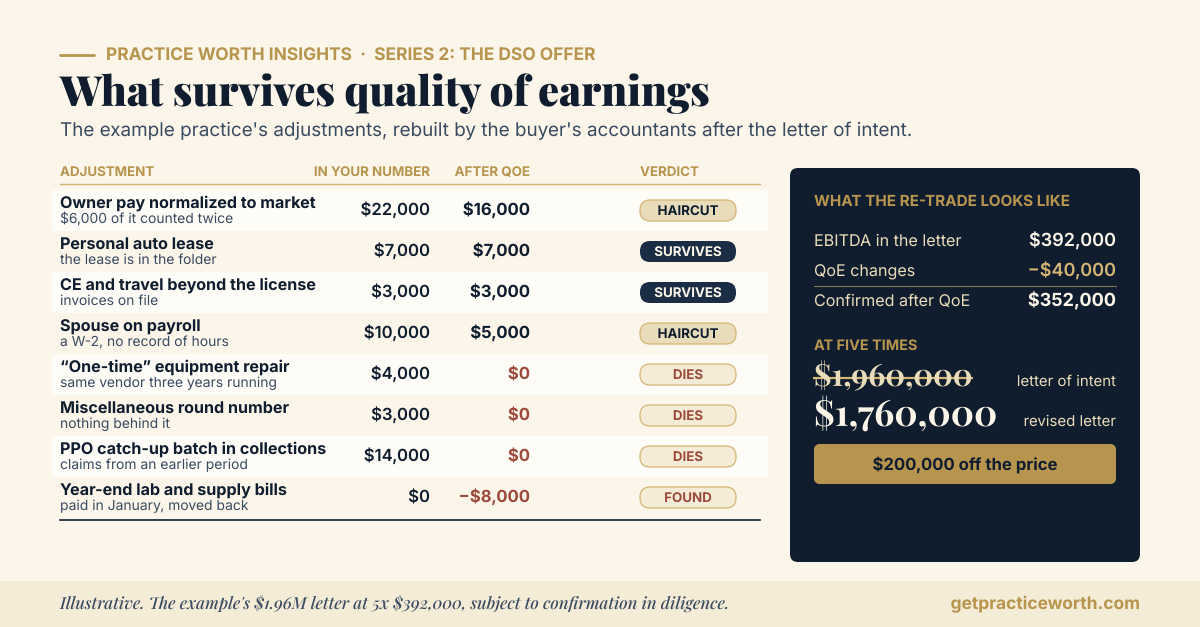
Most of what dies will be familiar from the add-backs piece in Series 1. The example practice claimed $27,000 of discretionary add-backs. The auto lease, $7,000, and the CE travel beyond what the license requires, $3,000, survive, because the lease and the invoices are in the folder. The spouse on payroll, $10,000, is cut in half: there is a W-2, but no record of hours or duties. The “one-time” equipment repair, $4,000, dies when the analyst finds the same vendor in each of the last three years. The $3,000 round number labeled miscellaneous dies too. That is the same $12,000 the buyer’s model set aside in Week 2, now confirmed with evidence.
Then the review finds something nobody was looking for: a double count. The owner-pay normalization added $22,000 back, and the health insurance premium the practice pays for you sat inside it. The add-back schedule claimed the same premium again as a perk, so $6,000 comes out. Double counts do the most damage to credibility, because they look like padding even when they are honest mistakes.
Revenue, receivables, and write-offs
The second half of the review is revenue. The team reconciles collections in the software to deposits in the bank, ages the receivables, and compares production, PPO write-offs, and collections by payer, month by month. Two findings come up more than any others: a collections spike that will not repeat, and costs that landed in the wrong year.
In the example, a large PPO held claims for three months during a processing backlog, then paid them in one batch inside the trailing year. That is $14,000 of real money that belongs to an earlier period, and QoE removes it from the run-rate. The practice also keeps its books on a cash basis, and $8,000 of lab and supply bills from the last month of the year were paid in the next one. QoE moves them back. Neither finding involves an add-back, and neither involves anyone doing anything wrong.
Write-offs get the same treatment. If a PPO cut its fee schedule partway through the year, the trailing collections overstate the next twelve months, and the team will annualize the lower fees. Receivables more than 90 days old read as collections the practice may never see.
How $40,000 becomes $200,000
Add it up: the $6,000 double count, the $5,000 haircut on the spouse, the $4,000 recurring repair, the $3,000 of miscellaneous, the $14,000 catch-up, and the $8,000 of bills moved back. QoE confirms $352,000 of adjusted EBITDA, not $392,000. At the five-times multiple in the letter, it is $200,000 of price, and $1,960,000 becomes $1,760,000.
The new number usually arrives as a revised letter, late in exclusivity, with the closing date already on everyone’s calendar. That timing is not a coincidence. Every week you have spent in the process is a week you would have to start over with someone else, and the buyer knows it. This is the re-trade, and it is the most common way a DSO price moves between the letter of intent and closing.
Answering a re-trade
Ask for the QoE schedule itself, not a summary, and work it line by line the way you worked the Week 2 bridge. Some findings are simply right, and accepting them quickly buys credibility for the rest. Some are judgment calls you can document your way back from: a written job description and hours for the spouse’s role, or invoices showing the repairs were different machines in different years. And some cut the other way. A review that annualizes one PPO’s fee cut should also annualize the increase another payer gave you, and growth in your most recent months belongs in the run-rate too.
Preparing so there is nothing to find
The best answer to quality of earnings is to run it on yourself before the letter of intent, while you still have more than one buyer. Tie a year of deposits to collections by month. Build the add-back folder: the lease, the invoices, and a written role and timesheet for every family member on payroll. Take anything you cannot document off the schedule yourself. Check the owner-pay normalization against every add-back for the same dollars counted twice. Ask your CPA to move year-end bills into the year they belong to. For larger practices, an outside sell-side QoE can be worth its fee.
An owner who does this does not get a higher price out of quality of earnings. They get the price in the letter, and that is the point.
The letter of intent prices your earnings. Quality of earnings decides how much of them were real. Run that review yourself, before the buyer does.
These figures are illustrative, and every buyer’s review is different. None of this is legal, tax, or accounting advice. Next week takes up the non-compete, which is part of the price whether anyone says so or not.
Where to start
Practice Worth rebuilds your adjusted EBITDA from the P&L and the collections-by-provider report and documents every adjustment on a line-by-line schedule, keeping the add-backs a diligence team rejects out of the math. That is the schedule a QoE team will test, built before they see it. If a revised letter or a re-trade is already in hand, the offer review works through the buyer’s findings with you, one line at a time.
About the author. Dr. David Eslinger holds a DDS and an MBA and has spent more than a decade on the buy side of dental practice transactions, founding Eslinger Dental Consultants and holding C-suite, executive leadership, and board roles in the DSO industry. Karen Eslinger, RDH, co-founded Practice Worth in 2026. Practice Worth is a Missouri LLC. Learn more at getpracticeworth.com.
Karen’s companion piece on Thursday covers the paperwork behind the review: the records a QoE team will ask for.