On Tuesday Dave wrote about what dies in quality-of-earnings review. This piece is about the paperwork behind it. A few days after the letter of intent is signed, the buyer sends a request list. It often runs several pages, and it lands on the desk of the person who also runs the schedule, answers the phones, and, if you followed the order from Week 1, may be the only person on the team who knows about the sale yet.
The deadline is the buyer’s, and it runs inside exclusivity. Most of what is on the list already exists in your software and your filing cabinet. The work is finding it, running it with the right settings, and getting it out the door without the rest of the team noticing.
The reports they will pull, and how they read them
- Production and collections by provider, by month. Usually 36 months. They compare the two to see what each provider actually collects, not only what is produced.
- Adjustments and write-offs by payer. This is where a PPO fee cut or a write-off habit shows up, and it is often the first report the accountants ask about.
- Accounts receivable aging. Split between insurance and patient balances. Old balances read as money the practice may never see.
- Hygiene production, recare, and reappointment. How many patients were due, how many were scheduled, and how many came in.
- New patients and the schedule. New patients by month and by source, and scheduled versus completed appointments.
Dave’s piece explains why each of these gets matched to the bank. The practical point for the office is simpler. Whatever settings you use to run a report the first time, write them down: the date range, the providers included, the filters. If the buyer reruns it and gets a different number, someone has to explain the difference, and that is much easier from a note than from memory.
Settle the definitions before they do
Three numbers get quoted in nearly every sale and defined differently in nearly every office.
- Active patients. In Week 2 I wrote about a practice that called itself 2,200 active patients on a 24-month count and was closer to 1,600 on an 18-month count of patients with a completed hygiene visit. Pick the definition the buyer will use, run it yourself, and quote that number.
- Recare rate. Patients due who were seen, patients due who were scheduled, or patients seen who left with their next appointment. The three can be far apart.
- New patients. A first completed visit, or anyone who registered, including the emergency patient you never saw again.
None of these definitions is wrong. They are different, and the one you quoted early in the process is the one you will be held to.
Credentialing, licenses, and compliance files
These rarely change the price. They change the closing date, and every extra week of diligence is another week inside exclusivity. These are the files that most often go missing.
- PPO credentialing for each provider, with effective dates. A provider who is not credentialed with a plan produces claims that are held or denied, and that shows up in the collections Dave described.
- Licenses and registrations. Dental and hygiene licenses, DEA and state controlled-substance registrations, radiography and expanded-function certificates for assistants, and the registration and inspection records for your X-ray equipment.
- OSHA. The exposure control plan, training sign-in sheets, and safety data sheets.
- HIPAA. The most recent risk assessment, your written policies, and business associate agreements with your vendors.
- Infection control. Sterilizer spore-test logs and waterline testing records.
If one of these is missing, find out now, while fixing it is a phone call rather than a closing condition.
The team and the contracts
The buyer will also want an employee roster with hire dates, pay, and benefits, your handbook, and the paid time off each person has banked. Banked time off is money someone owes at closing, so it gets read closely. Then come the contracts: the office lease, equipment leases and loans, PPO contracts and fee schedules, and the agreements for your software, phones, and lab. Read your lease again yourself before the buyer’s attorney does.
A one-page list to work from
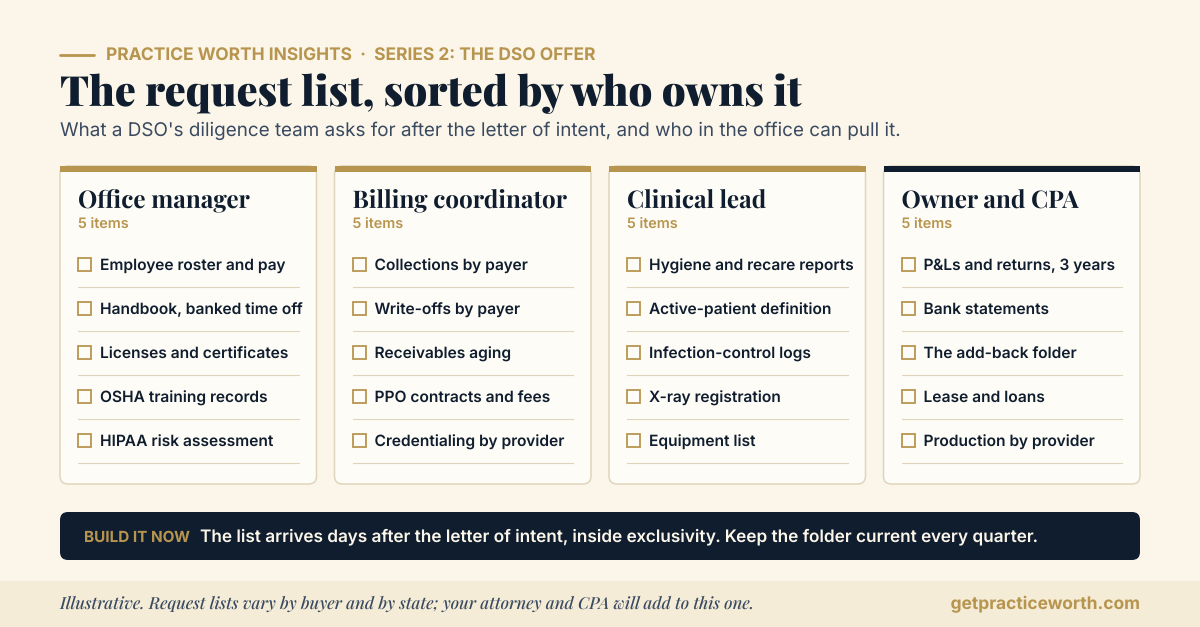
The chart above sorts the request list by who owns each item, because that is how it actually gets done in an office.
- Office manager. The employee roster, handbook, and banked time off; licenses and certificates; the OSHA and HIPAA files.
- Billing coordinator. Collections and adjustments by payer, receivables aging, PPO contracts and fee schedules, and credentialing status.
- Clinical lead. Hygiene and recare reports, infection-control logs, X-ray registration, and the equipment list.
- Owner and CPA. Three years of P&Ls and tax returns, bank statements, the add-back folder, and the lease and loans.
Build it once, keep it current every quarter, and the request list becomes a matter of sending files rather than chasing them. It also gives the buyer’s team a first impression of how the practice is run, before anyone has visited.
The request list always arrives at the worst time. The practices that close on schedule are the ones that built the answers before anyone asked.
Request lists vary by buyer and by state, and this one is a starting point rather than a complete list. Your attorney and CPA will add to it, and your compliance consultant can tell you which of your files would hold up to a close reading.
Where to start
Practice Worth’s valuation starts from two of the documents on this list, the P&L and the collections-by-provider report, and the report shows how your production splits between the doctor and the hygiene chair. That is a good first page for the folder. If a letter of intent and a request list are already in hand, the offer review reads the terms alongside what the buyer is asking to see.
About the author. Karen L. Eslinger, RDH, is a registered dental hygienist with decades of chairside experience and the owner and CEO of Practice Worth, which she co-founded in 2026 with Dr. David Eslinger, DDS, MBA. Practice Worth is a Missouri LLC. Learn more at getpracticeworth.com.
Dave’s companion piece from Tuesday covers what the review does with these records: what dies in quality-of-earnings review.