The call I have taken most often on the buy side goes like this. An owner has an offer in hand, or a broker on the phone, and wants to know what the practice is worth. The honest answer is that the practice is worth what its trailing twelve months say it is worth, and the trailing twelve months are already written. Whatever the owner might have fixed over the past two years is now priced exactly as it sits. The window for improving the number closed before the question was asked.
This is the final piece in our twelve-week series, and it is the one I would hand to any owner who is even two or three years from selling. Everything the series covered, reading the P&L the way a buyer does, normalizing owner pay, add-backs that survive diligence, becomes a to-do list the moment you put it on a timeline.
Why a dollar of EBITDA is worth five at the sale
Start with the arithmetic that makes the runway valuable. A general practice trades on a multiple of adjusted EBITDA, typically in the 4.5x to 5.5x range depending on size, provider structure, and risk. That means every dollar of adjusted EBITDA you add, or successfully defend, returns roughly $4.50 to $5.50 at closing. Find $25,000 of durable earnings improvement on our example $1.2M practice, the one with $392K of adjusted EBITDA and a midpoint value near $1.96M, and you have added something on the order of $112,000 to $137,000 to the price. Not by producing more dentistry. By running the same practice cleaner and proving it on paper.
The catch is the word durable. A buyer's analyst does not pay for a good quarter. They pay for a trailing twelve months that shows the improvement living in the practice, which is why the slowest levers have to start first.
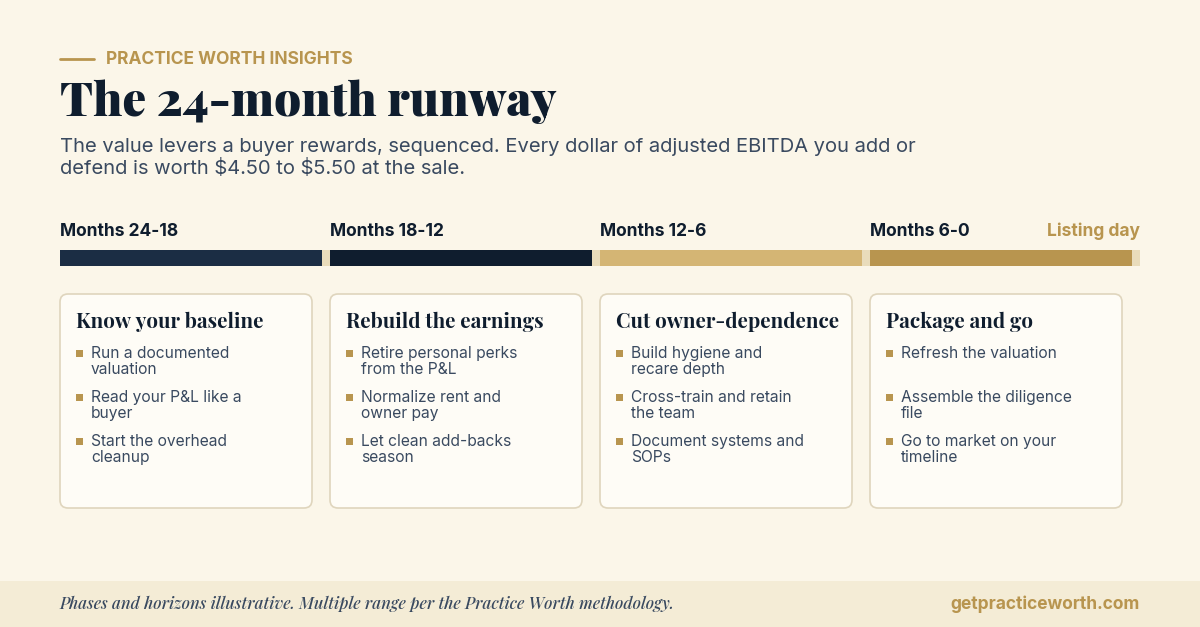
Months 24 to 18: know your baseline
You cannot manage a number you have never seen. The first move on the runway is a documented valuation: earnings rebuilt line by line, add-backs identified, the multiple tier stated. That baseline does three jobs. It tells you whether your retirement math works. It shows you which specific levers are available in your practice rather than in a generic checklist. And it gives you the before picture, so that two years from now the improvement is provable rather than asserted. While you are at it, pull your own P&L and read it the way an analyst will. Most owners find at least one expense line they cannot explain, and the time to find it is now, not in diligence.
Months 18 to 12: rebuild the earnings
This is the year of the boring work that pays the best. Personal expenses routed through the practice, the perks hiding in overhead, get retired or moved off the P&L, because a clean year of financials beats a stack of add-back arguments. Related-party rent gets set to market with a lease to prove it. Owner compensation gets understood against a replacement rate. None of this changes how the practice runs. All of it changes what an analyst can verify, and verified earnings are the only kind that get multiplied.
Months 12 to 6: reduce what depends on you
The multiple, not just the earnings, responds to this phase. A practice that collapses without its owner carries risk a buyer prices down; a practice that demonstrably runs itself earns the top of its tier. Build hygiene and recare depth so revenue does not walk out with you. Cross-train the front office. Write down the systems that live in your head. My co-founder Karen covers the operational half of this in her companion piece on getting buyer-ready, and her point is the right one: the goal is a practice a stranger could operate on Monday.
Months 6 to 0: package and go
The last phase is assembly, not construction. Refresh the valuation so you are negotiating from the current number, not the two-year-old one. Pull the diligence file together: three years of P&Ls, production by provider, the lease, the equipment list. Then go to market on your timeline. Sellers who start the runway at month 24 choose when to sell. Sellers who start at month 2 have the timing chosen for them, usually by the first buyer who calls.
The scramble version of this, done in the ninety days before listing, produces explanations. The runway version produces a trailing twelve months. Buyers pay for one of these.
Where to start
Start where the runway starts, with the baseline. Practice Worth rebuilds your earnings from the P&L and the collections-by-provider report, walks every adjustment, and gives you the documented starting number in about ten minutes. The framework is on the methodology page and there is a free sample report to inspect first. Run it now, work the levers, run it again before you list. The difference between those two reports is the money the runway earned you.
About the author. Dr. David Eslinger holds a DDS and an MBA and has spent more than a decade on the buy side of dental practice transactions, founding Eslinger Dental Consultants and holding C-suite, executive leadership, and board roles in the DSO industry. Karen Eslinger, RDH, co-founded Practice Worth in 2026. Practice Worth is a Missouri LLC. Learn more at getpracticeworth.com.
Karen’s companion piece covers the operational half of the runway: the buyer-ready checklist to start working now.