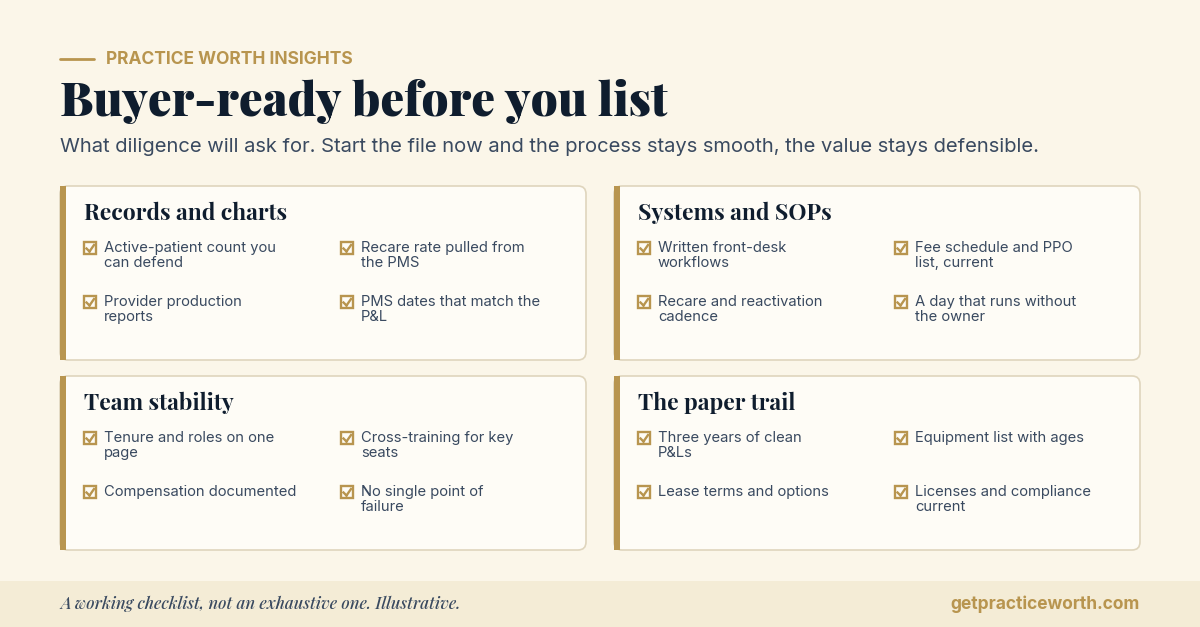
When a practice goes under contract, the buyer's team sends a list. Not questions, a list: reports to pull, documents to produce, numbers to reconcile. I have watched owners meet that list from two very different positions. Some spend a stressful month excavating, explaining, and apologizing for what they cannot find. Others open a folder. The practices were often equally healthy. The folders were not.
Dave's piece this week lays out the 24-month financial runway. This one is the operational half: what will actually be asked of you, and the checklist to start working now so that diligence confirms your value instead of eroding it.
The records a buyer will request
The first requests are about patients, because patients are what the buyer is buying. Expect to produce an active-patient count with the definition attached, seen in the last 18 months is a common one, because a number without a definition invites a haircut. Expect to show your recare rate pulled straight from the practice management system, not estimated from memory. Expect production by provider, month by month, so the buyer can see how much of the dentistry depends on you personally.
And expect the buyer's analyst to lay your PMS reports next to your P&L. The dates have to match. A production report from one date range and financials from another is the fastest way to turn a clean practice into a suspicious one. If the two systems tell the same story over the same months, diligence moves. If they do not, everything stops while you explain.
Systems that prove it runs without you
A buyer is not just valuing the dentistry. They are valuing whether the practice keeps working when the seller's keys change hands. The evidence is unglamorous: written front-desk workflows, a current fee schedule and PPO list, a documented recare and reactivation cadence, a treatment-plan follow-up process that happens because the system fires and not because you remembered. I spent decades chairside, and I can tell you the difference between an office with systems and an office with habits is invisible on a good day and unmistakable the week the owner is out. Buyers know this, which is why two practices with identical collections can be worth very different amounts.
The team a buyer inherits
Team stability is diligence material now. Expect questions about tenure, roles, compensation, and what happens if your senior hygienist or office manager leaves. Cross-training is the honest answer: every key seat has someone who can cover it, written down. A strong hygiene department that recurs on its own schedule is the single most transferable asset in the building, and a team that stays through a transition protects the value you negotiated. None of this can be assembled in the month before listing. All of it can be started this quarter.
The paper trail
The rest is assembly. Three years of P&Ls your CPA would stand behind. An equipment list with ages, so the buyer's offer is not discounting for a mystery. The lease, with its remaining term and options, read recently enough that its assignment clause will not surprise you. Licenses, registrations, and compliance documentation current and in one place. Each item is small. Together they are the difference between a diligence period measured in weeks and one measured in months, and time kills deals more reliably than price does.
Every item on this list has the same property: cheap to produce now, expensive to produce under deadline, and impossible to produce credibly after the question has been asked.
Start the file, then get the number
Pick the category that made you wince and start there. The hero image on this article is the working checklist; print it, put it in front of your office manager, and work it one item a week. Then pair the operational file with the financial baseline Dave described: run a documented valuation so you know what the practice is worth while you still have time to change the answer. The wizard walks your P&L and provider report through every adjustment in about ten minutes, and the sample report shows what the output looks like. A buyer-ready practice with a documented number negotiates from the front foot.
About the author. Karen L. Eslinger, RDH, is a registered dental hygienist with decades of chairside experience and the co-owner and CEO of Practice Worth, which she co-founded in 2026 with Dr. David Eslinger, DDS, MBA. Practice Worth is a Missouri LLC. Learn more at getpracticeworth.com.
Dave’s companion piece covers the financial half of the same runway: the 24-month sequence of value levers a buyer rewards.