Dave walks through how a buyer rebuilds your profit into adjusted EBITDA. I want to come at the same document from the chair side, because your profit-and-loss statement is really a story about how your practice is run, and a buyer reads it that way.
Overhead is a set of choices
Every dollar that does not become profit went somewhere, and the major categories are familiar to anyone who has helped run a practice: team wages, lab and clinical supplies, the cost of the facility, and administrative expenses. None of these are wrong to spend on. The question a buyer asks is whether each category sits in a healthy range for a practice your size.
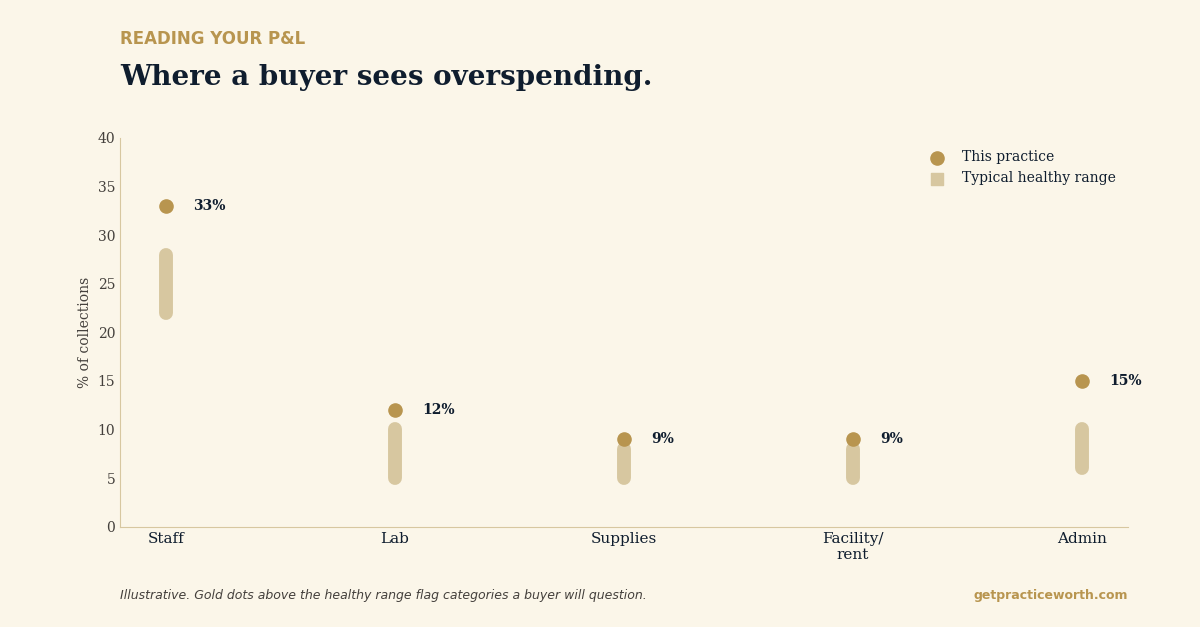
Where owners tend to overspend
A few categories drift high without anyone noticing. Staffing is the big one. Payroll creeps up over years of raises and added roles, and a practice can end up paying well above a healthy share of collections for its team. Supply and lab costs slide when ordering is not watched. Facility costs can run high if the space is larger or richer than the patient base requires. None of this means the practice is run badly. It means there is room a buyer will notice, and often room you can tighten now.
The ratio buyers watch
Staff cost as a share of collections is one of the first things a buyer checks, because it is hard to change quickly and it speaks to how the practice is managed. A practice where the team is productive and right-sized reads very differently from one carrying more payroll than its production supports.
Clean books help you
Here is the practical part. When personal expenses are mixed into practice spending without being labeled, a buyer either has to guess or discount them, and discounts cost you. Keeping owner perks identifiable, categorizing consistently, and tidying up the P&L well before a sale all translate into a higher, more defensible number.
The cleaner and clearer your books, the easier it is for a buyer to give you full credit for your profit.
The takeaway
Your P&L is not just a tax document. It is the first impression a buyer gets of how your practice runs. Reading it the way they do, category by category against a healthy range, tells you where your value is strong and where a little operational discipline now will pay off later.
Practice Worth reads your numbers this way and shows where each piece lands. If you want to see how it handles a practice like yours, there is a free sample report at getpracticeworth.com.
About the author. Karen Eslinger, RDH, spent more than two decades chairside as a registered dental hygienist before co-founding Practice Worth in 2026 with her husband, Dr. David Eslinger. She focuses on the clinical and operational side of practice value. Practice Worth is a Missouri LLC. Learn more at getpracticeworth.com.
The companion piece on the financial half: EBITDA for dentists, and how a buyer rebuilds your profit.