Every week since spring I have opened a fresh temporary chat and asked ChatGPT the same question: is ChatGPT accurate for dental practice valuation? This week it gave the most candid answer yet. It said it would happily use itself to estimate a practice's value, and that it would not rely on its own number as the one to take to a buyer. That is a sensible position. It is also exactly the step that gets skipped, because the number arrives in thirty seconds, sounds authoritative, and costs nothing.
Three ways to do it yourself
Owners who value their own practice tend to reach for one of three tools. The first is the percent-of-collections rule of thumb. The second is a free online calculator, which is usually the same rule of thumb with a form in front of it. The third, increasingly, is ChatGPT with a P&L pasted in. All three share a property that makes them dangerous rather than merely rough: they return a specific dollar figure with no indication of how far off it might be, or in which direction.
I have written before about why collections do not set the price. What I want to do here is show what happens when the most capable of the three tools, the one that can actually read a P&L, is handed two real practices.
Two practices, two answers, opposite directions
In May we ran two realistic practice files through ChatGPT and through Practice Worth, same documents, same question. The full study is on this site, so I will keep to the numbers that matter.
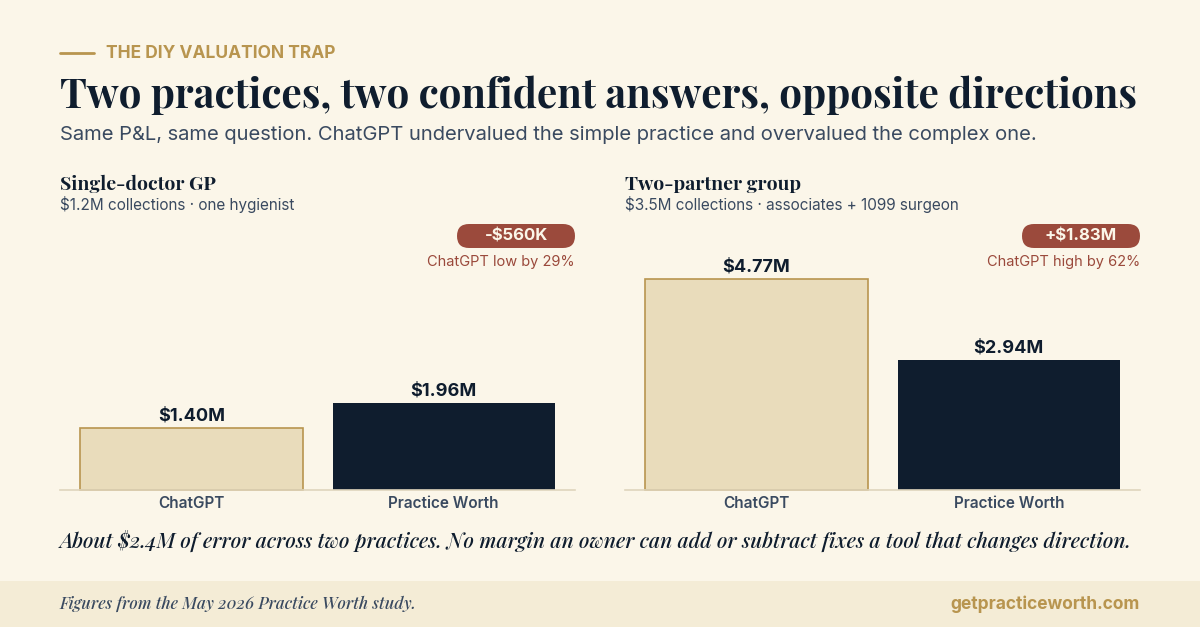
The first practice was a single-doctor GP: $1.2M in collections, one hygienist, a clean P&L. ChatGPT produced an adjusted EBITDA of $280,300 and a midpoint value near $1.4M. Practice Worth produced $392,561 of adjusted EBITDA and a midpoint of $1.96M. ChatGPT was low by about $560,000. It misread net income by $21,000, skipped a depreciation line that was labeled as such, and never normalized owner compensation at all, which on this practice is a $292,200 add-back against $270,000 of replacement pay.
The second practice was a two-partner group: $3.5M in collections, two W-2 associates, three hygienists, and an oral surgeon paid on a 1099 outside the P&L. Here ChatGPT went the other way. It produced $1,060,000 of adjusted EBITDA and a midpoint near $4.77M. Practice Worth produced $489,747 and $2.94M. ChatGPT was high by about $1.83M. It read an $80,000 depreciation line as $8,000, dropped roughly $273,700 of expense lines from its math, never noticed the 1099 surgeon, and applied the owner-operator multiple tier to a practice that qualifies for the at-scale group tier.
Roughly $2.4M of error across two practices, and the sign flipped between them. There is no mental correction an owner can apply to a tool that is sometimes 30 percent low and sometimes 60 percent high.
Why the direction matters more than the size
If a tool were reliably low, you could add a margin and get on with your life. If it were reliably high, you could shave one off. When the error changes direction with the complexity of the practice, the owner running the tool has no way to know which case they are in. Asked how confident it was, ChatGPT said "reasonably confident" both times.
The same problem shows up with the rule of thumb, just less visibly. Seventy percent of collections on the $1.2M practice gives $840,000. The earnings-based value is closer to $1.96M. On a practice with weak margins, the same percentage can land above what a buyer will pay. The rule is wrong in both directions too. It just never tells you.
What a confident wrong number does in a real deal
On the buy side I have watched both failure modes play out, and neither is abstract. A seller arrives with a high number, the buyer's analyst rebuilds earnings during quality-of-earnings review, the gap surfaces, and the letter of intent is either withdrawn or repriced at terms the seller would never have accepted on day one. Word travels in a regional market, and the next buyer already knows the first deal fell apart.
The low number is quieter and costs just as much. The seller anchors on it, the first credible offer clears it, and the deal closes with everyone satisfied except the person who left several hundred thousand dollars in the room without knowing it. The buyer's analyst knew the real number. The seller never did.
The step every DIY route skips
Look back at what ChatGPT missed and it is not the multiple. It is the reconstruction of earnings that has to happen first: reading every line, normalizing owner pay to a replacement rate, catching the add-backs that survive diligence, handling 1099 versus W-2 providers, and only then choosing the tier. The multiple is the easy part. The earnings base is where a DIY number goes wrong, and it goes wrong silently.
That reconstruction is what Practice Worth does. You upload the P&L and the collections-by-provider report, the wizard walks each adjustment, and the report shows every line so your CPA or your buyer can check the work. The same inputs produce the same answer every time. The framework is on the methodology page, and there is a free sample report at getpracticeworth.com. If you are going to price the biggest asset you own, price it from earnings someone has actually rebuilt.
About the author. Dr. David Eslinger holds a DDS and an MBA and has spent more than a decade on the buy side of dental practice transactions, founding Eslinger Dental Consultants and holding C-suite, executive leadership, and board roles in the DSO industry. Karen Eslinger, RDH, co-founded Practice Worth in 2026. Practice Worth is a Missouri LLC. Learn more at getpracticeworth.com.
Karen’s companion piece takes up the other half of the same problem: the number that was already in your head before you opened any tool.