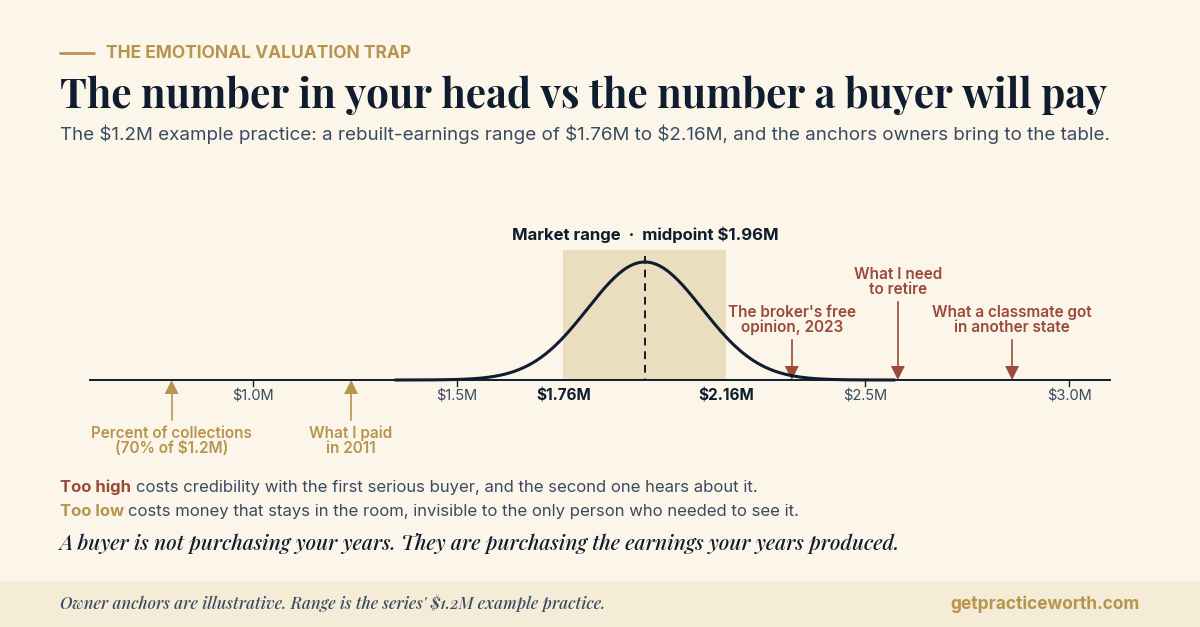
A dentist I worked for years ago carried a number for his practice in his head for most of a decade. It came from what a classmate got for an office in another state, back when the classmate sold, adjusted upward each year for inflation and for how hard he was working. He never wrote it down and never tested it. When a real offer finally came in, it was well below his number, and the conversation that followed was about him, not about the practice. Dave wrote on Tuesday about the tools that hand an owner a confident wrong number. I want to write about the number that was already in your head before you opened any tool.
Where the number in your head comes from
By the time an owner starts thinking about selling there is usually already an estimate, and it usually has a story behind it. Sometimes it is what you paid, plus every dollar of equipment since. Sometimes it is what a friend got, or what a broker's free opinion said three years ago, or what you would need to retire the way you planned. Very often it is the years. Twenty-five years of Saturdays, of building a hygiene department from one column to three, of knowing which patients need the long appointment. That feels like it should be worth something, and it is. It is worth what a buyer can keep after you leave, and only that.
A buyer is not purchasing your years. They are purchasing the earnings your years produced, and only the part of those earnings that survives your departure.
When the number is too high
The high estimate is the one that shows in public. An owner who has anchored on $2.6M for a practice the market will support at $1.9M does not just miss one buyer. The asking price goes out through a broker or a conversation, the first serious buyer rebuilds the earnings and walks, and in a regional dental market the second buyer usually hears about it. Dave's Tuesday piece has the sharpest version of this: a group practice whose owners would have asked $4.8M on a tool's say-so, for a practice worth about $2.9M. That gap ends deals before they reach a letter of intent, and it makes every later conversation start from a position of doubt.
What I have seen on the operations side is quieter. An owner who believes the high number stops investing. Why replace the pan unit or re-credential the sedation permit when the sale is a year away? Then the sale takes three years because of the number, and the practice a buyer finally sees is tired.
When the number is too low
The low estimate never makes the news, because nothing visibly goes wrong. The owner takes seventy percent of collections as gospel, or trusts a tool that skipped the owner-compensation adjustment, and the first offer that clears that figure looks generous. The deal closes and everyone shakes hands, and the money that stayed in the room is invisible to the only person who needed to see it.
The parts of a practice most likely to be undercounted are the ones I spent my career inside. A hygiene department that runs on its own schedule with strong recare. A team that stays. The add-backs the owner never thought to count because the expenses had been running through the practice for so long they looked like overhead. On the $1.2M practice this series has followed all summer, the difference between reading net income off the tax return and rebuilding earnings properly is the difference between about $289K and $392K, and every dollar of that gap gets multiplied.
Why an outside number protects you in both directions
An objective valuation does something for the owner that has nothing to do with the buyer. It moves the conversation off of you. When the number comes from a documented rebuild of earnings, with each adjustment shown, then a low offer is a disagreement about the math and not a judgment of your career, and a high hope is something you can test against a page instead of defending across a table. Your CPA and your spouse can both read it, and so can a buyer's analyst, who will find nothing in it to argue with. That is the whole point.
It also gives you time. The owners I have watched do this well got their number two or three years before they needed it, while there was still room to fix the things it showed them: a recare system that had drifted, an associate arrangement that made the earnings look worse than they were, a lease with too little term left. For them the number turned out to be the start of the part of the sale they could still control.
Getting one without spending five thousand dollars
For a long time the choice was a broker's free opinion, with the broker's incentives attached, or a formal appraisal at a price most owners only pay when a bank or a court requires it. Practice Worth sits in between. You upload the P&L and the collections-by-provider report, walk through each adjustment, and get a report that shows its work line by line. The framework is on the methodology page, and there is a free sample report at getpracticeworth.com. If you have been carrying a number in your head, this is the cheapest way I know to find out whether it is right.
About the author. Karen L. Eslinger, RDH, is a registered dental hygienist with decades of chairside experience and the co-owner and CEO of Practice Worth, which she co-founded in 2026 with Dr. David Eslinger, DDS, MBA. Practice Worth is a Missouri LLC. Learn more at getpracticeworth.com.
Dave’s companion piece covers the tools side of the same week: the DIY valuation trap.