A periodontist I worked with years ago was offered a number that looked generous next to the general practices on the same street. Same collections, higher price. He nearly took it on that comparison alone. The problem was that the comparison told him almost nothing, because his practice and the GP down the block were not the same kind of business, and the buyer knew it better than he did.
The rule of thumb was built for one kind of practice
Percent-of-collections shorthand comes from general dentistry, where overhead, payer mix, and patient flow are similar enough from office to office that a single percentage is a usable first guess. Specialists inherit that shorthand by default, and it is the wrong tool. Buyers do not pay for collections. They pay a multiple of what is left after the practice is staffed, supplied, and run, and the amount left over differs by specialty more than it differs between two GPs.
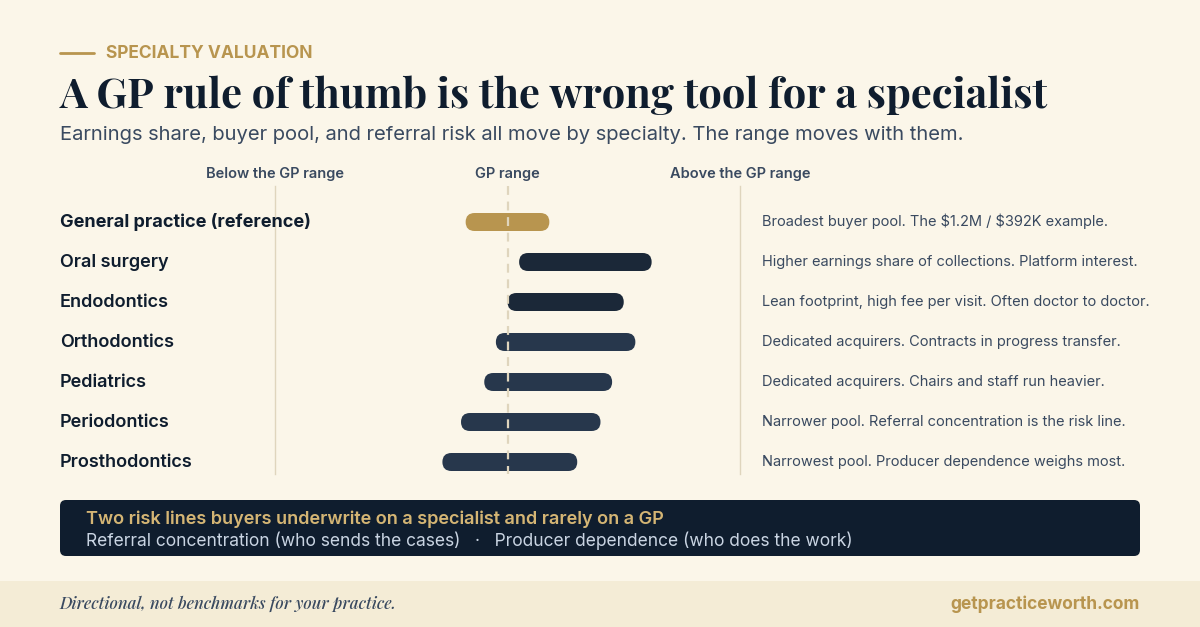
On the $1.2M example general practice this series has followed all summer, adjusted EBITDA is $392K, and the working range has been 4.5x to 5.5x. Move that same $1.2M of collections into an endodontic or oral surgery practice and the earnings base usually changes first. Fewer visits at higher fees, a leaner hygiene footprint, and a different supply and lab profile tend to leave more of each dollar as earnings. Move it into a pediatric or orthodontic practice and the profile changes again, with more chairs, more staff, and a different mix of who does the work.
The multiple is the second conversation. The first one is how much earnings a specialty produces from a dollar of collections, and that is where a GP rule of thumb goes wrong.
Who shows up to buy
The second difference is the buyer pool, and it matters as much as the margin. A general practice can be bought by an individual dentist, a local group, or any of several dozen DSOs. That breadth is a price support. Specialty practices face narrower pools. Orthodontics and pediatrics have their own dedicated acquirers, and oral surgery has drawn steady platform interest. Endodontics and periodontics more often transact doctor to doctor, or as a capability a larger group wants to bring in-house.
A thinner pool does not mean a lower price. It means a wider range and less predictability. When only a handful of buyers can realistically close, the outcome depends on whether one of them is active in your market this year. That is a timing question, and it is one reason specialty owners should know their number well before they need to act on it.
Referral dependence is a risk line buyers actually underwrite
A general practice owns its patient relationships. A specialist is downstream of other doctors' relationships, and a buyer will ask how concentrated those sources are before anything else. If a large share of cases comes from a short list of referring offices, the practice carries a risk a GP does not. One referring dentist retires, sells to a group that refers internally, or simply drifts, and a meaningful slice of production walks. The best-run specialty practices treat the referral book as an asset, document it, and widen it on purpose, because a broad and stable referral base moves the offer toward the top of the range in exactly the way risk factors always do.
Producer dependence is heavier
Specialty production is concentrated in one clinician's hands more often than in a general practice, where hygiene and associates spread it out. A buyer has to price the chance that patients and referrers came for the surgeon rather than the sign. That shows up as a longer transition ask, a more demanding earnout, or simply a lower position in the range. None of it is unfair. It is the same question a GP faces about owner dependence, asked with more force.
How to think about your own number
Start with earnings, not collections. Normalize owner compensation to what a replacement specialist would actually cost in your market, which is a bigger adjustment than it is for a GP. Build adjusted EBITDA the way a buyer builds it. Then ask what a realistic buyer pool looks like for your specialty and your geography, and be honest about referral and producer concentration, because the buyer will be.
Practice Worth builds the earnings side for you and applies specialty-specific calibration rather than a single GP yardstick, so the range you see reflects the kind of practice you actually run. The framework is on the methodology page, and there is a free sample report at getpracticeworth.com. Ranges by specialty are directional; the corridors behind them are published market figures that we continue to validate against live deals.
About the author. Dr. David Eslinger holds a DDS and an MBA and has spent more than a decade on the buy side of dental practice transactions, founding Eslinger Dental Consultants and holding C-suite, executive leadership, and board roles in the DSO industry. Karen Eslinger, RDH, co-founded Practice Worth in 2026. Practice Worth is a Missouri LLC. Learn more at getpracticeworth.com.
Karen’s companion piece takes up the operational side of the same week: the specialty workflows that make a practice easier or harder to hand off.