Dave wrote on Tuesday about why a specialty practice does not value like a GP: the earnings base is different, the buyer pool is narrower, and referral risk gets underwritten. I want to stay on the floor of the practice for the companion question. When a specialty office changes hands, what actually has to transfer, and what makes that easy or hard?
I have spent a long time on the hygiene side of general dentistry, and one thing that stands out about specialty offices is how much of the practice lives in relationships and routines that never appear on a P&L. A buyer is paying for those to survive the handoff. Whether they do is mostly decided before the sale.
The referral book is a set of relationships, not a list
Every specialist can name their top referring offices. Fewer can say who at each office actually makes the referral, how fast the report goes back, and what happens when a case does not go to plan. Those details are the relationship. They are often held by the doctor and by one or two front-desk people who know the referring teams by voice.
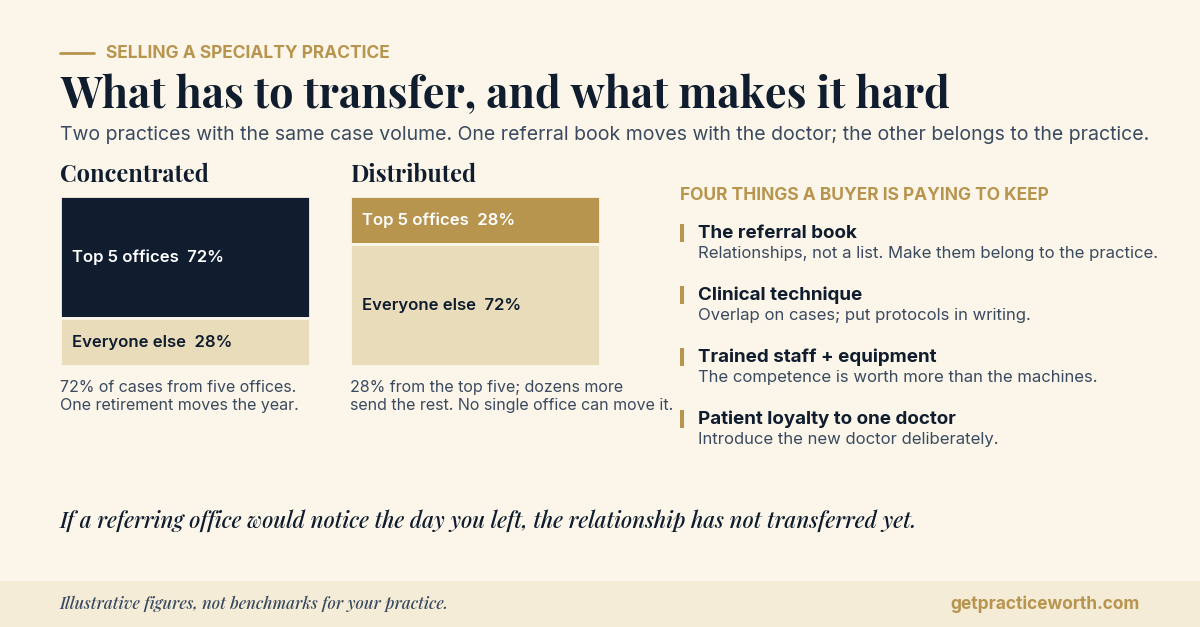
That is exactly what a buyer worries about. If the top handful of offices send most of the cases, and the reason they send them is the surgeon personally, the practice has a concentration problem that no spreadsheet fixes after closing. The practices that hand off well have done two things ahead of time. They widened the base, so no single office can move the year. And they made the relationship belong to the practice, with a named referral coordinator, a consistent report-back routine, and a visible habit of the whole team, not just the doctor, showing up for referring offices.
If a referring office would notice the day you left, you have not finished transferring the relationship yet.
Clinical skill does not transfer on a signature
Specialty work concentrates technique in one set of hands. Sedation protocols, microscope endodontics, implant planning, the way a pediatric team manages a frightened four-year-old. A buying doctor will have their own training, but patients and referrers notice when the approach changes, and mid-treatment cases are the pressure point. Orthodontics is the clearest example, with patients partway through a course of care that the new doctor inherits, along with the family's expectations and the contract that goes with it.
The workable answer is overlap. Bring the incoming doctor into cases before closing where you can, share cases openly during the transition, and put your protocols in writing. A buyer who can see the method on paper and in the chair prices the handoff with less fear.
Trained staff and specialized equipment are part of what is being sold
A GP buyer walks into a familiar setup. A specialty buyer walks into CBCT, surgical suites, sedation permits, scanners, microscopes, and a team that knows how to run them. The equipment is on the asset list. The competence is not, and it is the more valuable of the two. A surgical assistant who can set up and recover a sedation case, an ortho assistant who can scan and manage an aligner workflow, a pediatric team that keeps the schedule moving with anxious kids, these people are the practice's operating system.
Keep the certifications current and documented. Keep maintenance and calibration logs. And as the team piece covered earlier in the series, settle the team's terms before you sign, because a specialty buyer losing a trained assistant in month two is losing something they cannot hire off the street.
When the patient relationship is with one person
In pediatrics and orthodontics especially, families chose a doctor, not a building. Parents ask for you by name. That loyalty is an asset while you own the practice and a risk the moment you sell it. It transfers when the introduction is deliberate: the new doctor meets families during the transition, the team talks about the change with confidence, and the office feels the same on the Monday after as it did on the Friday before.
What to do a year out
Document the referral book and widen it. Write down your clinical protocols. Credential and cross-train the team, and keep the equipment records clean. Decide how long you are willing to overlap, because a specialty transition is usually longer than a GP transition, and your leverage on that term is highest before closing. None of this changes the clinical work. It changes how much of the practice is still standing after you leave it, which is what a buyer is paying for.
Knowing your number first makes all of this easier to plan. That is what Practice Worth is for, and it calibrates for specialty practices rather than treating every office as a GP. The framework is on the methodology page, and there is a free sample report at getpracticeworth.com.
About the author. Karen L. Eslinger, RDH, is a registered dental hygienist with decades of chairside experience and the co-owner and CEO of Practice Worth, which she co-founded in 2026 with Dr. David Eslinger, DDS, MBA. Practice Worth is a Missouri LLC. Learn more at getpracticeworth.com.
Dave’s companion piece covers the money side of the same week: why perio, OMS, and pedo don’t value like a GP.