The letter of intent in Week 3 left three things out: who keeps the receivables, how much working capital the buyer expects to find in the practice, and what happens to the building. None of them is in the price. Each can still move six figures of what you take home, and each is usually settled in the buyer’s first draft of the purchase agreement, during exclusivity, when you can no longer walk to anyone else.
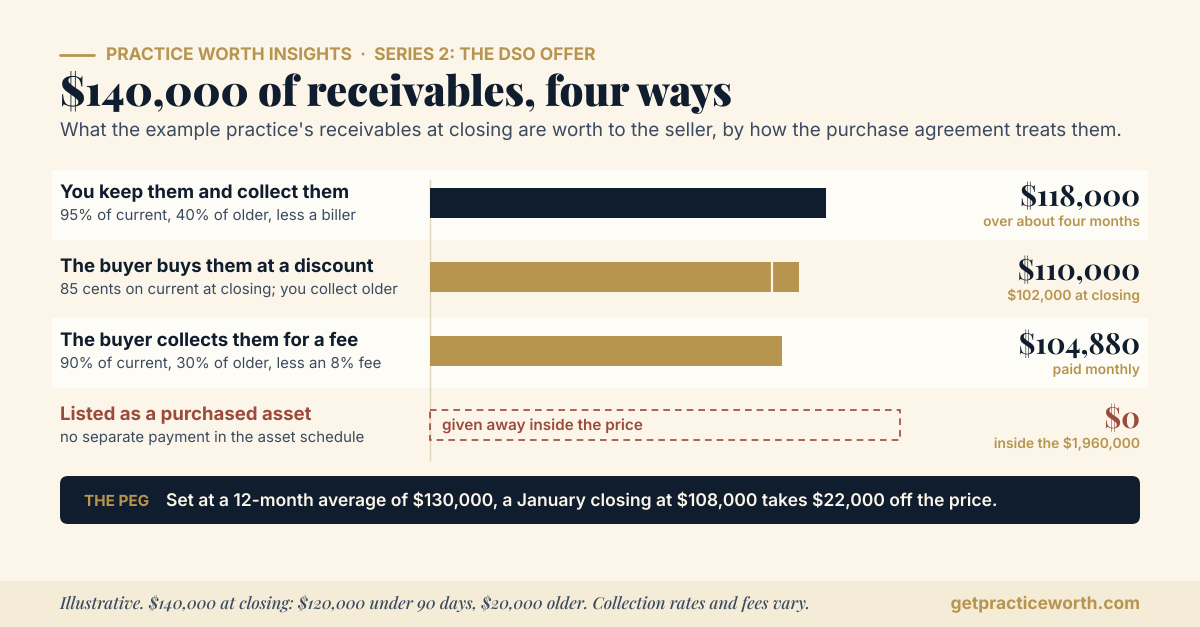
The example practice collects $1.2M a year, about $100K a month. On the day it closes it has $140,000 of accounts receivable: $120,000 less than ninety days old and $20,000 older. The chart above shows four ways to handle that $140,000 and what each is worth to you. Every figure is illustrative.
Who keeps the receivables
Receivables are dentistry you already did and have not been paid for. In most dental sales they belong to the seller, and the question is how they get collected. There are three common answers, and a fourth nobody proposes out loud.
- You keep them and collect them. If current claims come in at 95 percent and older balances at 40 percent, the $140,000 is worth about $122,000. Pay a part-time biller for four months and you net about $118,000. It is the most money, it arrives over months, and patient balances get harder to collect once patients are paying a different company at the front desk.
- The buyer buys them at a discount. A buyer that pays 85 cents on the dollar for current receivables wires $102,000 at closing. You keep the older balances and collect about $8,000 more, for $110,000. Less money, sooner, and no billing staff to manage.
- The buyer collects them for a fee. The buyer’s billing team works your old accounts and sends you what comes in, less a fee. Nobody chases an old balance as hard for someone else. At 90 percent on current, 30 percent on older and an 8 percent fee, you net about $105,000, paid monthly.
The fourth answer is the one to look for. In an asset purchase, the buyer’s draft often lists accounts receivable among the purchased assets. If there is no separate payment for them, they are included in the $1,960,000, and you have given away $140,000 of work you already did.
The peg, and how a normal month becomes a closing adjustment
When the buyer takes the receivables or the working capital, the purchase agreement usually sets a target called a peg, which Week 4 introduced. Here is how it costs money.
Suppose the peg is the trailing twelve-month average of working capital, $130,000, and the deal closes at the end of January. January is a slow month for collections in many practices: deductibles reset, the holidays thinned the December schedule, and the claims that would have paid in January were never filed. On the closing date working capital is $108,000. Nothing is wrong with the practice. It is January. The purchase agreement still takes the $22,000 shortfall out of your price, dollar for dollar.
Ask for four things. Set the peg from the same month in prior years, or a seasonal average, rather than a twelve-month average applied to a slow month. Ask for a collar, a band of plus or minus $10,000 inside which nothing is adjusted. Make the adjustment work in both directions, so a strong closing month pays you. And attach the definition, the exact accounts that count, to the agreement as an exhibit, with a date for the final count and a way to dispute it.
If you own the building
Most DSOs lease rather than buy real estate, so if you own the building through your own company, you become the buyer’s landlord. That is a second negotiation, run alongside the purchase agreement, with a conflict built into it.
The example assumes the practice already pays a market rent of $96,000 a year, so nothing in the $392K of adjusted EBITDA changes. Now move the rent. Every $12,000 a year of rent is $12,000 of the buyer’s EBITDA, or about $60,000 of price at five times. The same $12,000 a year is worth about $160,000 of building value to an investor who buys at a 7.5 percent cap rate. As the seller of the practice you want lower rent. As the landlord you want higher rent. Buyers know this, which is why most insist on a market rent set by an appraisal.
Start the lease with who signs as tenant: the operating company alone, or the operating company with a guarantee from the parent. A ten-year lease to a thinly capitalized entity is worth less to you, and to any investor you later sell the building to, than one backed by the platform. Then the step-ups, often 2 to 3 percent a year, the renewal options, which are usually at the tenant’s choice, and whether the tenant can assign the lease if the platform is sold. In a sale-leaseback, where you sell the building to an investor once the lease is signed, those terms are what the investor pays for.
If you lease your space
Then the landlord has a vote. Most leases require the landlord’s consent to assign them, and a DSO will want ten years or more of term, counting options, before it closes. A landlord who knows a sale depends on consent may ask for higher rent, a fee, or a new guarantee. Read your assignment clause before you sign the letter, ask that your personal guarantee be released at closing, and get the landlord’s consent and an estoppel letter well before the exclusivity period runs out.
The price is negotiated in the letter. The receivables, the peg, and the building are negotiated in the drafts that follow. Read those drafts as carefully as you read the price.
These figures are illustrative. None of this is legal, tax, or real estate advice. Your transaction attorney, your CPA, and an appraiser should see the asset schedule, the peg definition, and the lease before you sign. Next week steps back from the DSO offer to the alternatives: an associate buy-in, a private buyer, and a partnership.
Where to start
Practice Worth rebuilds your adjusted EBITDA from the P&L and the collections-by-provider report, including the rent normalization a buyer will make if you own the building, so you know what the practice earns before the lease and the receivables become part of the negotiation. If an offer is already in hand, the offer review reads the asset schedule, the peg, and the lease alongside the price.
About the author. Dr. David Eslinger holds a DDS and an MBA and has spent more than a decade on the buy side of dental practice transactions, founding Eslinger Dental Consultants and holding C-suite, executive leadership, and board roles in the DSO industry. Karen Eslinger, RDH, co-founded Practice Worth in 2026. Practice Worth is a Missouri LLC. Learn more at getpracticeworth.com.
Karen’s companion piece on Thursday covers the people who keep the receivables coming: what to tell patients, and what not to.