The most valuable operatory I ever priced was full of Christmas decorations. The seller apologized for it on the walk-through, the way you apologize for a messy garage. The model did not see a storage room. It saw a plumbed, wired, fully permitted operatory that a buyer could put a hygienist in without pulling a single construction permit, and it quietly moved the offer up.
Upside moves the multiple, not the EBITDA
Start with what a buyer will not do. On the $1.2M example practice this series has used all summer, adjusted EBITDA is $392K, and no buyer is going to add hypothetical earnings to that number because the practice could grow. Revenue that does not exist yet gets no EBITDA credit. That instinct protects buyers from every overoptimistic pro forma they have ever been handed.
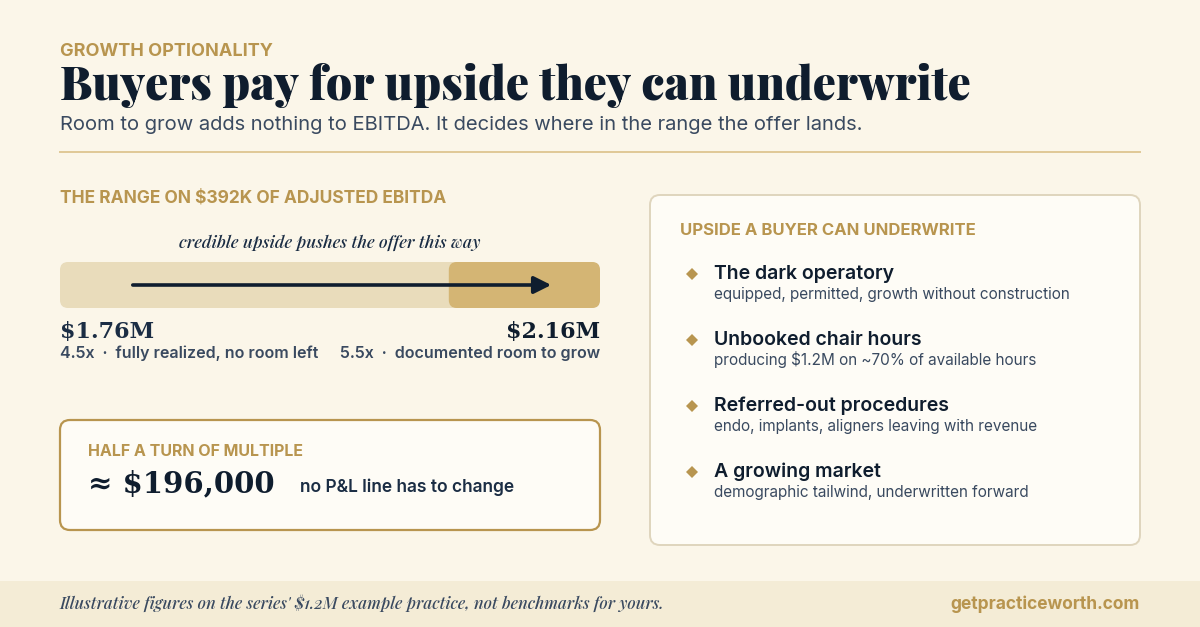
What credible upside does instead is decide position. The risk-factors article showed that the same $392K prices anywhere from $1.76M at 4.5x to $2.16M at 5.5x, and that risk pushes an offer toward the cautious end. Growth optionality is the same mechanism running in your favor. A practice with visible, underwriteable room to grow gives the buyer confidence that the earnings will be larger in year three than in year one, and that confidence is what the top of the range is made of.
Half a turn of multiple on the example practice is about $196,000. Room to grow is one of the few things that can earn it without changing a line of the P&L.
Where a buyer finds upside
The dark operatory is the classic, because it converts to revenue with a hire rather than a construction loan. Close behind it sits the schedule itself. A practice producing $1.2M on roughly 70% of its available chair hours is telling a buyer there is growth inside the walls that costs nothing but recruiting and recall discipline. A strong hygiene engine with capacity left over reads the same way.
Then there is the production leaving the building. Most general practices refer out some mix of endodontics, implant placement, and aligner cases. Every referral slip is revenue with the practice’s name already on it, and a buyer with an associate bench or specialty support can underwrite bringing a portion of it in-house. Finally, the market itself: the demographic analysis from the risk-factors piece runs in both directions, and a growing suburb with young families is a tailwind a buyer will pay to stand in front of.
Credible is the operative word
The difference between upside and a sales pitch is documentation. “A motivated buyer could double this” is priced at zero, every time. An equipped operatory the buyer can walk into, a utilization report from your practice management software, a referral log with procedure counts on it, a market study with household growth in it: those are things an underwriter can take to a committee. If the growth story is real, the paperwork to prove it usually already exists in your systems. The work is pulling it.
The honest corollary is that a fully optimized practice, every chair staffed, every hour booked, everything kept in-house, is a strong practice priced as fully realized. There is nothing wrong with that offer. It is simply an offer for what the practice is, with no premium for what it could become, because the seller already became it.
Practice Worth’s Practice Profile asks about exactly these signals, unused operatories, capacity, referred-out procedures, and market direction, and reads them the way a buyer’s model does. The framework is on the methodology page, and there is a free sample report at getpracticeworth.com.
About the author. Dr. David Eslinger holds a DDS and an MBA and has spent more than a decade on the buy side of dental practice transactions, founding Eslinger Dental Consultants and holding C-suite, executive leadership, and board roles in the DSO industry. Karen Eslinger, RDH, co-founded Practice Worth in 2026. Practice Worth is a Missouri LLC. Learn more at getpracticeworth.com.
Karen’s companion piece walks the same ground from inside the practice: the capacity you don’t know you’re selling.