On Tuesday, Dave showed how buyers price room to grow: it moves the offer toward the confident end of the range, but only when the upside can be documented. I want to walk the same ground from inside the practice, because after two decades chairside I can tell you most practices hold more capacity than their owners realize, and almost none of them can prove it on paper the day a buyer asks.
The schedule tells the truth
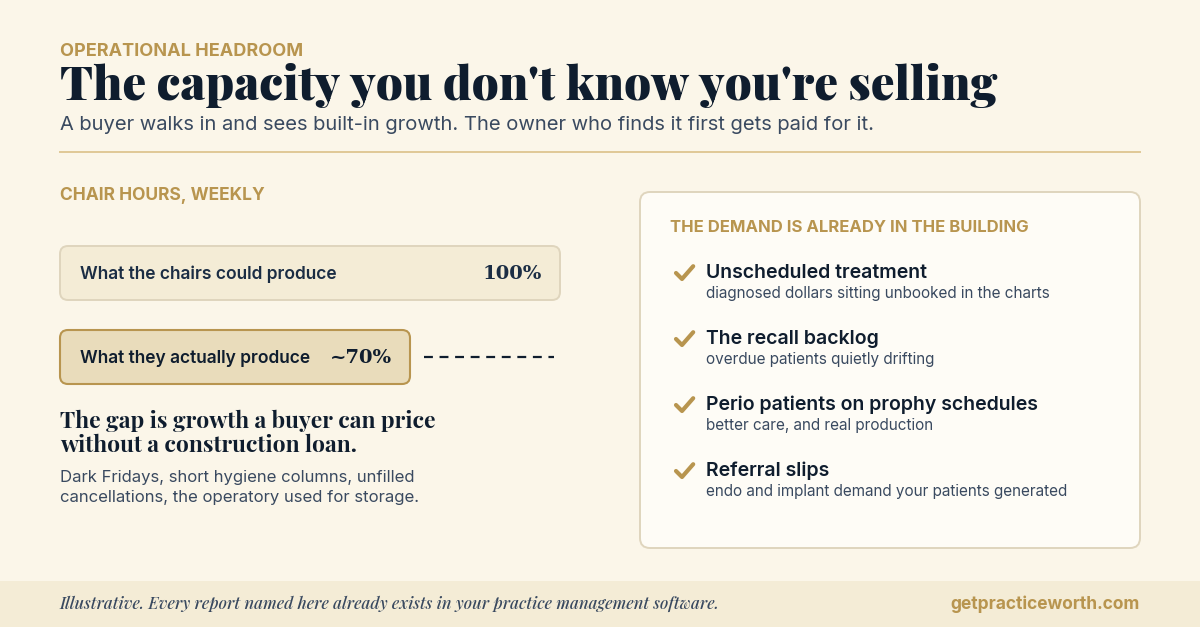
Start with the difference between the hours your chairs could produce and the hours they actually do. Every practice management system can run this report, and very few owners ever have. A practice open four days a week has a fifth day of capacity sitting dark. A hygiene column that ends at three because it always has, gaps the schedule never backfills after cancellations, an operatory that became the supply room years ago: it all adds up, and on the example practice this series uses, it looks like producing $1.2M on roughly 70% of the available chair hours. An owner sees a comfortable schedule. A buyer sees a practice that can grow without a construction loan.
The demand already in your charts
Capacity is only half of the story, because empty hours need patients to fill them. Here is what I learned running recall: the demand is usually already in the building. Pull the unscheduled-treatment report and look at the dollars diagnosed but never booked. Look at the recall list for patients overdue and quietly drifting. Look at the perio program, because patients on a prophy schedule who belong in periodontal maintenance represent both better care and real production. Then count the referral slips. Endo, implants, aligner cases walking out the door are demand your own patients generated that someone else is collecting.
Hours and hands
The third place capacity hides is people. A practice that runs entirely on the owner’s hours has a ceiling exactly one clinician tall. An associate day a week, an early-morning hygiene block for the patients who cannot miss work, a cross-trained assistant who keeps a column moving: none of this is exotic, and a buyer models all of it. As Dave wrote Tuesday, the buyer will not pay EBITDA credit for any of it today. What they will do is move the offer toward the top of the range for a practice where the growth is visible, staffed sensibly, and waiting.
Make it a selling point instead of a surprise
Latent capacity only helps your value if it shows up as evidence rather than a story. The reports already exist in your systems: chair utilization from the schedule, the unscheduled-treatment total, the recall backlog, a simple count of what got referred out last year. An owner who walks into a sale with those numbers is handing the buyer a documented growth story, which is exactly the thing that earns the confident end of the range. And if you are a year or two from selling, that same report stack is your to-do list, because every hour of capacity you fill before a sale converts from a buyer’s upside into your EBITDA.
Practice Worth’s Practice Profile asks about capacity, referred-out procedures, and the growth signals a buyer underwrites, and shows you the effect. The framework is on the methodology page, and there is a free sample report at getpracticeworth.com.
About the author. Karen Eslinger, RDH, spent more than two decades chairside as a registered dental hygienist before co-founding Practice Worth in 2026 with her husband, Dr. David Eslinger. She focuses on the clinical and operational side of practice value. Practice Worth is a Missouri LLC. Learn more at getpracticeworth.com.
Dave’s companion piece runs the pricing mechanics: buyers pay for upside: how growth optionality is priced.